Adding clopidogrel to aspirin therapy reduces risk of second stroke
February 11, 2013 in Cardiology
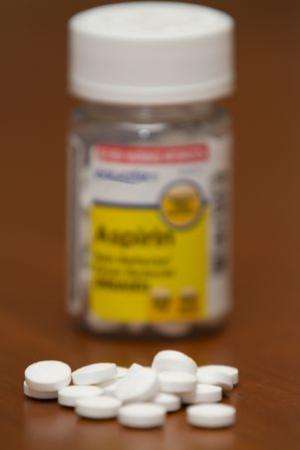
Aspirin Bottle and pills 325 mg Dose. Credit: American Heart Association
Adding a second drug to aspirin therapy reduced the risk of a second stroke in the weeks after Chinese patients had a minor ischemic (due to a clot) stroke or a transient ischemic attack (TIA), according to research presented at the American Stroke Association's International Stroke Conference 2013.
A minor ischemic stroke is caused by a clot that blocks blood supply to the brain, but its effects are minimal. A TIA, sometimes known as a "mini stroke," occurs when a blood clot temporarily clogs an artery and blocks blood flow to the brain. TIAs and minor strokes don't typically cause permanent harm, but early treatment is critical to prevent the possibility of a major stroke with permanent neurological deficits.
"TIAs and minor strokes are emergencies," said S. Claiborne Johnston, M.D., Ph.D., senior author of the study and professor of neurology and director of the Stroke Service at the University of California, San Francisco. "If we start dual treatment early, it looks like we can reduce the risk of another stroke by more than 30 percent."
In comparison, aspirin therapy alone cuts stroke risk by about 20 percent, he said.
If you've had one or more TIAs, you're almost 10 times more likely to have a stroke than someone of the same age and sex who hasn't, according to the American Stroke Association.
The Clopidogrel in High-risk patients with Acute Non-disabling Cerebrovascular Events (CHANCE) study included 5,174 patients (median age 62, 34 percent women) with minor, clot-caused strokes or TIAs from 114 centers in China.
Within 24 hours, treatment was started with either low-dose aspirin (75-300 mg on the first day followed by 75 mg/day) plus a placebo or the same aspirin regimen plus clopidogrel (an initial 300 mg load followed by 75 mg/day for the first 21 days).
During the 90 days after treatment began, 8.2 percent of patients in the dual therapy group and 11.7 percent in the aspirin-only group experienced another stroke, a significant reduction with dual therapy.
Both aspirin and clopidogrel (Plavix) prevent small particles in the blood from sticking together and forming clots, so the investigators tracked bleeding incidents to see if dual therapy was safe. During the follow-up, seven (0.3 percent) in the dual therapy group and eight (0.3 percent) in the aspirin only group had a moderate or severe hemorrhage. Rates of bleeding strokes were also the same (0.3 percent).
The large trial is the first to demonstrate that combining clopidogrel with aspirin is safe and better protects against subsequent stroke. However, researchers aren't certain that the study's results apply to other populations.
"In China, stroke and mini-stroke patients are 6-8 years younger on average than Americans, and there are different genetic variations that have an impact on the metabolism of clopidogrel," said Yongjun Wang, M.D., study principal investigator, professor of neurology and vice-president of Beijing TianTan Hospital, Capital Medical University in Beijing, China.
In the United States, the ongoing Platelet-Oriented Inhibition in New TIA and Minor Ischemic Stroke (POINT) trial led by Johnston is also testing dual therapy, with a higher loading dose of clopidogrel and treatment initiated within 12 hours of symptom onset. Results are due in 2016.
"In China, the combination therapy should now be used routinely and systems developed so that TIA and minor stroke are not neglected and treatment is not delayed," Johnston said. "I suspect the study applies to U.S. patients and settings, but we really need to be sure with the POINT trial."
Provided by
American Heart Association
-
Clopidogrel with aspirin doesn't prevent more small strokes, may increase risk of bleeding, death
Feb 03, 2012 |
not rated yet |
0
-
Aspirin-clopidogrel no better than aspirin alone for patients with lacunar stroke
Aug 29, 2012 |
not rated yet |
0
-
TARDIS trial seeks new dimension in stroke treatment
Oct 17, 2011 |
not rated yet |
0
-
'Mini' stroke can cause major disability, may warrant clot-busters
Sep 13, 2012 |
not rated yet |
0
-
Many patients don't know they had minor stroke, need emergency care
Apr 15, 2010 |
not rated yet |
0
-
Motion perception revisited: High Phi effect challenges established motion perception assumptions
Apr 23, 2013 |
3 / 5 (2) |
2
-
Anything you can do I can do better: Neuromolecular foundations of the superiority illusion (Update)
Apr 02, 2013 |
4.5 / 5 (11) |
5
-
The visual system as economist: Neural resource allocation in visual adaptation
Mar 30, 2013 |
5 / 5 (2) |
9
-
Separate lives: Neuronal and organismal lifespans decoupled
Mar 27, 2013 |
4.9 / 5 (8) |
0
-
Sizing things up: The evolutionary neurobiology of scale invariance
Feb 28, 2013 |
4.8 / 5 (10) |
14
-
what is the distance traveled
2 hours ago
-
Image of a Convex Lens Cut in Half Horizontally
5 hours ago
-
Ray tracing throught optical system of thick lenses
6 hours ago
-
Faraday's law on circular wire
6 hours ago
-
Specific Exergy vs Specific Flow Exergy
8 hours ago
-
The Durability of Bone: Long Falls
16 hours ago
- More from Physics Forums - Classical Physics
More news stories
Costs to treat stroke in America may double by 2030
Costs to treat stroke are projected to more than double and the number of people having strokes may increase 20 percent by 2030, according to the American Heart Association/American Stroke Association.
Cardiology
3 hours ago |
not rated yet |
0
New blood-thinner measures may cut medication errors
Blood thinners are the preferred treatment option to prevent heart attacks, blood clots and stroke, but they are not without risk, and not just because of their side effects. These high-risk drugs, known as anticoagulants, ...
Cardiology
5 hours ago |
not rated yet |
0
Registry questions superiority of bivalirudin over heparin
Results from a large observational study reported at EuroPCR 2013 today question whether bivalirudin is superior to heparin in the absence of GPIIb/IIIa blockade, showing similar 30-day mortality in patients with non-ST segment ...
Cardiology
5 hours ago |
not rated yet |
0
Study shows low rate of late lumen loss with bioresorbable DESolve device
The DESolve bioresorbable coronary scaffold system achieves good efficacy and safety with low rates of late lumen loss and major coronary adverse events at six months, show first results from the pivotal DESolve Nx trial ...
Cardiology
5 hours ago |
not rated yet |
0
Biodegradable stent proves non-inferior to drug-eluting stent
The Orsiro stent, which is a novel stent platform eluting sirolimus from a biodegradable polymer, demonstrated non-inferiority to the Xience Prime everolimus-eluting stent for the primary angiographic endpoint of in-stent ...
Cardiology
21 hours ago |
5 / 5 (1) |
0
Enzyme-activating antibodies revealed as marker for most severe form of rheumatoid arthritis
In a series of lab experiments designed to unravel the workings of a key enzyme widely considered a possible trigger of rheumatoid arthritis, researchers at Johns Hopkins have found that in the most severe ...
Research offers promising new approach to treatment of lung cancer
Researchers have developed a new drug delivery system that allows inhalation of chemotherapeutic drugs to help treat lung cancer, and in laboratory and animal tests it appears to reduce the systemic damage ...
Researchers complete largest genetic sequencing study of human disease
Researchers from Queen Mary, University of London have led the largest sequencing study of human disease to date, investigating the genetic basis of six autoimmune diseases.
Slowing the aging process—only with antibiotics
Swiss scientists reveal the mechanism responsible for aging hidden deep within mitochondria—and dramatically slow it down in worms by administering antibiotics to the young.
Overeating learned in infancy, study suggests
In the long run, encouraging a baby to finish the last ounce in their bottle might be doing more harm than good.
Researchers analyse hunting behaviour of fish larvae in virtual reality
Moving objects attract greater attention – a fact exploited by video screens in public spaces and animated advertising banners on the Internet. For most animal species, moving objects also play a major ...