Bedbugs: Easy to attract, hard to eliminate
Bedbugs: easy to attract, hard to eliminate
Medical expert offers tips on how spotting infestation in your home.

(HealthDay)—Death, taxes ... and bedbugs? Infestations of bedbugs are on the rise in the United States and elsewhere, and while people are "bedbug magnets," the tiny pests are hard to detect, an expert says.

One in five Americans has had a bedbug infestation in their home or knows someone who has encountered bedbugs, according to the National Pest Management Association.

You may not have seen any in your home, but that doesn't mean they're not there, said Dr. Jorge Parada, medical director of the at Loyola University Health System in Maywood, Ill.

"Look closely because bedbugs are very hard to see," Parada said in a university news release. "Bedbugs love to hide in the cracks and crevices associated with mattresses, cushions, bed frames and other structures. They are rarely seen out in the open or on the resting surface of beds or chairs."

"Bedbugs are champions of hide-and-seek. It is not uncommon to miss the bedbugs altogether, so also look for telltale signs of bedbug infestation," he added. "These may be suspected if specks of blood or feces are found on the linens, mattresses or behind wallpaper."

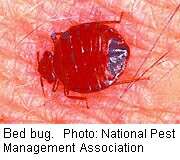
"Bedbugs are sometimes described as appearing like an apple seed," Parada said.

Adult bedbugs range in size from five to seven millimeters (less than one-quarter of an inch), while juveniles may be as small as 1.5 mm (one-sixteenth of an inch).

"With feeding, they enlarge, or engorge, with blood," Parada said. "The adults turn from more brown to more red in color, while the translucent nymphs may become bright red."

Bedbugs typically bite at night on exposed areas of skin such as the face, neck, hands and arms. The bite itself is painless and can look like other .

"Clues that can suggest the presence of bedbugs include finding red, itchy bites upon awakening—especially if the bites line up in a row on the skin," Parada said. "However, while some people develop a bite reaction immediately, others may take two to three days before a reaction becomes noticeable, and not all people react to bites."

He noted that a bedbug bite can look like a tiny puncture wound without a surrounding reaction, and can easily be missed. Thirty percent of people living in bedbug-infested homes don't report bites or skin reactions.

However, "other people have exuberant reactions, with large, red, raised and itchy welts," Parada said. "This is especially true if one becomes sensitized to bedbug bites, so that with repeated bites there may be an exaggerated reaction to the bite."

Eliminating bedbugs is not something you can do yourself. " are notoriously difficult to eradicate and there is good reason to get professional help from qualified pest professionals with expertise in treating bed bugs," Parada advised.

More information: The U.S. Centers for Disease Control and Prevention has more about bedbugs.

add to favorites email to friend print save as pdf

Related Stories

Bedbugs can infest your office, too

Apr 20, 2012

(HealthDay) -- Add bedbugs to your list of potential occupational health hazards. A new report reveals nearly half of the employees of a U.S. government office in Tennessee were bitten by the blood-thirsty ...

Battling the bedbug epidemic

Mar 09, 2011

"Sleep tight, don't let the bedbugs bite" -- is becoming an impossible dream for millions of people as the world experiences a resurgence of an ancient scourge that is fostering human misery, financial burdens and the risk ...

Recommended for you

Taxing unhealthy food spurs people to buy less

3 hours ago

Labeling foods and beverages as less-healthy and taxing them motivates people to make healthier choices, finds a recent study in the American Journal of Preventive Medicine. When faced with a 30 percent tax on ...

User comments

Adjust slider to filter visible comments by rank

Display comments: newest first

baudrunner
not rated yet Feb 09, 2013
People carry bedbugs around without knowing it. They go home, satisfied that the pest control people have done their jobs, sit in front of the TV screen, and absentmindedly scratch their bellies without paying much attention to it or even knowing why they are doing it. The bedbugs have been holed up in the buckle loops of their leather belts, and they are wandering around looking for a prime cut of flesh to gorge upon. You only notice them when they are creeping around on your skin, because their bite releases a local anesthetic that temporarily numbs the area of the bite until they are long gone and it begins to get itchy. They will be either holed up in their belt buckles again, or wandering around looking for kin under the piping of their living room couch cushions.

More news stories

Validating maps of the brain's resting state

Kick back and shut your eyes. Now stop thinking. You have just put your brain into what neuroscientists call its resting state. What the brain is doing when an individual is not focused on the outside world ...

No danger of cancer through gene therapy virus

In fall 2012, the European Medicines Agency (EMA) approved the modified adeno-associated virus AAV-LPL S447X as the first ever gene therapy for clinical use in the Western world. uniQure, a Dutch biotech company, had developed ...

Antioxidant shows promise in Parkinson's disease

Diapocynin, a synthetic molecule derived from a naturally occurring compound (apocynin), has been found to protect neurobehavioral function in mice with Parkinson's Disease symptoms by preventing deficits in motor coordination.

Laughing gas does not increase heart attacks

(Medical Xpress)—Nitrous oxide—best known as laughing gas—is one of the world's oldest and most widely used anesthetics. Despite its popularity, however, experts have questioned its impact on the risk ...

Paralysed with fear: The story of polio

Thanks to vaccination, polio has been pushed to the brink of extinction – but can we finish the job? This is one of the big questions which a Bristol academic addresses in his new book, published next week.

Model recreates wear and tear of osteoarthritis

(Medical Xpress)—There's a reason osteoarthritis is often called wear-and-tear arthritis: Repeated stress on joints over time results in degeneration of the soft cartilage that normally distributes loads ...