Reports of toxic milk trigger scare in Balkans
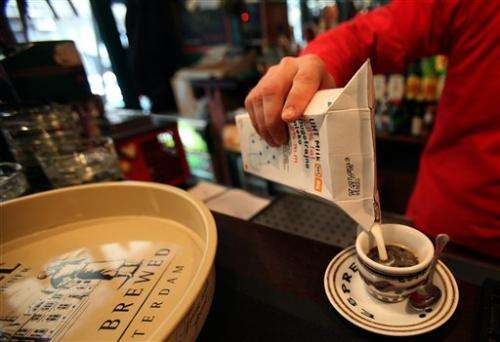
(AP)—Some milk in the Balkans has been contaminated by a naturally occurring cancer-causing toxin and consumers are accusing officials of hiding the real truth of how serious the problem is.
Most health officials agree that the milk is safe and that even higher levels of aflatoxins—a fungus linked to mildewed cattle feed—are not harmful in small amounts. Serbian officials have refused to have milk pulled off store shelves and appealed for calm Tuesday before official tests show conclusive results.
But a warning by a regional official on his personal website has fueled doubts about the official line, suspicions fed by the region's widespread corruption and the cozy ties between politicians and industry.
Worry has grown among consumers in the 10 days since the media first reported that the toxin had been found in some milk products after an extremely dry summer provided conditions for the poisonous mold to grow, mostly in corn that is used as animal feed.
Very high doses are linked to cancer, especially of the liver, but experts say a person would have to drink a gallon a day for years to see any health effects.
Serbia's National Consumers' Association maintained that the levels of aflatoxins were within the allowed limits. The organization said that 17 kinds of milk had been tested, and in 13 the toxin levels were on the upper limits, but not exceeding them.
But a senior agricultural official broke from the official stance, claiming on his personal website that out of 35 tested milk samples in Serbia, 29 had higher levels of aflatoxins than allowed. He published a list of various brands of milk with high levels, saying the government was keeping them secret.
"If you ask me whether to buy milk, the answer is 'no,'" Goran Jesic, the official in charge of Serbia's breadbasket region of Vojvodina, told a media conference. "I am a father of two children and that is why I published the results and I will always do that."
Milk is still widely available on store shelves and there have been no official numbers on how sales have responded. But his warning has hit a nerve with many in the Balkans who are fed up with what they consider politicians who are greedy and out of touch with everyday people.
Some Serbs fear that the authorities are hiding the real contamination levels in order to save the milk industry from collapse. Officials have said the milk is safe without revealing specific figures or how widespread the contamination is.
"No more milk for me and my family, at last for a while," said Dragica Jovanovic, a Belgrade homemaker, as she shopped at a downtown grocery store. "I don't believe them about anything. They would kill for a profit."
Opposition politicians appealed to the government to come out with comprehensive milk contamination figures to avoid panic from spreading.
"Is the government on purpose refusing to withdraw milk from the store shelves, hiding the truth and jeopardizing the health of the population?," asked the head of the national parliament's health committee, Dusan Milosavljevic.
The Serbian agriculture minister is expected to meet with representatives of milk producers, inspection services and the labs that tested the milk. The government has not commented specifically on Jesic's accusations.
"Things are under control and the worst thing would be to allow panic to spread," government minister Verica Kalanovic said.
While advising people to drink only small quantities of milk, Dragan Papovic, who heads the National Consumers' Association in Serbia, said people would "have to drink three to 4 liters (1.06 gallons) of milk with high aflatoxin levels per day, and drink it for two to three years in order to have problems."
Bosnian veterinary officials said that concentrations of aflatoxin above the limit had been found in imported milk from Hungary, Slovenia and Germany and that a shipment from Serbia is also suspected. Recently, Bosnia's border controls have found the toxin in milk imported from Croatia.
All producers have been informed about the tests, officials said. The milk was intended for processing and packaging in plants in Bosnia and did not reach consumers.
On Tuesday, Croatian health authorities pulled four milk brands off store shelves after discovered that they—two made in Croatia and two in Bosnia—were contaminated with high levels of aflatoxin. The excessive levels of the toxin were also found in some samples of milk produced in Slovenia.
"You have to wonder are you harming your children by insisting that they drink milk," said Amra Muratbegovic, a mother of two in the Bosnian capital, Sarajevo. "It turns out that you can be sure about what you are drinking only if you tie up a cow on your balcony."
_____
Niksic reported from Sarajevo, Bosnia. Jovana Gec contributed to this report.
Copyright 2013 The Associated Press. All rights reserved. This material may not be published, broadcast, rewritten or redistributed.


