Winter storm hazard: Snowblower injuries
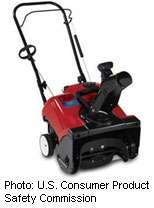
February 8, 2013 in Health

Winter storm hazard: snowblower injuries

Broken bones, amputation possible if safety precautions not followed, expert warns.

(HealthDay)—The massive winter storm battering the northeastern United States means that many people will be using snowblowers to clear snow from their driveways and sidewalks.

While snowblowers can make that task easier, they can also cause serious injuries if people fail to take proper safety precautions, an expert warns.

Each year, about 5,700 people in the United States go to the emergency room for treatment of snowblower-related injuries such as , cuts to skin and soft tissue, bruises, and sprains. About 10 percent of injuries involve amputation of the hand or fingers.

"Snowblower injuries tend to happen when someone stops paying attention for even a few seconds," Dr. R. Michael Koch, chief of the microsurgery and replantation service at the Westchester Medical Center in Valhalla, N.Y., said in a center news release.

"Even after the snowblower is turned off, tension is stored in the . A hand or finger stuck in to remove wet snow or ice is at risk for being cut, mangled or even amputated," added Koch, who is also an assistant professor of surgery at New York Medical College and a surgeon with the New York Group for Plastic Surgery.

To stay safe, keep your hands and fingers out of the snowblower mechanism whether the machine is running or turned off. Do not disable the built into most new snowblowers and take the time to review the key in the owner's manual.

In addition, always pay attention when using a snowblower. Many accidents occur when people allow their thoughts to wander, they get distracted, or they're in a hurry and skip important safety steps, Koch said.

It is also recommended that you wear thick gloves when using a snowblower. They don't offer complete protection, but may lessen the potential damage if there is an accident.

Koch noted that advances in enable surgeons to reattach, replace or repair hands and fingers that are injured in snowblower accidents.

More information: The American Academy of Orthopaedic Surgeons offers tips to prevent snow-shoveling and snowblower injuries.

Health News Copyright © 2013 HealthDay. All rights reserved.

5 /5 (1 vote)  

Rank 5 /5 (1 vote)
Related Stories
Relevant PhysicsForums posts

More news stories

Seniors more likely to crash when driving with pet, study finds

(HealthDay)—Animals make great companions for senior citizens, but elderly people who always drive with a pet in the car are far more likely to crash than those who never drive with a pet, researchers have ...

Health created 10 hours ago | popularity not rated yet | comments 1

Driving and hands-free talking lead to spike in errors, study shows

Talking on a hands-free device while behind the wheel can lead to a sharp increase in errors that could imperil other drivers on the road, according to new research from the University of Alberta.

Health created May 24, 2013 | popularity not rated yet | comments 1

About one in four uninsured could be excluded from ACA

(HealthDay)—More than one in four of those eligible for new premium assistance tax credits under the Affordable Care Act (ACA) do not have a checking account and will not be able to receive premiums from ...

Health created May 24, 2013 | popularity not rated yet | comments 0

Audiologists recommend smart phone apps to monitor noise levels

After studying noise in one French Quarter neighborhood of New Orleans to determine whether or not noise levels exceeded municipal ordinances, Annette Hurley, PhD, Assistant Professor of Audiology at LSU Health Sciences Center ...

Health created May 24, 2013 | popularity not rated yet | comments 0

Young children who miss well-child visits are more likely to be hospitalized

Young children who missed more than half of recommended well-child visits had up to twice the risk of hospitalization compared to children who attended most of their visits, according to a study published today in the American Jo ...

Health created May 24, 2013 | popularity not rated yet | comments 0


First drug to improve heart failure mortality in over a decade

Coenzyme Q10 decreases all cause mortality by half, according to the results of a multicentre randomised double blind trial presented today at Heart Failure 2013 congress. It is the first drug to improve heart failure mortality ...

Heart failure accelerates male 'menopause'

Heart failure accelerates the aging process and brings on early andropausal syndrome (AS), according to research presented today at the Heart Failure Congress 2013. AS, also referred to as male 'menopause', was four times ...

Death highest in heart failure patients admitted in January, on Friday, and overnight

Mortality and length of stay are highest in heart failure patients admitted in January, on Friday, and overnight, according to research presented today at the Heart Failure Congress 2013. The analysis of nearly 1 million ...

Feds fight morning-after pill age ruling in NY

(AP)—Department of Justice lawyers have again asked a federal appeals court in New York to delay lifting age restrictions and prescription requirements on an emergency contraceptive popularly known as the morning-after ...

New immune system discovered

(Medical Xpress)—A research team, led by Jeremy Barr, a biology post-doctoral fellow, unveils a new immune system that protects humans and animals from infection.

Brain can be trained in compassion, study shows

Until now, little was scientifically known about the human potential to cultivate compassion—the emotional state of caring for people who are suffering in a way that motivates altruistic behavior.