5-organ transplant patient gives birth: baby girl (Update)
March 13, 2013 by Suzette Laboy in Other
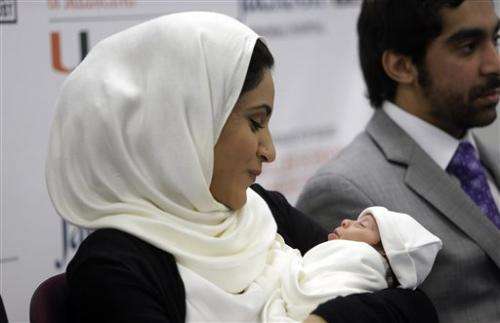
Fatema Al Ansari of Qatar, left, holds her baby Alkadi Alhayal, as her husband Khalifa Alhayal, right, looks on during a news conference at Jackson Memorial Hospital, Wednesday, March 13, 2013, in Miami. Al Ansari was diagnosed with a condition called mesenteric thrombosis at age 19, causing her abdominal organs to fail. She is the first multivisceral transplant patient in the world to conceive and give birth. (AP Photo/Lynne Sladky)
A woman whose doctors believe is the first known case of a five-organ transplant patient to deliver a baby said Wednesday her joy is hard to describe.
Fatema Al Ansari, 26, was given a new liver, pancreas, stomach and small and large intestine at a Miami hospital in 2007. Five years after that surgery, she gave birth Feb. 26 at the same hospital, Jackson Memorial, with her transplant doctor on a team closely watching.
"It's a hard feeling to express," the new mother said of the cesarean birth of a healthy girl, who weighed 4 pounds 7 ounces upon arrival. "It's the best feeling in the world," she said in Arabic, her words translated by an interpreter.
The infant, Alkadi Alhayal, snuggling in a white blanket and white cap, slept quietly in her mother's arms while her parents addressed reporters' questions with her doctors Wednesday at the hospital.
The woman, who lives in Qatar and plans to return home in the coming weeks, was there at 19 when she was diagnosed with a blood clot in a major vein to the intestine—requiring transplant surgery.
Just over 600 five-organ transplants have been recorded as of 2011, according to the latest figures available from the Intestinal Transplant Association.
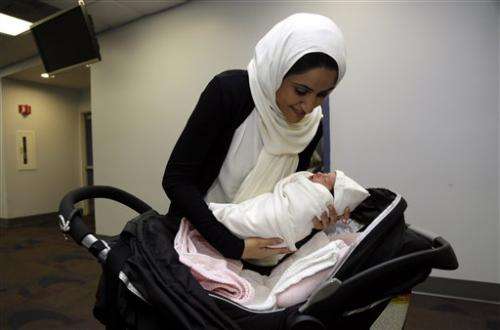
Fatema Al Ansari of Qatar, left, places her baby Alkadi Alhayal in a stroller following a news conference at Jackson Memorial Hospital, Wednesday, March 13, 2013, in Miami. Al Ansari was diagnosed with a condition called mesenteric thrombosis at age 19, causing her abdominal organs to fail. She is the first multivisceral transplant patient in the world to conceive and give birth. (AP Photo/Lynne Sladky)
The most recent annual report by the National Transplantation Pregnancy Registry also indicates she is the first reported case of a five-organ transplant patient in the world to give birth.Dr. Shalih Y. Yasin, the woman's obstetrician , said there have been some cases in Europe of births by transplant patients who had two organs "but not five."
"We have searched all medical literature all over the world for any pregnancy that had five multi-transplants and this is the first case to our knowledge," said the doctor with the University of Miami Health System.
Yasin said an adult with five transplanted organs healthy enough to even consider having a child "is a miracle by itself."
Al Ansari was forced to terminate a previous pregnancy early on after her diagnosis, which made her think she would never be able to get pregnant. She said her husband, Khalifa Alhayal, gave her hope to realize her dream and they became parents through in vitro fertilization.
Her recent pregnancy was considered high-risk and she was monitored closely by her team of transplant doctors and gynecologists in Miami.
She did not have an infection during her pregnancy, as her doctors had prepared for, but she faced minor complications including the flu, some bleeding and physical discomfort from her growing baby.
"It's not an easy pregnancy to go through," Yasin said. "One has to make sure the transplant organ is not rejected, that the medications are safe to the baby."
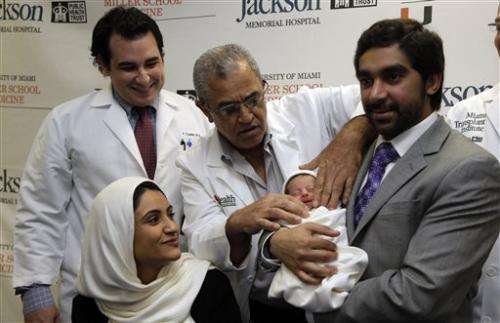
Fatema Al Ansari of Qatar, left, front, looks on as Dr. Salih Yasin, second from left, adjusts the clothing of her baby Alkadi Alhayal, center, held by her husband Khalifa Alhayal, right, during a news conference at Jackson Memorial Hospital, Wednesday, March 13, 2013, in Miami. Al Ansari was diagnosed with a condition called mesenteric thrombosis at age 19, causing her abdominal organs to fail. She is the first multivisceral transplant patient in the world to conceive and give birth. (AP Photo/Lynne Sladky)
Experts noted the uniqueness of the case."While we have a good success rate to get patients to survive and back to normal, almost none of them go on to bear children," said Dr. Thomas Fishbein, Executive Director at the Georgetown Transplant Institute, who was not part of Al Ansari's medical team.
He said he has seen multi-organ patients go through pregnancy, but not five-organ transplants.
"So this is very good news for the field," he said, noting the number of patients who have had successful bowel transplants is very small because of difficulty achieving stable, long-term acceptance of that organ.
Al Ansari's doctors said she is in fact healthy enough to try for a second baby. And they said her case also offers some hope to other multi-organ transplant patients.
"We wanted to say that this was a very hard decision," said Al Ansari's husband, also speaking through an interpreter. "But we wanted to give hope to other people who have transplants and give them a chance, too."
Copyright 2013 The Associated Press. All rights reserved. This material may not be published, broadcast, rewritten or redistributed.
-
US girl, 9, gets six-organ transplant
Feb 05, 2012 |
not rated yet |
0
-
Argentine woman gives birth after heart transplant
Jan 29, 2013 |
not rated yet |
0
-
Patient dies after Turkey quadruple limb transplant
Feb 27, 2012 |
not rated yet |
0
-
Complication in Turkey's quadruple limb transplant
Feb 26, 2012 |
not rated yet |
0
-
Turkey: doctors perform quadruple limb transplant
Feb 25, 2012 |
not rated yet |
0
-
Motion perception revisited: High Phi effect challenges established motion perception assumptions
Apr 23, 2013 |
3 / 5 (2) |
2
-
Anything you can do I can do better: Neuromolecular foundations of the superiority illusion (Update)
Apr 02, 2013 |
4.5 / 5 (11) |
5
-
The visual system as economist: Neural resource allocation in visual adaptation
Mar 30, 2013 |
5 / 5 (2) |
9
-
Separate lives: Neuronal and organismal lifespans decoupled
Mar 27, 2013 |
4.9 / 5 (8) |
0
-
Sizing things up: The evolutionary neurobiology of scale invariance
Feb 28, 2013 |
4.8 / 5 (10) |
14
-
Classical and Quantum Mechanics via Lie algebras
Apr 15, 2011
- More from Physics Forums - Independent Research
More news stories
Flesh-eating disease victim gets prosthetic hands
(AP)—A woman who lost both hands, her left leg and right foot after contracting a flesh-eating disease has been fitted with prosthetic hands.
Other
May 18, 2013 |
not rated yet |
0
Illinois Senate approves medical marijuana bill
(AP)—Medical marijuana use in Illinois is now in Gov. Pat Quinn's hands after the state Senate approved legislation.
Other
May 17, 2013 |
5 / 5 (1) |
0
Nigerian court jails two over killer teething drug
A Nigerian court on Friday sentenced two officials from a pharmaceutical company to seven years in prison over the sale of an adulterated teething drug which killed 84 babies in 2008.
Other
May 17, 2013 |
not rated yet |
0
Many patients would switch doc to cut health care costs
(HealthDay)—Many Americans feel that keeping out-of-pocket health care costs is more important than staying with the same primary care physician.
Other
May 17, 2013 |
not rated yet |
0
Cultural attitudes impede organ donations in China
(AP)—China is phasing out its reliance on executed prisoners for donated organs, but an architect of the country's transplant system said Friday that ingrained cultural attitudes are impeding the rise of ...
Other
May 17, 2013 |
not rated yet |
0
Consuming coffee linked to lower risk of detrimental liver disease, study finds
Regular consumption of coffee is associated with a reduced risk of primary sclerosing cholangitis (PSC), an autoimmune liver disease, Mayo Clinic research shows. The findings were being presented at the Digestive Disease ...
Ketamine shows significant therapeutic benefit in people with treatment-resistant depression
Patients with treatment-resistant major depression saw dramatic improvement in their illness after treatment with ketamine, an anesthetic, according to the largest ketamine clinical trial to-date led by researchers from the ...
Research examines new methods for managing digestive health
Research presented at Digestive Disease Week (DDW) explores new methods for managing digestive health through diet and lifestyle.
New smartphone application improves colonoscopy preparation
The use of a smartphone application significantly improves patients' preparation for a colonoscopy, according to new research presented today at Digestive Disease Week (DDW). The preparation process, which begins days in ...
New research identifies practice changes to improve value and quality of GI procedures
There are significant cost and risk factors associated with two procedures commonly used to diagnose or treat gastrointestinal problems, according to research presented at Digestive Disease Week (DDW).
New research identifies risks, interventions for children's GI health
An increasing number of U.S. children are experiencing gastrointestinal issues that require interventions to resolve, according to research presented at Digestive Disease Week (DDW).

