MRI Fingerprinting: the 12-second scan and a whole lot more
March 21, 2013 by John Hewitt in Medical research report

MRI Fingerprinting

Enlarge

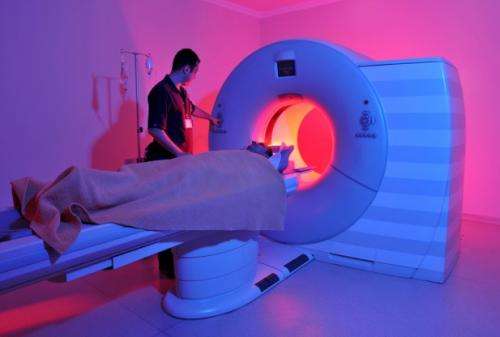
MRI scans can be done in one-tenth the time using MRI Fingerprinting

(Medical Xpress)—Getting an MRI can be an uncomfortable experience, particularly for a 40-minute or longer scan. In the US at least, it is also quite expensive—the same kind of scan costing just over $100 in France, for example, would undoubtedly cost over $1000 here. If the whole scan could be done in say, 12 seconds, the call to "make the patient the customer again" might be heard a little clearer. A new technique developed by a collaborative effort at Case Western University and Siemens, known as MRI Fingerprinting (MRF), promises to do just that. The team's findings are described in the recent issue of the journal Nature.

While MRI is in principle a quantitative instrument, in practice, the results are typically best described as qualitative. If it were really quantitative, caregivers would probably discuss features of the scan more in terms of absolutes, ideally suffixed with appropriate units. Instead, we usually settle for the familiar, regions of hyper, or hypointensity to describe regions of .

MRF would be performed using the standard MRI hardware, but it draws on a set of new techniques falling under the rubric of compressive sampling. Engineers have been hammering out a novel approach to a broad class of problems arising in everything from telecommunications, to and processing. Most recently in medicine, compressive sampling, or as it is sometimes called, has been applied to create high resolution endoscopic images.

To analogize how these new methods might actually work, let's imagine acquiring a natural image. It can be shown that if the image is acquired through a psuedo-random mask of sorts, much greater efficiency can generally be achieved. Intuitively we might expect that if the first 300 pixels of a seascape, for example, are all highly correlated blue sky, perhaps structuring the pixel acquisition in some other way could be more efficient.

The metaphor is obviously a simplification, but the key for MRF is rather than using rigidly defined and error-prone scans on the front end, all the data can be acquired up front using compressive sampling. Afterwards, pattern recognition techniques can be used in the post processing. While the fingerprint is not to be understood literally as a kind of DNA fingerprinting as used in forensic science, the process resembles matching a person's fingerprint to a database that can then draw up additional related information.

Following acquisition of the imaging data, a so-called "dictionary" containing the realistic range of standard MRI parameters (like relaxation times and off-resonance frequency) can be obtained with relatively modest computing resource. Other properties often obtained from MRI data such as diffusion and magnetization transfer can also be measured. These are the parameters behind the techniques now at our disposal for tracing the paths of axon tracts in the brain, in particular diffusion tractoctagraphy.

The authors of the study conclude that in using MRF, the traditional imaging routine will be greatly simplified into an all-in-one scan. The dozens of parameters under operator control in current MRI machines could be replaced with a simple scan button, making MRI more routine, patient-friendly, and affordable.

More information: Magnetic resonance fingerprinting, Nature 495, 187–192 (14 March 2013) doi:10.1038/nature11971

Abstract
Magnetic resonance is an exceptionally powerful and versatile measurement technique. The basic structure of a magnetic resonance experiment has remained largely unchanged for almost 50 years, being mainly restricted to the qualitative probing of only a limited set of the properties that can in principle be accessed by this technique. Here we introduce an approach to data acquisition, post-processing and visualization—which we term 'magnetic resonance fingerprinting' (MRF)—that permits the simultaneous non-invasive quantification of multiple important properties of a material or tissue. MRF thus provides an alternative way to quantitatively detect and analyse complex changes that can represent physical alterations of a substance or early indicators of disease. MRF can also be used to identify the presence of a specific target material or tissue, which will increase the sensitivity, specificity and speed of a magnetic resonance study, and potentially lead to new diagnostic testing methodologies. When paired with an appropriate pattern-recognition algorithm, MRF inherently suppresses measurement errors and can thus improve measurement accuracy.

Journal reference: Nature search and more info website

© 2013 Medical Xpress

4.8 /5 (8 votes)  

Filter


Move the slider to adjust rank threshold, so that you can hide some of the comments.


Display comments: newest first

antialias_physorg
Mar 21, 2013

Rank: 2 / 5 (3)
The approach is good for getting quick images where pattern recognition is able to 'fill in the blanks'. But in medicine the whole point is that you are looking for something pathological. Especially with tumors there is no really good segmentation algorithm that catches all shape types.

Relying on post processing and pattern recognition will cause uniquely shaped tumors to be missed (and I'm saying this as someone who has done his PhD developing medical segmentation algorithms. I love what they can do - but relying on them fully in medical diagnostics is a recipe for disaster)

Humans still have one thing where they are way ahead of machines. That's the ability to go: "Whoa, what is that? Haven't seen one of those kinds before. Let's have a closer look."
johnhew
Mar 21, 2013

Rank: 5 / 5 (3)
Thanks for the comment. The technique involves a little more than post-processing. It is a fundamentally new way to acquire the scan as well. The technique was developed to get a better handle on disease states, like for example, observing white matter in demyelinating diseases.
MandoZink
Mar 21, 2013

Rank: not rated yet
Humans still have one thing where they are way ahead of machines. That's the ability to go: "Whoa, what is that? Haven't seen one of those kinds before. Let's have a closer look."

Exactly. That was how my first diagnosis (Diffuse Large B-cell Lymphoma) was made. As a matter of fact as soon as I felt it I remember using the "whoa" word.
Rank 4.8 /5 (8 votes)
Relevant PhysicsForums posts

More news stories

Study reveals new mechanism for estrogen suppression of liver lipid synthesis

By discovering the new mechanism by which estrogen suppresses lipid synthesis in the liver, UC Irvine endocrinologists have revealed a potential new approach toward treating certain liver diseases.

Medical research created 7 hours ago | popularity not rated yet | comments 0 | with audio podcast

MRI-based measurement helps predict vascular disease in the brain

Aortic arch pulse wave velocity, a measure of arterial stiffness, is a strong independent predictor of disease of the vessels that supply blood to the brain, according to a new study published in the June issue the journal ...

Medical research created 7 hours ago | popularity not rated yet | comments 0

Antibiotics: A new understanding of sulfonamide nervous system side effects

Since the discovery of Prontosil in 1932, sulfonamide antibiotics have been used to combat a wide spectrum of bacterial infections, from acne to chlamydia and pneumonia. However, their side effects can include serious neurological ...

Medical research created 9 hours ago | popularity not rated yet | comments 0 | with audio podcast

Scientists discover molecule triggers sensation of itch

Scientists at the National Institutes of Health report they have discovered in mouse studies that a small molecule released in the spinal cord triggers a process that is later experienced in the brain as ...

Medical research created 9 hours ago | popularity 5 / 5 (2) | comments 0 | with audio podcast

Discarded immune cells induce the relocation of stem cells

Spanish researchers have discovered that the daily clearance of neutrophils from the body stimulates the release of hematopoietic stem cells from the bone marrow into the bloodstream, according to a report published today ...

Medical research created 11 hours ago | popularity 5 / 5 (2) | comments 0


Controlling mood through the motions of mitochondria

(Medical Xpress)—Regulating the distribution of power in neurons is done by a system that makes the national electric grid look simple by comparison. Each neuron has several thousand mitochondria confined ...

Multiple research teams unable to confirm high-profile Alzheimer's study

Teams of highly respected Alzheimer's researchers failed to replicate what appeared to be breakthrough results for the treatment of this brain disease when they were published last year in the journal Science.

Motion quotient: IQ predicted by ability to filter motion (w/ video)

A brief visual task can predict IQ, according to a new study. This surprisingly simple exercise measures the brain's unconscious ability to filter out visual movement. The study shows that individuals whose ...

Researchers find common childhood asthma unconnected to allergens or inflammation

Little is known about why asthma develops, how it constricts the airway or why response to treatments varies between patients. Now, a team of researchers at Weill Cornell Medical College, Columbia University Medical Center ...

Diabetes' genetic underpinnings can vary based on ethnic background, studies say

Ethnic background plays a surprisingly large role in how diabetes develops on a cellular level, according to two new studies led by researchers at the Stanford University School of Medicine.

When oxygen is short, EGFR prevents maturation of cancer-fighting miRNAs

Even while being dragged to its destruction inside a cell, a cancer-promoting growth factor receptor fires away, sending signals that thwart the development of tumor-suppressing microRNAs (miRNAs) before it's dissolved, researchers ...