Persistence pays off in solving hemophilia mystery, showing curiosity drives discovery
Persistence pays off in solving hemophilia mystery, showing curiosity drives discovery
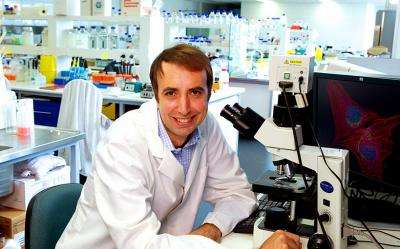
Professor Merlin Crossley is dean of science at University of New South Wales. Credit: UNSW

An Australian researcher has found the third and final missing piece in the genetic puzzle of an unusual form of hemophilia, more than 20 year after he discovered the first two pieces.

Professor Merlin Crossley, of the University of New South Wales, and his international team studied the , hemophilia B Leyden, which is unusual because symptoms improve after puberty.

The results, published in The , explain how more than half of the cases of this rare, hereditary bleeding disorder occur, and could help improve understanding of other conditions such as thrombosis.

The find also demonstrates the importance of curiosity-driven research, says Crossley, who is dean of science at UNSW.

"Science is advanced by people who get caught up in puzzles that are important to them and they never forget them. Curious investigators never give up," he says.

Crossley spotted the final genetic clue two years ago, when he was on an aeroplane, marking a young researcher's PhD project. Data in the thesis reminded him of his own PhD project on hemophilia B Leyden, carried out at the University of Oxford in the late 1980s.

People with the disorder have three different categories of mutations in the gene that produces clotting factor IX, which prevents excessive bleeding. Crossley was able to work out how two of them operate, while at Oxford.

He found the two sets of mutations prevent two key proteins from attaching to the DNA, which turns the gene off as a result. Symptoms improve in young men after puberty because a different protein that responds to the is able to bind to the DNA and boost the gene's production of clotting factor IX.

Crossley, and many other researchers after him, tried to find the key protein associated with the third group of mutations, which accounts for more than half the cases of the disease, but it remained elusive. "Things moved on, but I never forgot," he says.

Two decades later, on the plane, he realised the young researcher was describing a DNA-binding site for a newly discovered protein that had a very familiar ring to it. "I remembered it. It was the same sequence as for the binding site for the third group of mutations," Crossley says.

He joined forces with others at UNSW, including Dr Alister Funnell, and researchers in the UK, New Zealand and Belgium, to show the newly identified protein, ONECUT, was the missing piece in the puzzle of hemophilia B Leyden, which affects about 80 families worldwide.

The original research allowed families to be informed that their children were likely to get better after .

While the new research will not alter the method of treatment for people with B Leyden, it could lead to new approaches to regulating genes in general for experimental, or ultimately, therapeutic purposes.

"Understanding the molecular regulation of the coagulation factor IX gene may aid in the development of therapies for other blood-clotting disorders such as ," says Funnell.

Related Stories

Gene therapy helps patients with hemophilia B

Dec 13, 2011

(Medical Xpress) -- An experimental gene therapy technique boosted the production of a vital blood clotting factor in six people with hemophilia B, according to new research supported by the National Institutes of Health. ...

New animal model for hemophilia A developed

Sep 03, 2010

(PhysOrg.com) -- Researchers at Yale School of Medicine have developed a new animal model for studying hemophilia A, with the goal of eventually treating people with the disorder. Hemophilia A, a hereditary defect that prevents ...

Reasons for severe bleeding in hemophilia revealed

Nov 20, 2012

New insights into what causes uncontrollable bleeding in hemophilia patients are provided in a study published by Cell Press on November 20th in the Biophysical Journal. By revealing that blood clots spread in traveling waves ...

Recommended for you

The secret of DNA methylation

16 hours ago

Methylation refers to a chemical modification of DNA and this modification can occur in millions of positions in the DNA sequence. Until now, scientists believed that this epigenetic phenomenon actively reduced the expression ...

Aspirin may fight cancer by slowing DNA damage

19 hours ago

Aspirin is known to lower risk for some cancers, and a new study led by a UC San Francisco scientist points to a possible explanation, with the discovery that aspirin slows the accumulation of DNA mutations in abnormal cells ...

Study identifies protein essential for normal heart function

Jun 17, 2013

A study by researchers at Skaggs School of Pharmacy and Pharmaceutical Sciences and the Department of Pharmacology at the University of California, San Diego, shows that a protein called MCL-1, which promotes cell survival, ...

Scouring the genome of adenoid cystic carcinoma

Jun 17, 2013

Adenoid cystic carcinoma (ACC) is a slow-growing and often fatal malignancy that can occur at multiple organ site, but is most frequently found in the salivary glands. The primary treatment is surgical removal; however, the ...

Gene variants may play role in obesity

Jun 17, 2013

(HealthDay)—Two new studies offer some solace to those who can't control their weight despite diet and exercise by providing more evidence that genetics may play a role in obesity.

Decoding Rett syndrome: New pieces to the puzzle

Jun 17, 2013

(Medical Xpress)—Rett Syndrome is a neurological disorder that affects about 1 in 10,000 girls. Back in 1992, University of Edinburgh researcher Adrian Bird discovered that the protein, MeCP2, plays a major ...

User comments

More news stories

Study suggests new approach to fight lung cancer

Recent research has shown that cancer cells have a much different – and more complex – metabolism than normal cells. Now, scientists at The University of Texas at Dallas have found that exploiting these differences might ...

Getting enough sleep could help prevent type 2 diabetes

Men who lose sleep during the work week may be able to lower their risk of developing Type 2 diabetes by getting more hours of sleep, according to Los Angeles Biomedical Research Institute (LA BioMed) research findings presented ...