Technology to detect Alzheimer's takes SXSW prize

March 13, 2013 by Robert Macpherson in Alzheimer's disease & dementia

File photo shows a woman suffering from Alzheimer's holding the hand of a relative at a retirement home in France

Enlarge

File photo shows a woman suffering from Alzheimer's desease holding the hand of a relative at a retirement home in France. Technology capable of diagnosing Alzheimer's disease before its symptoms appear won a coveted honor for innovation at the South by Southwest festival.

Technology capable of diagnosing Alzheimer's disease long before its symptoms appear won a coveted honor for innovation at the South by Southwest (SXSW) festival.

Neurotrack, which uses eye tracking to achieve a claimed 100 percent success rate, clinched the health technologies category in the SXSW Accelerator competition Tuesday as the festival's interactive segment drew to a close.

"It's a computer-based visual that is able to diagnose Alzheimer's disease six years before symptoms appear," said Elli Kaplan, of the Richmond, Virginia-based upstart.

"Today the only way to diagnose Alzheimer's is once full symptoms are in existence," Kaplan told AFP, "but that's years after has already taken place."

Initial users of Neurotrack will be pharmaceutical manufacturers to help them develop drugs to prevent, or at least slow the progression of, the most common form of dementia, she said.

But in time, Kaplan added, it will be rolled out to doctor's offices and research hospitals—and potentially, a smartphone and tablet app that individuals can use as well.
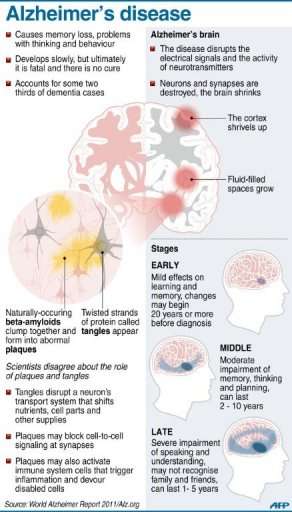
Alzheimer's disease

Graphic on Alzheimer's disease. Technology capable of diagnosing the disease long before its symptoms appear has won a coveted honor for innovation at theSXSW festival in the US.

SXSW Accelerator is a showcase for up-and-coming news, social, mobile, web, entertainment, health and music technologies. One of its 2010 winners, the voice recognition software Siri, now is standard equipment in Apple iPhones.

Other winners Tuesday included the mobile advocacy app Phone2Action; Plotter, a social network for maps; mobile typing assistant Syntellia; Wanderu, a website for young budget travellers; and MakieLab, a toy and game service.

The Accelerator winner for music technologies will be announced later this week, as the music portion of SXSW—with more than 1,000 bands playing live around the Texas state capital—kicks off and the film segment continues.

Kaplan, a Harvard Business School alumnus and mother-of-two who lost two grandparents to Alzheimer's, said Neurotrack was developed in collaboration with Emory University in Atlanta, Georgia and a crack team of neuroscientists.

It comes in two versions, one using an infrared camera and the other a simple computer mouse, and challenges the subject to compare images—some new, some not—that appear briefly on a screen.

"By monitoring the way a person moves their eyes, and watching how they view novel images versus familiar images, we're able to detect perturbations that exist on the hippocampus," Kaplan said, referring to the part of the brain that handles memory.

"Every human being has an instinctive preference for novelty and that's one of the things that we are testing," she added.

Mayer Hawthorne performs at the SXSW festival in Austin, Texas on March 12, 2013
Enlarge

Mayer Hawthorne performs at the SXSW festival in Austin, Texas on March 12, 2013. The music portion of SXSW—with more than 1,000 bands playing live around the Texas state capital—kicked off on Tuesday.

The hippocampus is also the first to be impacted by Alzheimer's, which is thought to affect as many as 5.1 million people in the United States alone.

Neurotrack was incorporated as a company last year, but work on the project dates back at least 20 years.

Kaplan said the claim of 100 percent accuracy is based on a large study, based at Emory University, that followed the progress of participants—some of whom developed the disease—over an extended period.

The study was supported by the National Institutes of Health, a US government agency.

Neurotrack's intention is to market a version for physicians that would cost somewhere between $300 and $1,000, which compares favorably to non-medical productivity software.

As for a version for home use, Kaplan said: "We're actually working on this."

"We are not very far away from a technology that will work on your (mobile) phone or on your tablet," with the results going directly to a doctor who would be best placed to reveal them face-to-face.

Kaplan added: "In 10 years, our hope is that there will be a pill that you can take (to combat Alzheimer's). You'd simply go in for an annual screening test—and if you get the news that you are on a trajectory for Alzheimer's, you'd be able to do something about it."

(c) 2013 AFP

4.7 /5 (3 votes)  

Rank 4.7 /5 (3 votes)
Related Stories
Relevant PhysicsForums posts
  • The idea behind a reverse shock
    created4 hours ago
  • Guass's Law for a charge distribution
    created4 hours ago
  • Noise dependence
    created5 hours ago
  • siphon and bernouli theorum
    created6 hours ago
  • Hot gas expansion rate into outer space
    created6 hours ago
  • Magnetic field lines through copper
    created12 hours ago
  • More from Physics Forums - Classical Physics

More news stories

A new strategy required in the search for Alzheimer's drugs?

In the search for medication against Alzheimer's disease, scientists have focused – among other factors – on drugs that can break down Amyloid beta (A-beta). After all, it is the accumulation of A-beta that causes the ...

Alzheimer's disease & dementia created May 24, 2013 | popularity not rated yet | comments 0

Alzheimer's disease, the soft target of the euthanasia debate

(Medical Xpress)—The way Alzheimer's disease is portrayed by advocacy groups and the media is having undue influence on the euthanasia debate, according to a Deakin University nursing ethics professor.

Alzheimer's disease & dementia created May 24, 2013 | popularity not rated yet | comments 2

Scientists discover cinnamon compounds' potential ability to prevent Alzheimer's

Cinnamon: Can the red-brown spice with the unmistakable fragrance and variety of uses offer an important benefit? The common baking spice might hold the key to delaying the onset of –– or warding off ...

Alzheimer's disease & dementia created May 23, 2013 | popularity 5 / 5 (5) | comments 0 | with audio podcast

Drug reverses Alzheimer's disease deficits in mice, research confirms

An anti-cancer drug reverses memory deficits in an Alzheimer's disease mouse model, University of Pittsburgh Graduate School of Public Health researchers confirm in the journal Science.

Alzheimer's disease & dementia created May 23, 2013 | popularity not rated yet | comments 0 | with audio podcast

Multiple research teams unable to confirm high-profile Alzheimer's study

Teams of highly respected Alzheimer's researchers failed to replicate what appeared to be breakthrough results for the treatment of this brain disease when they were published last year in the journal Science.

Alzheimer's disease & dementia created May 23, 2013 | popularity 3 / 5 (2) | comments 3 | with audio podcast


First drug to improve heart failure mortality in over a decade

Coenzyme Q10 decreases all cause mortality by half, according to the results of a multicentre randomised double blind trial presented today at Heart Failure 2013 congress. It is the first drug to improve heart failure mortality ...

Seniors more likely to crash when driving with pet, study finds

(HealthDay)—Animals make great companions for senior citizens, but elderly people who always drive with a pet in the car are far more likely to crash than those who never drive with a pet, researchers have ...

Heart failure accelerates male 'menopause'

Heart failure accelerates the aging process and brings on early andropausal syndrome (AS), according to research presented today at the Heart Failure Congress 2013. AS, also referred to as male 'menopause', was four times ...

Death highest in heart failure patients admitted in January, on Friday, and overnight

Mortality and length of stay are highest in heart failure patients admitted in January, on Friday, and overnight, according to research presented today at the Heart Failure Congress 2013. The analysis of nearly 1 million ...

Feds fight morning-after pill age ruling in NY

(AP)—Department of Justice lawyers have again asked a federal appeals court in New York to delay lifting age restrictions and prescription requirements on an emergency contraceptive popularly known as the morning-after ...

New immune system discovered

(Medical Xpress)—A research team, led by Jeremy Barr, a biology post-doctoral fellow, unveils a new immune system that protects humans and animals from infection.