UK study says violence more likely among vets, troops
March 15, 2013 by Maria Cheng in Psychology & Psychiatry
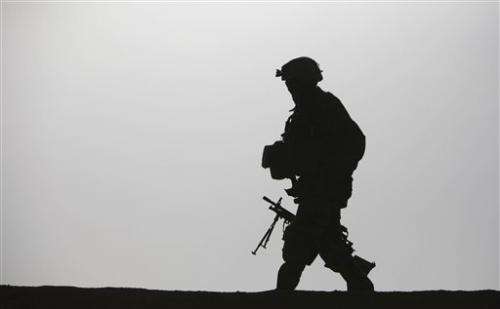
In this Monday, Feb. 15, 2010 file photo, a British soldier walks with his machine gun on the roof of a residential house in the village Qari Sahib, Nad Ali district, Helmend province, southern Afghanistan. Young men who have served in the British military are about three times more likely than civilians to have committed a violent offense, researchers reported Friday, March 15, 2013 in a study that explores the roots of such behavior. The research found that merely being sent to Iraq or Afghanistan made no difference in rates of violent crime later on. Instead, a key predictor was violent behavior before enlisting. (AP Photo/Altaf Qadri, File)
Young men who have served in the British military are about three times more likely than civilians to have committed a violent offense, researchers reported Friday in a study that explores the roots of such behavior.
The research found that merely being sent to Iraq or Afghanistan made no difference in rates of violent crime later on. Instead, a key predictor was violent behavior before enlisting. Combat duty also raised the risk, as did witnessing traumatic events during deployment or misusing alcohol afterward.
Still, the vast majority—94 percent—of British military staff who return home after serving in a combat zone don't commit any crimes, researchers told reporters at a briefing.
The study found little difference in the lifetime rates of violent offenses between military personnel and civilian populations at age 46—11 percent versus almost 9 percent. Among younger men, however, being in the military seemed to make a difference: Nearly 21 percent of the military group under age 30 had a conviction for a violent offense in their lifetime compared to fewer than 7 percent of similarly aged men in the general population, according to British crime statistics.
"The problem is that some of the qualities you want in a soldier are the same ones that get people arrested for violent behavior," said Walter Busuttil, director of medical services for Combat Stress, a British veterans' charity that was not part of the study. Busuttil said many of those recruited into the army are from disadvantaged backgrounds where violence is more common.
The research was published online Friday in the medical journal Lancet. Researchers at the Institute of Psychiatry at King's College London looked at data from more than 13,800 U.K. military personnel and veterans and compared that to records of violent crimes ranging from verbal threats to assaults and homicides. Some people were followed for up to seven years. Nearly 1,500 women were included, though they were mostly in noncombat roles.
Deirdre MacManus, the study's lead author, said combat experience seemed to matter when they compared violent crime rates among military personnel. "Being deployed in itself wasn't a risk factor for violent offenses but being exposed to multiple traumas, like seeing someone get shot, increased the risk by 70 to 80 percent," she said, compared to someone who hadn't witnessed such a harrowing ordeal.
Researchers said other studies have made similar findings.
Britain currently has some 5,000 soldiers in the NATO-led mission fighting in Afghanistan and it is the second-largest foreign contingent after the U.S. It withdrew its soldiers from Iraq in 2009 after six years. The U.K. Ministry of Defense has been under pressure to develop more mental health programs for veterans after reports of returning servicemen committing crimes, like the 2012 case of an ex-soldier in Leeds jailed for shooting his landlady after fighting in Afghanistan. He had been diagnosed with post-traumatic stress disorder but had not been monitored or treated.
In the U.S., there have been numerous cases of veterans committing violent crimes, including a Marine charged with killing six people in California last year. Soldiers from a single Army unit in Colorado killed 11 people over a few years after their return home. An Army report in 2009 placed part of the blame on the psychological trauma of fierce combat in Iraq. And this week, a U.S. Senate panel heard women in the military describe sexual assaults by fellow soldiers.
American researchers said it is possible the same links the British study found between fighting in a war and violent crime exist in the U.S. but that there isn't enough data yet.
"For some soldiers, it's hard to stop being a warrior," said Brett Litz, a psychology professor at Boston University who studies veterans' issues. "What happens during a war may be a prescription for a small percentage of men to get into trouble," he said. "They may find it very difficult to switch out of a wartime mindset."
But given the differences between Britain and the U.S., Litz said it was impossible to predict what effects would be seen in the United States. "Maybe the economy is better here, maybe the (department of defense) does a better job with transition, maybe (the) culture is different especially with respect to alcohol," Litz said.
"There will be a lot of returning soldiers who have to be reintegrated and unfortunately there is no quick fix," he said.
More information: www.thelancet.com/… 4-2/abstract
Journal reference:
The Lancet
Copyright 2013 The Associated Press. All rights reserved. This material may not be published, broadcast, rewritten or redistributed.
-
UK military personnel at increased risk of violent offending
Mar 14, 2013 |
not rated yet |
0
-
Military/civilian medical experts turning attention to 'army' of injured civilians supporting wars
Feb 14, 2011 |
not rated yet |
0
-
Study: Rates of PTSD among Afghanistan, Iraq soldiers dramatically lower than predicted
May 17, 2012 |
not rated yet |
0
-
Women soldiers see more combat than in prior eras, have same PTSD rate as men, study says
Jan 16, 2012 |
not rated yet |
0
-
Suicides are surging among US troops
Jun 08, 2012 |
not rated yet |
0
-
Motion perception revisited: High Phi effect challenges established motion perception assumptions
Apr 23, 2013 |
3 / 5 (2) |
2
-
Anything you can do I can do better: Neuromolecular foundations of the superiority illusion (Update)
Apr 02, 2013 |
4.5 / 5 (11) |
5
-
The visual system as economist: Neural resource allocation in visual adaptation
Mar 30, 2013 |
5 / 5 (2) |
9
-
Separate lives: Neuronal and organismal lifespans decoupled
Mar 27, 2013 |
4.9 / 5 (8) |
0
-
Sizing things up: The evolutionary neurobiology of scale invariance
Feb 28, 2013 |
4.8 / 5 (10) |
14
-
Pressure-volume curve: Elastic Recoil Pressure don't make sense
May 18, 2013
-
If you became brain-dead, would you want them to pull the plug?
May 17, 2013
-
MRI bill question
May 15, 2013
-
Ratio of Hydrogen of Oxygen in Dessicated Animal Protein
May 13, 2013
-
Alcohol and acetaminophen
May 13, 2013
-
Marie Curie's leukemia
May 13, 2013
- More from Physics Forums - Medical Sciences
More news stories
Music therapy reduces anxiety, use of sedatives for patients receiving ventilator support
New research suggests that for some hospitalized ICU patients on mechanical ventilators, using headphones to listen to their favorite types of music could lower anxiety and reduce their need for sedative medications.
Psychology & Psychiatry
45 minutes ago |
not rated yet |
0
|
Anabolic steroids may affect future mental health
There is a link between use of anabolic-androgenic steroids and reduced mental health later in life. This is the main conclusion of a new study on elite male strength athletes that researchers from the University of Gothenburg ...
Psychology & Psychiatry
4 hours ago |
not rated yet |
0
Youth bullying because of perceived sexual orientation widespread and damaging
(Medical Xpress)—Bullying because of perceived sexual orientation is prevalent among school-aged youths, according to a study led by Donald Patrick, professor of health services at the UW School of Public ...
Psychology & Psychiatry
5 hours ago |
not rated yet |
0
Rethinking treatment goals improves results for 'untreatable' anorexics
(Medical Xpress)—Patients with the most severe and dangerous form of chronic anorexia are more likely to make a significant improvement towards recovery and stay in therapy if traditional psychological treatments are re-focused ...
Psychology & Psychiatry
7 hours ago |
not rated yet |
0
Ketamine shows significant therapeutic benefit in people with treatment-resistant depression
Patients with treatment-resistant major depression saw dramatic improvement in their illness after treatment with ketamine, an anesthetic, according to the largest ketamine clinical trial to-date led by researchers from the ...
Psychology & Psychiatry
May 19, 2013 |
4.8 / 5 (6) |
1
|
Tiny, implantable coil promises hope for emphysema patients
A small, easily implantable device called the Lung Volume Reduction Coil (LVRC) may play a key role in the treatment of two types of emphysema, according to a study conducted in Europe. Results of the study indicate the beneficial ...
Early IV nutrition for certain patients does improve survival or reduce ICU length of stay
The early (within 24 hours of intensive care unit [ICU] admission) provision of intravenous nutrition among critically ill patients with contraindications (a condition that makes a particular procedure potentially inadvisable) ...
Having a nighttime critical care physician in the ICU doesn't improve patient outcomes, research finds
With little evidence to guide them, many hospital intensive care units (ICUs) have been employing critical care physicians at night with the notion it would improve patients' outcomes. However, new results from a one-year ...
CT radiation risk less than risk of examination indicator
(HealthDay)—For young adults needing either a chest or abdominopelvic computed tomography (CT), the short-term risk of death from underlying morbidity is greater than the long-term risk of radiation-induced ...
Extra vitamin D may ease Crohn's symptoms, study finds
(HealthDay)—Vitamin D supplements may help those with Crohn's disease overcome the fatigue and decreased muscle strength associated with the inflammatory bowel disease, according to new research.
Digital divide exists with physician EHR adoption
(HealthDay)—The majority of physicians remain reluctant to adopt health information technology (HIT), according to a report by Deloitte Touche Tohmatsu.
Mar 15, 2013
Rank: not rated yet