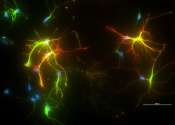
News tagged with brain cells

Do salamanders hold the solution to regeneration?

Salamanders' immune systems are key to their remarkable ability to regrow limbs, and could also underpin their ability to regenerate spinal cords, brain tissue and even parts of their hearts, scientists have ...

Medical research created May 20, 2013 | popularity 4.9 / 5 (7) | comments 4 | with audio podcast

Scientists discover cinnamon compounds' potential ability to prevent Alzheimer's

Cinnamon: Can the red-brown spice with the unmistakable fragrance and variety of uses offer an important benefit? The common baking spice might hold the key to delaying the onset of –– or warding off ...

Alzheimer's disease & dementia created 2 hours ago | popularity 5 / 5 (3) | comments 0 | with audio podcast

Drug reverses Alzheimer's disease deficits in mice, research confirms

An anti-cancer drug reverses memory deficits in an Alzheimer's disease mouse model, University of Pittsburgh Graduate School of Public Health researchers confirm in the journal Science.

Alzheimer's disease & dementia created 4 hours ago | popularity not rated yet | comments 0 | with audio podcast

Cold plasma successful against brain cancer cells

For the first time, physicists from the Max Planck Institute for Extraterrestrial Physics (MPE), biologists and physicians demonstrated the synergistic effect of cold atmospheric plasma - a partly ionized ...

Cancer created 9 hours ago | popularity 5 / 5 (3) | comments 0 | with audio podcast

Depression linked to telomere enzyme, aging, chronic disease

(Medical Xpress)—The first symptoms of major depression may be behavioral, but the common mental illness is based in biology—and not limited to the brain.

Psychology & Psychiatry created 10 hours ago | popularity 4.8 / 5 (6) | comments 0 | with audio podcast

Researchers find possible 'master switch' in deadly brain cancer

(Medical Xpress)—Researchers at the University of Virginia School of Medicine have identified a promising target for treating glioblastoma, one that appears to avoid many of the obstacles that typically frustrate efforts ...

Cancer created 10 hours ago | popularity 3.5 / 5 (2) | comments 0 | with audio podcast

Reducing caloric intake delays nerve cell loss

Activating an enzyme known to play a role in the anti-aging benefits of calorie restriction delays the loss of brain cells and preserves cognitive function in mice, according to a study published in the May ...

Neuroscience created May 21, 2013 | popularity 5 / 5 (7) | comments 0 | with audio podcast

Common food supplement fights degenerative brain disorders

Widely available in pharmacies and health stores, phosphatidylserine is a natural food supplement produced from beef, oysters, and soy. Proven to improve cognition and slow memory loss, it's a popular treatment for older ...

Medical research created May 21, 2013 | popularity 5 / 5 (3) | comments 0 | with audio podcast

Finding a family for a pair of orphan receptors in the brain

Researchers at Emory University have identified a protein that stimulates a pair of "orphan receptors" found in the brain, solving a long-standing biological puzzle and possibly leading to future treatments for neurological ...

Medical research created May 21, 2013 | popularity 5 / 5 (1) | comments 0 | with audio podcast

Study shows premature birth interrupts vital brain development processes leading to reduced cognitive abilities

Researchers from King's College London have for the first time used a novel form of MRI to identify crucial developmental processes in the brain that are vulnerable to the effects of premature birth. This new study, published ...

Neuroscience created May 20, 2013 | popularity 5 / 5 (1) | comments 0 | with audio podcast

Study identifies new approach to improving treatment for MS and other conditions

(Medical Xpress)—Working with lab mice models of multiple sclerosis (MS), UC Davis scientists have detected a novel molecular target for the design of drugs that could be safer and more effective than current FDA-approved ...

Alzheimer's disease & dementia created May 17, 2013 | popularity 5 / 5 (2) | comments 0 | with audio podcast

Brain makes call on which ear is used for cell phone

If you're a left-brain thinker, chances are you use your right hand to hold your cell phone up to your right ear, according to a newly published study from Henry Ford Hospital in Detroit.

Neuroscience created May 16, 2013 | popularity 2 / 5 (2) | comments 0 | with audio podcast

Vicious cycle: Obesity sustained by changes in brain biochemistry

With obesity reaching epidemic levels in some parts of the world, scientists have only begun to understand why it is such a persistent condition. A study in the Journal of Biological Chemistry adds substantially to the st ...

Medical research created May 16, 2013 | popularity 3 / 5 (2) | comments 2 | with audio podcast

Breakthrough on Huntington's disease

Researchers at Lund University have succeeded in preventing very early symptoms of Huntington's disease, depression and anxiety, by deactivating the mutated huntingtin protein in the brains of mice.

Neuroscience created 6 hours ago | popularity 4 / 5 (1) | comments 0

New imaging techniques used to help patients suffering from epilepsy

New techniques in imaging of brain activity developed by Jean Gotman, from McGill University's Montreal Neurological Institute, and his colleagues lead to improved treatment of patients suffering from epilepsy. The combination ...

Neuroscience created 8 hours ago | popularity not rated yet | comments 0

Brain cell

Brain cell is a generic term for the neurons and glial cells. Neurons are nerve cells that process and transmit information through the nervous system. Glial cells provide support, protection, and nutrition to the neurons. Other cells in the brain include epithelial cells that make up the lining of the blood vessels.

Brain cells are commonly thought to remain in the beginning stage of interphase of cell reproduction for their life, and never divide, and instead develop by forming new synapses with other neurons. However, a landmark study in 1998 by researchers from Sweden and the Salk Institute in La Jolla, California, showed for the first time that some brain cells in mature humans may regenerate under certain circumstances.

For more information about Brain cell, read the full article at Wikipedia.
This text uses material from Wikipedia and is available under the GNU Free Documentation License.