News tagged with cancer cells

The compound in the Mediterranean diet that makes cancer cells 'mortal'

New research suggests that a compound abundant in the Mediterranean diet takes away cancer cells' "superpower" to escape death. By altering a very specific step in gene regulation, this compound essentially re-educates cancer ...

Cancer created May 20, 2013 | popularity 4.9 / 5 (17) | comments 3 | with audio podcast

Making cancer less cancerous: Blocking a single gene renders tumors less aggressive

Researchers at Johns Hopkins have identified a gene that, when repressed in tumor cells, puts a halt to cell growth and a range of processes needed for tumors to enlarge and spread to distant sites. The researchers hope that ...

Cancer created May 02, 2013 | popularity 4.7 / 5 (10) | comments 0 | with audio podcast

Study IDs key protein for cell death, offers way to kill cancer cells by forcing them into programmed-death pathway

When cells suffer too much DNA damage, they are usually forced to undergo programmed cell death, or apoptosis. However, cancer cells often ignore these signals, flourishing even after chemotherapy drugs have ...

Genetics created May 14, 2013 | popularity 5 / 5 (9) | comments 0 | with audio podcast

New cancer driver found: Monoclonal antibody therapy stops tumor growth in mice

(Medical Xpress)—Approximately 90 percent of cancers start within tissues that form the inner linings of various organs. Decades of accumulated genetic mutations can, on occasion, induce cells specialized ...

Cancer created May 08, 2013 | popularity 5 / 5 (7) | comments 0 | with audio podcast

Tumor-activated protein promotes cancer spread

Researchers at the University of California, San Diego School of Medicine and UC San Diego Moores Cancer Center report that cancers physically alter cells in the lymphatic system – a network of vessels that transports and ...

Cancer created May 13, 2013 | popularity 4.2 / 5 (5) | comments 0 | with audio podcast

Researchers describe how breast cancer cells acquire drug resistance

A seven-year quest to understand how breast cancer cells resist treatment with the targeted therapy lapatinib has revealed a previously unknown molecular network that regulates cell death. The discovery provides new avenues ...

Cancer created May 07, 2013 | popularity 5 / 5 (4) | comments 0 | with audio podcast

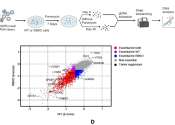
Computational tool translates complex data into simplified 2-dimensional images

In their quest to learn more about the variability of cells between and within tissues, biomedical scientists have devised tools capable of simultaneously measuring dozens of characteristics of individual ...

Medical research created May 19, 2013 | popularity 5 / 5 (4) | comments 0 | with audio podcast

Physicists, biologists unite to expose how cancer spreads

(Medical Xpress)—Cancer cells that can break out of a tumor and invade other organs are more aggressive and nimble than nonmalignant cells, according to a new multi-institutional nationwide study. These ...

Cancer created Apr 26, 2013 | popularity 4.8 / 5 (4) | comments 0 | with audio podcast

Research shows oral supplement increases body's storage of antioxidant

(Medical Xpress)—Oral supplementation of glutathione is effective in increasing the body's stores of the antioxidant, said Penn State College of Medicine researchers in study results presented at a conference today (April ...

Medical research created Apr 23, 2013 | popularity 5 / 5 (3) | comments 0

Growing new arteries, bypassing blocked ones

Scientific collaborators from Yale School of Medicine and University College London (UCL) have uncovered the molecular pathway by which new arteries may form after heart attacks, strokes and other acute illnesses bypassing ...

Medical research created Apr 29, 2013 | popularity 5 / 5 (3) | comments 0 | with audio podcast

Student's fast start in research contributes to life-saving rapid test

As if the story of breakthrough research were not enough, there is the story of the researcher. The accomplishment, in this case, is a rapid test for detecting devastating bacterial infections. The researcher ...

Medical research created May 08, 2013 | popularity 5 / 5 (3) | comments 0

Cancer drug prevents build-up of toxic brain protein

Researchers at Georgetown University Medical Center have used tiny doses of a leukemia drug to halt accumulation of toxic proteins linked to Parkinson's disease in the brains of mice. This finding provides the basis to plan ...

Genetics created May 10, 2013 | popularity 5 / 5 (3) | comments 0 | with audio podcast

Researchers discover master regulator that drives majority of lymphoma

A soon-to-be-tested class of drug inhibitors were predicted to help a limited number of patients with B-cell lymphomas with mutations affecting the EZH2 protein. However, a research team, led by investigators at Weill Cornell ...

Cancer created May 13, 2013 | popularity 5 / 5 (3) | comments 0 | with audio podcast

Leap in leukemia treatment reported by Dartmouth researchers

Doctors at Dartmouth-Hitchcock's Norris Cotton Cancer Center (NCCC) have found a combination of drugs to potentially treat chronic lymphocytic leukemia (CLL) more effectively. The research was published online on May 3, 2013, ...

Cancer created May 13, 2013 | popularity 5 / 5 (3) | comments 0

Newly described type of immune cell and T cells share similar path to maturity, according to new study

(Medical Xpress)—Labs around the world, and a core group at Penn, have been studying recently described populations of immune cells called innate lymphoid cells (ILCs). Some researchers liken them to foot soldiers that ...

Immunology created May 14, 2013 | popularity 5 / 5 (3) | comments 0 | with audio podcast

Cancer

Cancer (medical term: malignant neoplasm) is a class of diseases in which a group of cells display uncontrolled growth (division beyond the normal limits), invasion (intrusion on and destruction of adjacent tissues), and sometimes metastasis (spread to other locations in the body via lymph or blood). These three malignant properties of cancers differentiate them from benign tumors, which are self-limited, and do not invade or metastasize. Most cancers form a tumor but some, like leukemia, do not. The branch of medicine concerned with the study, diagnosis, treatment, and prevention of cancer is oncology.

Cancer may affect people at all ages, even fetuses, but the risk for most varieties increases with age. Cancer causes about 13% of all human deaths. According to the American Cancer Society, 7.6 million people died from cancer in the world during 2007. Cancers can affect all animals.

Nearly all cancers are caused by abnormalities in the genetic material of the transformed cells. These abnormalities may be due to the effects of carcinogens, such as tobacco smoke, radiation, chemicals, or infectious agents. Other cancer-promoting genetic abnormalities may be randomly acquired through errors in DNA replication, or are inherited, and thus present in all cells from birth. The heritability of cancers are usually affected by complex interactions between carcinogens and the host's genome. New aspects of the genetics of cancer pathogenesis, such as DNA methylation, and microRNAs are increasingly recognized as important.

Genetic abnormalities found in cancer typically affect two general classes of genes. Cancer-promoting oncogenes are typically activated in cancer cells, giving those cells new properties, such as hyperactive growth and division, protection against programmed cell death, loss of respect for normal tissue boundaries, and the ability to become established in diverse tissue environments. Tumor suppressor genes are then inactivated in cancer cells, resulting in the loss of normal functions in those cells, such as accurate DNA replication, control over the cell cycle, orientation and adhesion within tissues, and interaction with protective cells of the immune system.

Diagnosis usually requires the histologic examination of a tissue biopsy specimen by a pathologist, although the initial indication of malignancy can be symptoms or radiographic imaging abnormalities. Most cancers can be treated and some cured, depending on the specific type, location, and stage. Once diagnosed, cancer is usually treated with a combination of surgery, chemotherapy and radiotherapy. As research develops, treatments are becoming more specific for different varieties of cancer. There has been significant progress in the development of targeted therapy drugs that act specifically on detectable molecular abnormalities in certain tumors, and which minimize damage to normal cells. The prognosis of cancer patients is most influenced by the type of cancer, as well as the stage, or extent of the disease. In addition, histologic grading and the presence of specific molecular markers can also be useful in establishing prognosis, as well as in determining individual treatments.
For more information about Cancer, read the full article at Wikipedia.
This text uses material from Wikipedia and is available under the GNU Free Documentation License.

Related topics: cancer , breast cancer , cells , tumor cells , protein