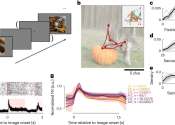
Glaucoma drug can cause droopy eyelids
Prostaglandin analogues (PGAs), drugs which lower intraocular pressure, are often the first line of treatment for people with glaucoma, but their use is not without risks. PGAs have long been associated with blurred vision, ...
Ophthalmology
16 hours ago |
not rated yet |
0
Early screenings key to diagnosing glaucoma
New research is emphasizing the importance of regular screenings for glaucoma, a disease that deteriorates the optic nerve over time and is a leading cause of irreversible blindness worldwide. The onset of glaucoma is associated ...
Ophthalmology
May 17, 2013 |
not rated yet |
0
|
Brain, not eye mechanisms keep color vision constant across lifespan
Cone receptors in the human eye lose their color sensitivity with age, but our subjective experience of color remains largely unchanged over the years. This ability to compensate for age-related changes in color perception ...
Cardiology
May 08, 2013 |
5 / 5 (1) |
0
Study provides clarity on supplements for protection against blinding eye disease
Adding omega-3 fatty acids did not improve a combination of nutritional supplements commonly recommended for treating age-related macular degeneration (AMD), a major cause of vision loss among older Americans, ...
Ophthalmology
May 06, 2013 |
3 / 5 (2) |
0
|
Wide-eyed fear expressions may help us—and others—to locate threats
Wide-eyed expressions that typically signal fear may enlarge our visual field and mutually enhance others' ability to locate threats, according to new research published in Psychological Science, a journal of the Association for Ps ...
Psychology & Psychiatry
May 01, 2013 |
not rated yet |
0
|
Contacts uncomfortable? Changing lens type or lens care product may help
If your contact lenses are causing you discomfort, simply switching to a different type of contact lens or lens care product may bring improvement, reports a study, " Effect of Lens and Solution Choice on the Comfort of Contact ...
Ophthalmology
May 01, 2013 |
not rated yet |
0
VCU Medical Center first in Virginia to implant telescope for macular degeneration
Physicians at the Virginia Commonwealth University Medical Center have become the first in Virginia to successfully implant a telescope in a patient's eye to treat macular degeneration.
Ophthalmology
Apr 15, 2013 |
not rated yet |
0
Despite what you may think, your brain is a mathematical genius
The irony of getting away to a remote place is you usually have to fight traffic to get there. After hours of dodging dangerous drivers, you finally arrive at that quiet mountain retreat, stare at the gentle ...
Neuroscience
Apr 11, 2013 |
4.5 / 5 (10) |
2
|
Are people really staring at you?
(Medical Xpress)—People often think that other people are staring at them even when they aren't research led by the University of Sydney has found.
Psychology & Psychiatry
Apr 09, 2013 |
4.8 / 5 (6) |
1
|
Blindness more than a pain in the neck
(Medical Xpress)—Surveys regularly reveal that, when asked about their greatest fear, people nominate blindness as one of the two things they dread most (cancer being the other).
Health
Apr 05, 2013 |
not rated yet |
0
Ophthalmologists urge early diagnosis and treatment of age-related macular degeneration
Age-related macular degeneration (AMD) continues to be the leading cause of visual impairment in the United States for people over age 65, according to a study recently published online in Ophthalmology, the journal of the ...
Ophthalmology
Apr 03, 2013 |
not rated yet |
0
New view of origins of eye diseases
Using new technology and new approaches, researchers at Lund University in Sweden hope to be able to explain why people suffer vision loss in eye diseases such as retinal detachment and glaucoma.
Ophthalmology
Apr 03, 2013 |
5 / 5 (1) |
0
Cholesterol-lowering eye drops could treat macular degeneration
A new study raises the intriguing possibility that drugs prescribed to lower cholesterol may be effective against macular degeneration, a blinding eye disease.
Medical research
Apr 02, 2013 |
5 / 5 (4) |
0
|
New technique shows promise in restoring near vision without glasses
By middle age, most people have age-related declines in near vision (presbyopia) requiring bifocals or reading glasses. An emerging technique called hyperopic orthokeratology (OK) may provide a new alternative for restoring ...
Ophthalmology
Apr 01, 2013 |
5 / 5 (2) |
0
US approves new multiple sclerosis capsules
The U.S. Food and Drug Administration said Wednesday it approved a new drug from Biogen Idec to control multiple sclerosis in adults with hard-to-treat forms of the disease.
Medications
Mar 27, 2013 |
not rated yet |
0