Bioengineering students' invention may help diagnose painful eye condition
April 25, 2011 in Medical research
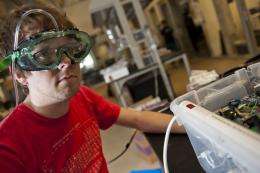
Rice University senior Austin Edwards wears the modified, sensor-laden laboratory goggles designed by a Rice student engineering team as part of a device for the diagnosis of dry eye. (Credit Jeff Fitlow/Rice University)
Rice University bioengineering students responded to an ophthalmologist's cry for help with a device to diagnose dry eye, the itching and burning sensation that results when a person doesn't produce enough tears or the tears evaporate too quickly.
A team of five seniors made a portable unit that controls the air around a patient's eyes so doctors can study and treat those who suffer from this painful condition.
Stephen Pflugfelder, the James and Margaret Elkins Chair and professor of ophthalmology at Baylor College of Medicine's Cullen Eye Institute, approached Rice to invent a device to help clinicians standardize a testing regime for dry eye.
This video is not supported by your browser at this time.
A team of five Rice University seniors made a portable unit that controls the air around a patient's eyes so doctors can study and treat those who suffer from painful dry eye conditions. Credit: Mike Williams/Rice University
"He wanted a way to control temperature, humidity and air flow all around the eyes and record it over time so he could track changes in their dryness," said Daniel Hays, a member of Team ClimaTears, the student group that included Austin Edwards, Amanda Shih, Anastasia Alex and Michelle Kerkstra.The students' solution incorporates a modified and padded set of laboratory goggles with embedded data sensors that monitor temperature, relative humidity, air flow and blink rate over an hour and a half. A cable carries data saved every 10 seconds to a small box that includes controls and conditioning equipment. A separate hose carries air to the goggles.
The goggles keep the humidity of air around the eyes between 40 and 15 percent -- "about as low as we can go without hurting patients," Alex said.
"We're exacerbating the symptoms so doctors can see them," Hays explained.
Normal patients will produce tears, he said, but those who suffer dry eye will exhibit symptoms, which will give clues about how to treat them. Follow-up sessions with the goggles will let doctors see how well the treatment is working.
"With this, we're putting the power in the hands of clinicians, which is very appealing to them," Shih said.
"We did a lot of research on the ocular test they currently perform to help us analyze the data we collected," Alex said. "We know there's still a lot to be done."
"We hope our device will create a gold standard for diagnosis," Kerkstra said.
The team and Pflugfelder spent two weeks this spring testing patients at the Alkek Eye Center in Houston and will continue this summer. The students hope the larger trial will lead to an academic paper -- a fine reward for spending nearly 2,000 hours developing the goggles over the course of their final year at Rice.
Their work has already paid dividends. The students won the grand prize, $1,500, in the second annual Rice Alliance-George R. Brown School of Engineering Senior Design Elevator Pitch Competition last November, and more recently $500 for the Best Health-Related Engineering Design Project at the School of Engineering Design Showcase held April 14.
The team's faculty advisers were Renata Ramos, a Rice lecturer in bioengineering, and Maria Oden, professor in the practice of engineering education and director of Rice's Oshman Engineering Design Kitchen, where the goggles were developed.
Provided by
Rice University
-
Grin and bear it: Dentists to test Rice University students' portable suction device
May 24, 2010 |
not rated yet |
0
-
Baby Bubbler a breath of fresh air (w/ Video)
Jun 07, 2010 |
not rated yet |
0
-
Smart goggles track swimmers' laps, time
Jun 28, 2005 |
not rated yet |
0
-
Revolution with a salad spinner (w/ Video)
May 03, 2010 |
not rated yet |
0
-
Compact microscope a marvel
Aug 04, 2010 |
not rated yet |
0
-
Motion perception revisited: High Phi effect challenges established motion perception assumptions
Apr 23, 2013 |
3 / 5 (2) |
2
-
Anything you can do I can do better: Neuromolecular foundations of the superiority illusion (Update)
Apr 02, 2013 |
4.5 / 5 (11) |
5
-
The visual system as economist: Neural resource allocation in visual adaptation
Mar 30, 2013 |
5 / 5 (2) |
9
-
Separate lives: Neuronal and organismal lifespans decoupled
Mar 27, 2013 |
4.9 / 5 (8) |
0
-
Sizing things up: The evolutionary neurobiology of scale invariance
Feb 28, 2013 |
4.8 / 5 (10) |
14
-
Why is zone 1 in liver more prone to ischemic injury?
May 23, 2013
-
How can there be villous adenoma in colon, if there are no villi there
May 22, 2013
-
How can there be a term called "intestinal metaplasia" of stomach
May 21, 2013
-
Pressure-volume curve: Elastic Recoil Pressure don't make sense
May 18, 2013
-
If you became brain-dead, would you want them to pull the plug?
May 17, 2013
-
MRI bill question
May 15, 2013
- More from Physics Forums - Medical Sciences
More news stories
Study reveals new mechanism for estrogen suppression of liver lipid synthesis
By discovering the new mechanism by which estrogen suppresses lipid synthesis in the liver, UC Irvine endocrinologists have revealed a potential new approach toward treating certain liver diseases.
Medical research
May 23, 2013 |
not rated yet |
0
|
MRI-based measurement helps predict vascular disease in the brain
Aortic arch pulse wave velocity, a measure of arterial stiffness, is a strong independent predictor of disease of the vessels that supply blood to the brain, according to a new study published in the June issue the journal ...
Medical research
May 23, 2013 |
not rated yet |
0
Antibiotics: A new understanding of sulfonamide nervous system side effects
Since the discovery of Prontosil in 1932, sulfonamide antibiotics have been used to combat a wide spectrum of bacterial infections, from acne to chlamydia and pneumonia. However, their side effects can include serious neurological ...
Medical research
May 23, 2013 |
not rated yet |
0
|
Scientists discover molecule triggers sensation of itch
Scientists at the National Institutes of Health report they have discovered in mouse studies that a small molecule released in the spinal cord triggers a process that is later experienced in the brain as ...
Medical research
May 23, 2013 |
5 / 5 (3) |
0
|
Discarded immune cells induce the relocation of stem cells
Spanish researchers have discovered that the daily clearance of neutrophils from the body stimulates the release of hematopoietic stem cells from the bone marrow into the bloodstream, according to a report published today ...
Medical research
May 23, 2013 |
5 / 5 (2) |
0
Engineered cytomegalovirus protects monkeys from HIV equivalent
(Medical Xpress)—A new study by researchers in the US has shown that an ancient virus can be modified to help in the fight against the simian immunodeficiency virus SIV, which is the equivalent in monkeys ...
Hormone levels may provide key to understanding psychological disorders in women
Women at a particular stage in their monthly menstrual cycle may be more vulnerable to some of the psychological side-effects associated with stressful experiences, according to a study from UCL.
Going live: Immune cell activation in multiple sclerosis
Biological processes are generally based on events at the molecular and cellular level. To understand what happens in the course of infections, diseases or normal bodily functions, scientists would need to ...
Researchers identify first drug targets in childhood genetic tumor disorder
Two mutations central to the development of infantile myofibromatosis (IM)—a disorder characterized by multiple tumors involving the skin, bone, and soft tissue—may provide new therapeutic targets, according to researchers ...
Driving and hands-free talking lead to spike in errors, study shows
Talking on a hands-free device while behind the wheel can lead to a sharp increase in errors that could imperil other drivers on the road, according to new research from the University of Alberta.
Depression raises diabetics' risk of severe low blood sugar episodes
(Medical Xpress)—Patients with diabetes who are depressed are much more likely to develop episodes of dangerously low blood sugars, or hypoglycemia, than are those who are not depressed, a new study has ...