DARPA takes new look at electrical brain stimulation to aid in learning
April 21, 2011 by Bob Yirka in Neuroscience report
DARPA takes new look at electrical brain stimulation to aid in learning

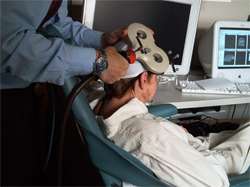
Image credit: Tmslab

(PhysOrg.com) -- New research going on in Albequerque, NM by a team of neuroscientists working for the Defense Advanced Research Projects Agency (DARPA) indicates that mild brain stimulation with electrical shocks, might in fact cause people to learn more easily.

The team, led by Vincent Clark, of the University of New Mexico, has been applying electrodes to the scalps of volunteers, and then giving them very mild electrical shocks while they play a battle simulation video game designed to teach soldiers to react properly in stressful conditions. Called transcranial direct-current stimulation (tDCS), the procedure employs a nine volt battery and connected to wet sponges affixed to the temples of to send just a few milliamps of current through the skull and into the as they attempt to differentiate between friend and foe in dilapidated, potentially dangerous environmental conditions.

Two groups were tested, one received 2 milliamps while they played, the other just 0.1. The volunteers receiving the larger amount showed twice as much improvement as those that did not, which Clark says shows quite clearly how effective tDCS can be.

This video is not supported by your browser at this time.

Pilot video for tDCS informed consent.

Applying electricity to the brain has a long and at times dark history. Doctors, psychiatrists and other researchers have known for hundreds of years that applying electrical current to the brain can cause changes; some good, some not so much. Electrical stimulation has been used to keep executed prisoners from twitching after death, to “help” patients overcome depression and more recently to help people with injuries or brain impairments to regain functionality. This history now colors any new research as fear and skepticism tend to get in the way of serious work. This is likely the reason that this new research is being done by DARPA, rather than an independent organization; it doesn’t have to answer to anyone except the DoD.

Because the amount of current is so small, volunteers report no pain, just a slight tingling sensation during the procedure, and afterwards can offer no real explanations as to why they performed better than they might have otherwise.

This research, and other studies like it, have set off both alarms and intrigue in certain quarters. Some worry people, such as college students will jump on the procedure as a means to help cram for exams, others wonder if electronic devices such as blue-tooth phones are emitting electricity that might help them learn; while others yet point out, very soberly, that no one really knows just yet what long-term effects people might have from exposure to something as simple as tCDS.

More information: http://tmslab.org/

© 2010 PhysOrg.com

4 /5 (3 votes)  

Filter


Move the slider to adjust rank threshold, so that you can hide some of the comments.


Display comments: newest first

chthonic
Apr 21, 2011

Rank: 1 / 5 (1)
Paragraph three ought to be deleted--it adds no relevant information and sophomorically and irresponsibly imputes a sadistic intent to doctors who deliver electroconvulsive therapy. Does the author not realize that people actually die by the thousands because of mood disorders? Certainly he denies knowledge that electroconvulsive therapy is a safe and dramatically effective treatment for those illnesses. I have personally treated patients with ECT who spontaneously volunteered that it was a life-saver. But the dread with which you infuse paragraph three tries to frame ECT as a Frankenstein-redolent torture. Mr. Yirka, your writing promulgates the very fear you say gets in the way of "serious work". Fail--go back to journalism school.
Skultch
Apr 21, 2011

Rank: 5 / 5 (1)
Nothing in paragraph three is untrue. I see no such denials that you claim. It adds some relevant history to the story. It sure seems you are reading more into what was actually in the text. Perhaps you'd rather these facts be forgotten so you don't have to deal with the stigma of what you do. ????

Before you claim my ignorance, know that my brother has paranoid schizophrenia and has had ECT treatment. I am in no way against it, I'm just confused as to why you are so defensive about what you do.
210
Apr 21, 2011

Rank: 3 / 5 (2)
Paragraph three ought to be deleted--it adds no relevant information and sophomorically and irresponsibly imputes a sadistic intent to doctors who deliver electroconvulsive therapy. Does the author not realize that people actually die by the thousands because of mood disorders? Certainly he denies knowledge that electroconvulsive therapy is a safe and dramatically effective treatment for those illnesses. I have personally treated patients with ECT who spontaneously volunteered that it was a life-saver. But the dread with which you infuse paragraph three tries to frame .

Paragraph three is essentially and entirely inoffensive and well stated.
Perhaps, you needed to vent, and after a stressful day and a long night with your 'patients' you saw a bit more in paragraph three than anyone else.
Get some sleep...!
Reread the article after Easter...that is, take the long weekend off, and read this again, say, Monday and let us hear from you on the rebound, please.
word-to-ya-muthas
cogsci
Apr 25, 2011

Rank: not rated yet
I have to agree with chthonic. The information isn't necessarily incorrect, but it puts forth a tone that is very negative. Quotes around the word help suggest a sarcastic tone even though ECT can be an extremely effective treatment for depression. Also, the last sentence is just wrong. First of all, DARPA is a funding body. The research is done at a university. The researchers will be subject to all ethical standards put in place by DARPA (yes they have them), the university, and any journals the researchers wish to publish in. Also, most research is funded by NIH or NSF, "independent organizations". There is no reason to believe that this same research couldn't be funded by non DoD sources.
vcabq
Apr 27, 2011

Rank: 5 / 5 (1)
This story is based on our research. I wanted to clear up one major misunderstanding in this article. The work was in fact performed at our University, with full approval and oversight by the University's IRB. As Cogsci says, it was not performed by the DOD, they just provided the funding.

Mr. Yirka based this on a Nature article that came out recently. However, the full story can be found in our publication:
doi:10.1016/j.neuroimage.2010.11.036

In general, brain stimulation looks like it may be an effective tool to enhance learning, reduce pain, increase performance, and so on. Its also safer than drugs that achieve the same results, since its action far more localized and doesn't need to be broken down by the liver or excreted. Like any effective tool, it can be used for good and for harm. Its up to us as a society to say what is appropriate and what is not, and to enforce that. But, if we can help people with memory problems, or reduce pain, we need to consider this seriously
Rank 4 /5 (3 votes)
Related Stories
Relevant PhysicsForums posts
  • A couple of questions about schizophrenia
    createdMay 17, 2012
  • Paralyzed woman uses thoughts to move robotic arm
    createdMay 17, 2012
  • Coffee Decreases Risk of Death
    createdMay 17, 2012
  • Understanding the mechanisms of disease .
    createdMay 14, 2012
  • Short burst of hypersensitivity disorder?
    createdMay 13, 2012
  • Copper aspirinate
    createdMay 12, 2012
  • More from Physics Forums - Medical Sciences

More news stories

Research holds out hope for stroke patients

(Medical Xpress) -- People with a curious condition that causes them to apply make-up on only one side of their face, or ignore food on half of their plate, are playing a new role in understanding stroke recovery.

Neuroscience created 49 minutes ago | popularity 5 / 5 (1) | comments 0 | with audio podcast

Songbirds' learning hub in brain offers insight into motor control

To learn its signature melody, the male songbird uses a trial-and-error process to mimic the song of its father, singing the tune over and over again, hundreds of times a day, making subtle changes in the pitch of the notes. ...

Neuroscience created 18 hours ago | popularity 5 / 5 (4) | comments 0 | with audio podcast

Acid in the brain: Team develops new way to look at brain function

University of Iowa neuroscientist John Wemmie, M.D., Ph.D., is interested in the effect of acid in the brain. His studies suggest that increased acidity or low pH, in the brain is linked to panic disorders, ...

Neuroscience created May 18, 2012 | popularity 5 / 5 (6) | comments 0 | with audio podcast

With fat: What's good or bad for the heart, may be the same for the brain

It has been known for years that eating too many foods containing "bad" fats, such as saturated fats or trans fats, isn't healthy for your heart. However, according to new research from Brigham and Women's Hospital (BWH), ...

Neuroscience created May 18, 2012 | popularity 5 / 5 (3) | comments 2 | with audio podcast

Various metabolic risk factors could be linked to diabetes-related pain with major implications for treatment

Around 1 in 50 people in the general population and 1 in 6 of those aged over 40 years experience neuropathy (damage to the nerves of the peripheral nervous system), which can cause numbness, tingling, pain, or weakness. ...

Neuroscience created May 17, 2012 | popularity not rated yet | comments 0


Building a drug delivery platform to regenerate heart tissue

(Medical Xpress) -- While current heart-attack treatments mainly try to preserve healthy heart tissue, scientists have been finding compounds that can stimulate growth of new tissue – either by getting heart muscle ...

Woman with flesh-eating disease takes own breaths

(AP) -- The father of a young Georgia woman fighting a flesh-eating bacteria says his daughter is now breathing on her own.

Inadequate pain meds in ER for patients with long-bone fractures

(HealthDay) -- The majority of patients with long-bone fractures receive inadequate pain medication in the emergency department, and disparities in management exist, according to a study published in the May ...

Folic acid may reduce some childhood cancers

Folic acid fortification of foods may reduce the incidence of the most common type of kidney cancer and a type of brain tumors in children, finds a new study by Kimberly J. Johnson, PhD, assistant professor at the Brown School ...

Blocking DNA: HDAC inhibitor targets triple negative breast cancer

The histone de-acetylase (HDAC) inhibitor panobinostat is able to target and destroy triple negative breast cancer, reveals a new study published in BioMed Central's open access journal Breast Cancer Research. Researchers from T ...

Increase in physical activity in men optimizes peak bone mass

(HealthDay) -- For young men, increasing physical activity over a five-year period is associated with improvements in bone mineral content (BMC) and bone mineral density (BMD), according to a study published ...