Researchers pinpoint brain region that influences gambling decisions
May 5, 2011 by Katie Neith in Neuroscience
(Medical Xpress) -- When a group of gamblers gather around a roulette table, individual players are likely to have different reasons for betting on certain numbers. Some may play a "lucky" number that has given them positive results in the pasta strategy called reinforcement learning. Others may check out the recent history of winning colors or numbers to try and decipher a pattern. Betting on the belief that a certain outcome is "due" based on past events is called the gambler's fallacy.
Recently, researchers at the California Institute of Technology (Caltech) and Ireland's Trinity College Dublin hedged their betsand came out winnerswhen they proposed that a certain region of the brain drives these different types of decision-making behaviors.
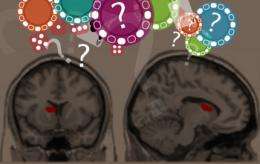
"Through our study, we found a difference in activity in a region of the brain called the dorsal striatum depending on whether people were choosing according to reinforcement learning or the gambler's fallacy," says John O'Doherty, professor of psychology at Caltech and adjunct professor of psychology at Trinity College Dublin. "This finding suggests that the dorsal striatum is particularly involved in driving reinforcement-learning behaviors."
In addition, the work, described in the April 27 issue of The Journal of Neuroscience, suggests that people who choose based on the gambler's fallacy may be doing so because at the time of the choice they are not taking into account what they had previously learned or observed.
The focus of O'Doherty's research is to understand the brain mechanisms that underlie the decisions people make in the real world. To study this kind of decision making in the lab, his team gets study participants to play simple games in which they make choices that result in winning or losing small amounts of money. To make these games interesting, the researchers often present simple "gambling" scenarios, such as playing slot machines or roulette.
"For this particular study, we were interested in what part of the brain might play a role in controlling these strategies that drive behavior," says O'Doherty, who conducted the study along with postdoctoral scholar Ryan Jessup.
The team asked 31 participants to complete four roulette-wheel tasks while lying in an MRI scanner. For each round, the volunteers were asked to choose a color on a tricolored spinning wheel. If the wheel stopped on their color, they won two euros. (The study was done at Trinity College Dublin.) For each round, participants were charged a half euro, regardless of the outcome. All the while, the researchers studied the brain activity of participants, with a focus on how they appeared to choose colors.
"The dorsal striatum was more active in people who, at the time of choice, chose in accordance with reinforcement-learning principles compared to when they chose according to the gambler's fallacy," says Jessup. "This suggests that the same region involved in learning is also used at the time of choice."
The two types of strategies are actually contradictory because in reinforcement-learning behavior, one would be more likely to choose something if it has won a lot recently, and less likely to choose something if it has lost a lot recently. The opposite is true of the gambler's fallacy.
"The task was novel because making decisions based on either reinforcement learning or the gambler's fallacy is not rational in this particular task, and yet most of the subjects acted irrationally," explains Jessup. "Only 8 out of 31 subjects were generally rational, meaning they simply chose the color that covered the largest area in that round."
"It is very important to try to understand how interactions between different brain areas result in different types of decision-making behavior," says O'Doherty. "Once we understand the basic mechanisms in healthy people, we can start to look at how these systems go wrong in patients who suffer from different diseases, such as psychiatric disorders or addiction, that impact their decision-making capabilities."
The study, "Human Dorsal Striatal Activity during Choice Discriminates Reinforcement Learning Behavior from the Gambler's Fallacy," was supported by a Science Foundation Ireland grant.
Provided by
California Institute of Technology
-
Learning strategies are associated with distinct neural signatures
May 26, 2010 |
not rated yet |
0
-
Researchers find similarities in brain activity for both habits and goals
Mar 23, 2011 |
not rated yet |
0
-
Decisions, decisions: Feedback influences decision making
Nov 12, 2008 |
not rated yet |
0
-
Brain mechanisms of social conformity
Jan 14, 2009 |
not rated yet |
0
-
People Use Separate Brain Mechanisms to Make Ambiguous and Risky Choices
Mar 02, 2006 |
not rated yet |
0
-
Motion perception revisited: High Phi effect challenges established motion perception assumptions
Apr 23, 2013 |
3 / 5 (2) |
2
-
Anything you can do I can do better: Neuromolecular foundations of the superiority illusion (Update)
Apr 02, 2013 |
4.5 / 5 (11) |
5
-
The visual system as economist: Neural resource allocation in visual adaptation
Mar 30, 2013 |
5 / 5 (2) |
9
-
Separate lives: Neuronal and organismal lifespans decoupled
Mar 27, 2013 |
4.9 / 5 (8) |
0
-
Sizing things up: The evolutionary neurobiology of scale invariance
Feb 28, 2013 |
4.8 / 5 (10) |
14
-
Pressure-volume curve: Elastic Recoil Pressure don't make sense
May 18, 2013
-
If you became brain-dead, would you want them to pull the plug?
May 17, 2013
-
MRI bill question
May 15, 2013
-
Ratio of Hydrogen of Oxygen in Dessicated Animal Protein
May 13, 2013
-
Alcohol and acetaminophen
May 13, 2013
-
Marie Curie's leukemia
May 13, 2013
- More from Physics Forums - Medical Sciences
More news stories
For combat veterans suffering from post-traumatic stress disorder, 'fear circuitry' in the brain never rests
Chronic trauma can inflict lasting damage to brain regions associated with fear and anxiety. Previous imaging studies of people with post-traumatic stress disorder, or PTSD, have shown that these brain regions can over-or ...
Neuroscience
May 18, 2013 |
5 / 5 (1) |
0
|
Temporal processing in the olfactory system
The neural machinery underlying our olfactory sense continues to be an enigma for neuroscience. A recent review in Neuron seeks to expand traditional ideas about how neurons in the olfactory bulb might encode information about ...
Neuroscience
May 17, 2013 |
4 / 5 (1) |
0
|
Melon focus headband turns to Kickstarter for rollout plans
(Medical Xpress)—What if the quality of your work depends more on your focus on the piano keys or canvas or laptop than your musical or painting or computing skills? If target users can be convinced, they ...
Neuroscience
May 17, 2013 |
3.7 / 5 (3) |
0
|
Deep brain stimulation: A fix when the drugs don't work
Neurological disorders can have a devastating impact on the lives of sufferers and their families.
Neuroscience
May 17, 2013 |
5 / 5 (1) |
0
|
Brain makes call on which ear is used for cell phone
If you're a left-brain thinker, chances are you use your right hand to hold your cell phone up to your right ear, according to a newly published study from Henry Ford Hospital in Detroit.
Neuroscience
May 16, 2013 |
2 / 5 (2) |
0
|
Researchers identify a potential new risk for sleep apnea: Asthma
Researchers at the University of Wisconsin have identified a potential new risk factor for obstructive sleep apnea: asthma. Using data from the National Institutes of Health (Heart, Lung, and Blood Institute)-funded Wisconsin ...
Study finds that sleep apnea and Alzheimer's are linked
A new study looking at sleep-disordered breathing (SDB) and markers for Alzheimer's disease (AD) risk in cerebrospinal fluid (CSF) and neuroimaging adds to the growing body of research linking the two.
Computational tool translates complex data into simplified 2-dimensional images
In their quest to learn more about the variability of cells between and within tissues, biomedical scientists have devised tools capable of simultaneously measuring dozens of characteristics of individual ...
New theory on genesis of osteoarthritis comes with successful therapy in mice
Scientists at Johns Hopkins have turned their view of osteoarthritis (OA) inside out. Literally. Instead of seeing the painful degenerative disease as a problem primarily of the cartilage that cushions joints, ...
'Gap' for HIV vaccine efforts after latest setback
The hunt for an HIV vaccine has gobbled up $8 billion in the past decade, and the failure of the most recent efficacy trial has delivered yet another setback to 26 years of efforts.
Ginger compounds may be effective in treating asthma symptoms
Gourmands and foodies everywhere have long recognized ginger as a great way to add a little peppery zing to both sweet and savory dishes; now, a study from researchers at Columbia University shows purified components of the ...