Research breakthrough on male infertility
May 13, 2011 in Medical research
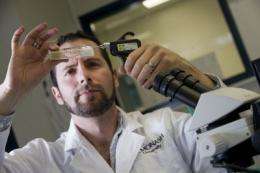
ARC Australian Research Fellow Monash Fellow, Dr Damian Dowling
(Medical Xpress) -- Around one in 20 men is infertile, but despite the best efforts of scientists, in many cases the underlying causes of infertility have remained a mystery. New findings by a team of Australian and Swedish researchers, however, will go a long way towards explaining this mystery.
According to their research published in Science today, a small set of genes located within the power-plants of our cells the mitochondria are crucial to unravelling the secrets of male infertility.
Most of our genes are subjected to a rigorous quality-control process that prevents harmful mutations from freely accumulating within the gene pools of most species. If nasty mutations appear, then the individuals that harbor these mutations tend to do very poorly when it comes to reproducing and surviving, and hence these mutations are kept at low levels within the general population.
But while this vital screening process works well for most of our genes, it is prone to breaking down in the set of genes housed inside of the mitochondria.
Lead researcher, Dr Damian Dowling explains that mitochondrial genes are unusual because they are passed only from mother to child.
"This seemingly trivial fact actually has an enormous consequence for males. It means that mutations in the mitochondria can slip through the quality-control checks unnoticed and therefore build up to high levels, if these mutations are harmful in their effects on males but not on females. This is because all of the screening of mitochondrial mutations is done in females as a result of their maternal inheritance," Dr Dowling said.
Dr Dowling and research colleagues Paolo Innocenti and Ted Morrow of Uppsala University, Sweden, have presented compelling evidence for this process in action in the common fruit fly.
Their studies show that the particular set of mitochondrial genes an individual harbours has major effects on the expression of about 10 per cent of all the other genes inside of males, but virtually no effect on females.
Crucially, the genes that are most affected in males are expressed almost exclusively in the male reproductive organs and associated with male fertility.
"What our results suggest is that the mitochondria have inadvertently evolved to be bad for males, but good for females, as a by-product of their maternal transmission. This might well put the sexes in conflict when it comes to the question of which mitochondrial genes should be passed on to future generations," Dr Dowling said.
"While medical practitioners have a fairly good idea that certain mitochondrial mutations can bring about male infertility, the evolutionary process that we uncover actually suggests that the mitochondria might well harbor very many unidentified mutations, all of which could contribute to the problem of male infertility.
"At the very least, our results should therefore provide a road-map of where we should be looking for these mutations."
Provided by
Monash University
-
Research breakthrough on the question of life expectancy
Aug 05, 2010 |
not rated yet |
0
-
New insight into Parkinson's disease
Apr 19, 2010 |
not rated yet |
0
-
Researchers uncover new role for mitochondria during RNA processing
Mar 16, 2011 |
not rated yet |
0
-
The sexual tug-of-war -- a genomic view
Mar 15, 2010 |
not rated yet |
0
-
Genetic alteration linked with human male infertility
Sep 30, 2010 |
not rated yet |
0
-
Limits to growth: Scientists identify key metastasis-enabling enzyme
20 hours ago |
5 / 5 (3) |
0
-
Seeing is as seeing does: Spatially-structured retinal input in early development of cortical maps
Apr 26, 2012 |
5 / 5 (4) |
1
-
Dreamless nights: Brain activity during nonrapid eye movement sleep
Apr 09, 2012 |
4.4 / 5 (12) |
0
-
Take your time: Neurobiology sheds light on the superiority of spaced vs. massed learning
Mar 28, 2012 |
4.5 / 5 (21) |
3
-
Your brain on 'shrooms: fMRI elucidates neural correlates of psilocybin psychedelic state
Feb 29, 2012 |
4.9 / 5 (42) |
45
-
Poor nutrition leading to overeating?
4 hours ago
-
Math and dyslexia?
May 21, 2012
-
portable metabolism meter?
May 21, 2012
-
Rare medical conditions on 20/20 tonight
May 18, 2012
-
"Good" Cholesterol in Doubt
May 17, 2012
-
A couple of questions about schizophrenia
May 17, 2012
- More from Physics Forums - Medical Sciences
More news stories
Array of light for early disease detection?
A special feature in this week's issue of the journal Science highlights protein array technology, touching on research conducted by Joshua LaBaer, director of the Biodesign Institute's Virginia G. Piper ...
Medical research
11 hours ago |
not rated yet |
0
|
Researchers spearhead groundbreaking research into treatment of brain swelling
Researchers at Trinity College Dublin have reported the results of groundbreaking research into the prevention of cerebral oedema or swelling of the brain, a major cause of death in people who have sustained a traumatic injury ...
Medical research
16 hours ago |
not rated yet |
0
|
FDA clears test for mastocytosis diagnosis
The Food and Drug Administration has approved a new test to help physicians diagnose a group of rare cell disorders. The test, or assay, was developed by an expert at Virginia Commonwealth University in the field of mast ...
Medical research
16 hours ago |
not rated yet |
0
Novel biomarkers reveal evidence of radiation exposure
Researchers at the Medical College of Wisconsin have identified novel biomarkers that could be used to confirm exposure to damaging radiation in large groups of people potentially exposed to unknown and variable doses for ...
Medical research
16 hours ago |
not rated yet |
0
Stem cell research paves way for progress on dealing with Fragile X retardation
Researchers at the Hebrew University of Jerusalem have achieved, for the first time, the generation of neuronal cells from stem cells of Fragile X patients. The discovery paves the way for research that will examine restoration ...
Medical research
18 hours ago |
not rated yet |
0
Scientists start explaining Fat Bastard's vicious cycle
Fat Bastard's revelation "I eat because I'm depressed and I'm depressed because I eat" in the Austin Powers film series may be explained by sophisticated neuroscience research being undertaken by scientists affiliated with ...
Socioeconomics may affect toddlers' exposure to flame retardants
A Duke University-led study of North Carolina toddlers suggests that exposure to potentially toxic flame-retardant chemicals may be higher in nonwhite toddlers than in white toddlers.
Breast MRI helps predict chemotherapy's effectiveness
Magnetic resonance imaging (MRI) provides an indication of a breast tumor's response to pre-surgical chemotherapy significantly earlier than possible through clinical examination, according to a new study published online ...
Kids suffer long-term from parents' smoking: study
Children exposed to their parents' cigarette smoke are at greater risk of suffering serious cardiovascular health problems later in life, a study showed Wednesday.
Hair loss pathology identified in pityriasis versicolor lesions
(HealthDay) -- Patients with pityriasis versicolor (PV) lesions may experience hair thinning and/or loss within the lesion, according to a study published online May 10 in the Journal of the American Academy of ...
New study confirms value of cardiac output monitor
(Medical Xpress) -- A new Australian study has confirmed the accuracy of a modern non-invasive cardiac output monitor that can replace a 40-year-old standard in this field.