Innate immune system proteins attack bacteria by triggering bacterial suicide mechanisms
May 23, 2011 in Medical research
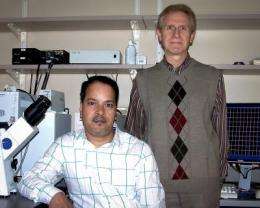
Des Raj Kashyap, Ph.D., (left) and Roman Dziarski, Ph.D., at the Indiana University School of Medicine - Northwest, report in Nature Medicine the mechanism employed by Peptidoglycan Recognition Proteins (PGRPs) to detect and destroy invading bacteria. Credit: Indiana University School of Medicine
A group of proteins that act as the body's built-in line of defense against invading bacteria use a molecular trick to induce bacteria to destroy themselves, researchers at the Indiana University School of Medicine have determined. The research could point the way toward new anti-bacterial treatments that could take on bacteria that are resistant to antibiotics.
The proteins, called Peptidoglycan Recognition Proteins (PGRPs), are able to detect and target bacteria because bacteria are unique in having peptidoglycan polymers in their cellular walls. However, the mechanism by which PGRPs are able to kill bacteria had not been determined.
A research team led by Roman Dziarski, Ph.D., professor of microbiology and immunology at Indiana University School of Medicine Northwest, reported May 22 in the advance online edition of the journal Nature Medicine that the PGRPs are able to induce a suicide response in the targeted bacteria.
The PGRPs accomplish the mission by binding to specific sites in bacterial cell walls in ways that exploit a bacterial defense mechanism known as protein-sensing two-component systems. These systems, which normally enable the bacteria to detect and eject malformed proteins, interpret the PGRPs as just such malformed proteins. Unable to dislodge the PGRPs, the bacteria then activate a suicide response, the researchers said.
This approach is different than those employed by other anti-bacterial mechanisms, such as the immune system's white blood cells, said Dziarski.
"This could be a target to develop new anti-bacterial applications," Dziarski said.
Dziarski and colleague Dipika Gupta, Ph.D., associate professor of biochemistry and molecular biology at Indiana University School of Medicine Northwest, first cloned the PGRP genes in 2001. The PGRP genes, which are found in species ranging from insects to mammals, are part of the body's innate immune system, in contrast to the mechanisms that learn and develop new immune responses to infections over time.
The PGRP proteins are normally expressed in phagocytic cells in blood and on body surface areas such as skin, mouth, intestine and other tissues that have direct or indirect contact with the external world, Dziarski noted. In some tissues it appears that the PGRPs help maintain a healthy relationship between the body and certain beneficial bacteria. Some studies have indicated that the loss of the PGRP proteins may lead to inflammatory bowel disease, suggesting that the research reported Monday could point the way to new approaches to target such problems, Dziarski said.
Provided by Indiana University School of Medicine
-
Going from ulcers to cancer
Aug 22, 2008 |
not rated yet |
0
-
How plague-causing bacteria disarm host defense
May 24, 2007 |
not rated yet |
0
-
Bacteria use 'toxic darts' to disable each other, scientists say
Nov 18, 2010 |
not rated yet |
0
-
Flu jab for bacteria
Mar 31, 2010 |
not rated yet |
0
-
Combatting antibiotic resistant bacteria
Jan 31, 2011 |
not rated yet |
0
-
Motion perception revisited: High Phi effect challenges established motion perception assumptions
Apr 23, 2013 |
3 / 5 (2) |
2
-
Anything you can do I can do better: Neuromolecular foundations of the superiority illusion (Update)
Apr 02, 2013 |
4.5 / 5 (11) |
5
-
The visual system as economist: Neural resource allocation in visual adaptation
Mar 30, 2013 |
5 / 5 (2) |
9
-
Separate lives: Neuronal and organismal lifespans decoupled
Mar 27, 2013 |
4.9 / 5 (8) |
0
-
Sizing things up: The evolutionary neurobiology of scale invariance
Feb 28, 2013 |
4.8 / 5 (10) |
14
-
How can there be a term called "intestinal metaplasia" of stomach
5 hours ago
-
Pressure-volume curve: Elastic Recoil Pressure don't make sense
May 18, 2013
-
If you became brain-dead, would you want them to pull the plug?
May 17, 2013
-
MRI bill question
May 15, 2013
-
Ratio of Hydrogen of Oxygen in Dessicated Animal Protein
May 13, 2013
-
Alcohol and acetaminophen
May 13, 2013
- More from Physics Forums - Medical Sciences
More news stories
Finding a family for a pair of orphan receptors in the brain
Researchers at Emory University have identified a protein that stimulates a pair of "orphan receptors" found in the brain, solving a long-standing biological puzzle and possibly leading to future treatments for neurological ...
Medical research
5 minutes ago |
not rated yet |
0
|
Insight into the dazzling impact of insulin in cells
Australian scientists have charted the path of insulin action in cells in precise detail like never before. This provides a comprehensive blueprint for understanding what goes wrong in diabetes.
Medical research
29 minutes ago |
4 / 5 (1) |
0
|
Do men's and women's hearts burn fuel differently?
Researchers at the University of Illinois at Chicago College of Medicine will study gender differences in how the heart uses and stores fat—its main energy source—and how changes in fat metabolism play ...
Medical research
3 hours ago |
not rated yet |
0
Study suggests new source of kidneys for transplant
Nearly 20 percent of kidneys that are recovered from deceased donors in the U.S. are refused for transplant due to factors ranging from scarring in small blood vessels of the kidney's filtering units to the organ going too ...
Medical research
19 hours ago |
5 / 5 (2) |
0
|
Discovery of circadian clock in mice hair reveals period of time when damage from radiotherapy can be quickly repaired
Discovering that mouse hair has a circadian clock - a 24-hour cycle of growth followed by restorative repair - researchers suspect that hair loss in humans from toxic cancer radiotherapy and chemotherapy ...
Medical research
20 hours ago |
5 / 5 (2) |
1
|
If you can remember it, you can remember it wrong
(Medical Xpress)—Native peoples in regions where cameras are uncommon sometimes react with caution when their picture is taken. The fear that something must have been stolen from them to create the photo ...
Estimates reveal low population immunity to new bird flu virus H7N9 in humans
The level of immunity to the recently circulating H7N9 influenza virus in an urban and rural population in Vietnam is very low, according to the first population level study to examine human immunity to the virus, which was ...
Study finds vitamin C can kill drug-resistant TB (w/ video)
In a striking, unexpected discovery, researchers at Albert Einstein College of Medicine of Yeshiva University have determined that vitamin C kills drug-resistant tuberculosis (TB) bacteria in laboratory culture. The finding ...
Glaucoma drug can cause droopy eyelids
Prostaglandin analogues (PGAs), drugs which lower intraocular pressure, are often the first line of treatment for people with glaucoma, but their use is not without risks. PGAs have long been associated with blurred vision, ...
New search engine finds rare diagnoses
Doctors are trained to think "common disease" when they meet patients in their practices, and as they rarely or never meet a rare disease, it often takes many years to reach the right diagnosis. A new search tool called FindZebra ...
People on higher incomes are happier with new knees
Knee replacement surgery is a very common procedure. However, it does not always resolve function or pain in all the recipients of new knees. A study by Robert Barrack, MD and his colleagues from the Washington University ...