Intestinal cell defense mechanism against bacteria
May 27, 2011 in Medical research

Intestinal cell defense mechanism against bacteria

Enlarge

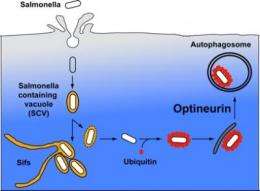
Scheme of Salmonella infection and clearance via autophagy pathway. The critical intracellular signals are ubiquitin that decorates Salmonella and Optineurin that acts as an autophagy receptor critical for targeting of Salmonella to the degradation in the lysosome. Credit: Ivan Dikic

Salmonella is widely prevalent in the animal kingdom. The reason we do not suffer from severe intestinal infections very often is due to our body's defence system, which manages to digest invading bacteria. This is why, generally speaking, a healthy human being will only fall ill if he consumes more than 100.000 salmonella bacteria via a contaminated food source, such as eggs or meat. An international team of researchers, led by Prof. Ivan Dikic from the Goethe University in Frankfurt has now found out how body cells recognise salmonella and render it harmless. Understanding this process at a molecular level is crucial in identifying new targets for treatment. Tropical and sub-tropical countries in particular, where various sub-species of salmonella are common, are experiencing a rapid increase in resistance to antibiotics, with children at greatest risk.

Salmonella infection begins with bacteria entering the of the intestinal mucosa. To prevent them multiplying there, special cell organelles, called autophagosomes are activated. These encircle the invaders and then become absorbed in other organelles – lysosomes – that contain certain special digestive enzymes, which break down the bacteria into their constituent parts. But how exactly do the autophagosomes recognise salmonella? Prof. Ivan Dikic and his research group at the Biochemistry Institute II have now shed light on this mechanism.

As reported in a current article in the scientific journal "Science", the salmonella are marked as 'waste material' by the molecule ubiquitin. In order for the autophagosomes to become active, the marked bacteria have to bind to another molecule – LC3 – on the autophagosomal membrane. Here, the protein optineurin plays a key role, linking the marked Salmonella to the autophagosmal LC3, thereby setting off a process of selective autophagy. But optineurin becomes active as a link only after being chemically modified by an enzyme, (in this case it is phosphorylated by the protein kinase TBK1). "We suspect that phosphorylation acts as a regulated switch to trigger selective autophagy of bacteria but might also prove significant in other cargoes like protein aggregates or damaged mitochondria" explains Prof. Ivan Dikic, underlining the importance of these findings. It is thought that impaired autophagy processes may be implicated in, among other things, the development of cancer as well as neurodegenerative diseases.

In the area of infectious diseases, these findings are particularly relevant in view of the fact that gastrointestinal disease caused by Salmonella enterica has rapidly increased since the mid-1980s. In Germany, approx. 30,000 cases were reported to the health authorities in 1985, but by 2005 the figure has risen to 52,000. Worldwide, 94 million people fall ill each year with acute gastroenteritis, and 155,000 of these die. Typhoid, a disease also caused by Salmonella, affects 16 million people annually and mortality rates reach 200,000, with children in particular falling victim to the disease. Bacteria are becoming increasingly resistant to so that the potential for treating disease is limited. Chloramphenicol, a formerly popular broad-spectrum antibiotic, is now ineffective, and even Fluoroquinolones, currently a commonly prescribed antibiotic, is proving inadequate in fighting bacteria. As co-author Prof. Dirk Bumann from the Biozentrum at Basel University puts it: "There is a pressing need to find new forms of treatment for infectious diseases. A better understanding of how the body's own defence mechanism makes use of autophagy will certainly help."

More information: Philipp Wild et al: Phosphorylation of the Autophagy Receptor Optineurin restricts Salmonella growth, Science 26th May 2011 advanced online publication (Science DOI: 10.1126/science.1205405)

Provided by Goethe University Frankfurt

not rated yet  

Rank not rated yet
Related Stories
Relevant PhysicsForums posts

More news stories

Study reveals new mechanism for estrogen suppression of liver lipid synthesis

By discovering the new mechanism by which estrogen suppresses lipid synthesis in the liver, UC Irvine endocrinologists have revealed a potential new approach toward treating certain liver diseases.

Medical research created May 23, 2013 | popularity 5 / 5 (1) | comments 0 | with audio podcast

MRI-based measurement helps predict vascular disease in the brain

Aortic arch pulse wave velocity, a measure of arterial stiffness, is a strong independent predictor of disease of the vessels that supply blood to the brain, according to a new study published in the June issue the journal ...

Medical research created May 23, 2013 | popularity not rated yet | comments 0

Antibiotics: A new understanding of sulfonamide nervous system side effects

Since the discovery of Prontosil in 1932, sulfonamide antibiotics have been used to combat a wide spectrum of bacterial infections, from acne to chlamydia and pneumonia. However, their side effects can include serious neurological ...

Medical research created May 23, 2013 | popularity 3 / 5 (1) | comments 0 | with audio podcast

Scientists discover molecule triggers sensation of itch

Scientists at the National Institutes of Health report they have discovered in mouse studies that a small molecule released in the spinal cord triggers a process that is later experienced in the brain as ...

Medical research created May 23, 2013 | popularity 5 / 5 (3) | comments 0 | with audio podcast

Discarded immune cells induce the relocation of stem cells

Spanish researchers have discovered that the daily clearance of neutrophils from the body stimulates the release of hematopoietic stem cells from the bone marrow into the bloodstream, according to a report published today ...

Medical research created May 23, 2013 | popularity 5 / 5 (2) | comments 0


First drug to improve heart failure mortality in over a decade

Coenzyme Q10 decreases all cause mortality by half, according to the results of a multicentre randomised double blind trial presented today at Heart Failure 2013 congress. It is the first drug to improve heart failure mortality ...

Seniors more likely to crash when driving with pet, study finds

(HealthDay)—Animals make great companions for senior citizens, but elderly people who always drive with a pet in the car are far more likely to crash than those who never drive with a pet, researchers have ...

Heart failure accelerates male 'menopause'

Heart failure accelerates the aging process and brings on early andropausal syndrome (AS), according to research presented today at the Heart Failure Congress 2013. AS, also referred to as male 'menopause', was four times ...

Death highest in heart failure patients admitted in January, on Friday, and overnight

Mortality and length of stay are highest in heart failure patients admitted in January, on Friday, and overnight, according to research presented today at the Heart Failure Congress 2013. The analysis of nearly 1 million ...

Feds fight morning-after pill age ruling in NY

(AP)—Department of Justice lawyers have again asked a federal appeals court in New York to delay lifting age restrictions and prescription requirements on an emergency contraceptive popularly known as the morning-after ...

New immune system discovered

(Medical Xpress)—A research team, led by Jeremy Barr, a biology post-doctoral fellow, unveils a new immune system that protects humans and animals from infection.