Mutated muscle protein causes deafness
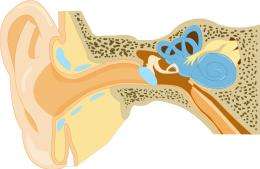
When sound waves reach the snail-shaped structure of the inner ear, sensory cells are activated. If the hair-like cilia of such cells are damaged by a mutation of the SMPX gene, they can no longer respond to acoustic stimuli. Credit: fotolia
(Medical Xpress) -- Excessive noise is not the only thing that causes damage to hearing. In many cases, genetic factors are responsible for the loss of hearing at a young age. Researchers at the Max Planck Institute for Molecular Genetics in Berlin together with colleagues from Nijmegen have discovered a previously unknown genetic cause of progressive hearing impairment: the disease is caused by mutations of the SMPX (small muscle protein) gene, which is located on the X chromosome. It was not previously known that this gene, which is active in the skeletal muscle and heart, also plays a role in hearing. The discovery will make it easier to diagnose progressive hearing impairment and may also provide a starting point for the development of new treatment methods.
Hereditary hearing loss has many causes: researchers have already identified over 50 genes with different functions that could be considered as possible triggers of the disease. However, it is not only the cause of the condition that differs from case to case. The pattern of inheritance is also highly variable. This wide range of possible causes makes it difficult to diagnose the cause of hearing loss and thus poses problems for doctors when counselling patients and their families.
Working in cooperation with colleagues from Nijmegen, scientists at the Max Planck Institute for Molecular Genetics in Berlin have discovered another previously unknown genetic mutation that gradually leads to complete hearing loss. As the researchers discovered, mutations of the SMPX gene can cause deafness.
In our study, we succeeded in demonstrating for the first time that SMPX is very active in the inner ear, says Vera Kalscheuer, a scientist at the Max Planck Institute for Molecular Genetics. Up to now, the gene was only known to play an important role in skeletal muscle and in the heart. The researchers were therefore surprised to discover that it is also active in the inner ear. The fact that the mutation only affects the hearing, while the function of the muscles and heart is not impaired, is also astonishing.
The disease-causing mutation involves the substitution of a single base in the genetic material. The mutation in the genetic code causes a premature stop codon. The missing information results in either the premature degradation of the mutated gene transcript or the truncation of the protein, which is unable to function correctly as a result.
Contrary to most X-chromosome disorders, women are also affected by the disease, though usually less severely.
The precise role played by the protein in the hearing process, the blueprint of which is encoded in the SMPX gene, is presently unknown. The researchers suspect that it is important for the development of the hair cell projections of the cochlea. These fine structures react to sound waves and are responsible for transforming sounds into electrical potential and transmitting them to the auditory centre in the brain. Accordingly, the malfunctioning of these cells, which are known as stereocilia, could be responsible for the hearing impairment.
As part of their study the scientists examined a family that had experienced hereditary hearing impairment across five generations. In order to carry out a targeted search for gene mutations, they concentrated and sequenced all genes of the X chromosome. This led to the discovery of the base substitution in the SMPX gene in all of the family members affected by the hearing impairment. The researchers encountered a second mutation in the course of their analysis which also leads to deafness. During subsequent SMPX mutation search on other families affected by the condition, they discovered a second family with a disease-causing mutation in this gene. This mutation is a deletion of a single base pair which leads to a stop codon and, therefore, the loss of function of the protein.
Our discovery makes hearing impairment easier to diagnose, says Vera Kalscheuer. Up to now, we could only speculate about the function of the SMPX protein. The next step is to identify the precise role that the protein plays in the hearing process by carrying out functional tests. When we know the precise mechanism at work here, we can carry out further research and possibly develop new treatment options, adds the scientist.
More information: Margit Schraders, et al. Next-Generation Sequencing Identifies Mutations of SMPX, which Encodes the Small Muscle Protein, X-Linked, as a Cause of Progressive Hearing Impairment, The American Journal of Human Genetics 88, May 13, 2011, pp. 628-34, doi:10.1016/j.ajhg.2011.04.012
Provided by
Max-Planck-Gesellschaft
-
Scientists identify genetic cause for type of deafness
Sep 03, 2009 |
not rated yet |
0
-
New mouse mutant contains clue to progressive hearing loss
Oct 31, 2008 |
not rated yet |
0
-
Inherited form of hearing loss stems from gene mutation
Jul 31, 2008 |
not rated yet |
0
-
Researchers reveal function of novel molecule that underlies human deafness
Jan 21, 2011 |
not rated yet |
0
-
Gene linked to a rare form of progressive hearing loss in males is identified
Dec 17, 2009 |
not rated yet |
0
-
Motion perception revisited: High Phi effect challenges established motion perception assumptions
Apr 23, 2013 |
3 / 5 (2) |
2
-
Anything you can do I can do better: Neuromolecular foundations of the superiority illusion (Update)
Apr 02, 2013 |
4.5 / 5 (11) |
5
-
The visual system as economist: Neural resource allocation in visual adaptation
Mar 30, 2013 |
5 / 5 (2) |
9
-
Separate lives: Neuronal and organismal lifespans decoupled
Mar 27, 2013 |
4.9 / 5 (8) |
0
-
Sizing things up: The evolutionary neurobiology of scale invariance
Feb 28, 2013 |
4.8 / 5 (10) |
14
-
Classical and Quantum Mechanics via Lie algebras
Apr 15, 2011
- More from Physics Forums - Independent Research
More news stories
Researchers develop model for better testing, targeting of malignant peripheral nerve sheath tumors
University of Minnesota Medical School researchers from the Masonic Cancer Center, University of Minnesota, in partnership with the University's Brain Tumor Program, have developed a new mouse model of malignant peripheral ...
Genetics
5 hours ago |
5 / 5 (1) |
0
|
Researchers identify new circadian clock component
Northwestern University scientists have shown a gene involved in neurodegenerative disease also plays a critical role in the proper function of the circadian clock.
Genetics
May 16, 2013 |
3 / 5 (1) |
1
|
Returning genetic incidental findings without patient consent violates basic rights, experts say
Informed consent is the backbone of patient care. Genetic testing has long required patient consent and patients have had a "right not to know" the results. However, as 21st century medicine now begins to use the tools of ...
Genetics
May 16, 2013 |
5 / 5 (1) |
3
|
Ethicists provide framework supporting new recommendations on reporting incidental findings in gene sequencing
In a paper published in Science Express, a group of experts led by bioethicists in the Center for Medical Ethics and Health Policy at Baylor College of Medicine provide a framework for the new American College of Medical Geneti ...
Genetics
May 16, 2013 |
not rated yet |
0
Experts urge caution over use of new genetic sequencing techniques
The use of genome-wide analysis (GWA), where the entirety of an individual's DNA is examined to look for the genomic mutations or variants which can cause health problems is a massively useful technology for diagnosing disease. ...
Genetics
May 16, 2013 |
not rated yet |
0
The compound in the Mediterranean diet that makes cancer cells 'mortal'
New research suggests that a compound abundant in the Mediterranean diet takes away cancer cells' "superpower" to escape death. By altering a very specific step in gene regulation, this compound essentially re-educates cancer ...
Do salamanders hold the solution to regeneration?
Salamanders' immune systems are key to their remarkable ability to regrow limbs, and could also underpin their ability to regenerate spinal cords, brain tissue and even parts of their hearts, scientists have ...
Scientists identify molecular trigger for Alzheimer's disease
Researchers have pinpointed a catalytic trigger for the onset of Alzheimer's disease – when the fundamental structure of a protein molecule changes to cause a chain reaction that leads to the death of neurons ...
Practice makes perfect? Not so much
Turns out, that old "practice makes perfect" adage may be overblown. New research led by Michigan State University's Zach Hambrick finds that a copious amount of practice is not enough to explain why people ...
Older prostate cancer patients should think twice before undergoing treatment
Older prostate cancer patients with other underlying health conditions should think twice before committing to surgery or radiation therapy for their cancer, according to a multicenter study led by researchers in the UCLA ...
New test better detects elephantiasis worm infection
A new diagnostic test for a worm infection that can lead to severe enlargement and deformities of the legs and genitals is far more sensitive than the currently used test, according to results of a field ...