'Octopus' provides cancer breakthrough
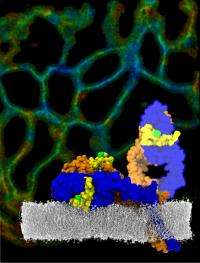
Background: Image of human epithelial cells from the set from which the variation in the shape of EGFR was derived. Foreground: Model of human EGFR showing the new conformation lying flat on the membrane and the previously known upright conformation
A breakthrough in understanding a biological process that causes many common cancers including lung and breast cancer opens up a whole new realm of possibilities for the development of improved cancer drugs. The results are featured on the front cover of the journal Molecular and Cellular Biology published today.
Experts from STFC's Central Laser Facility (CLF) and Computational Science and Engineering Department (CSED) have solved a puzzle that has confounded scientists for more than 30 years.
The researchers have discovered a previously unknown molecular shape which is partly responsible for transmitting the signals that instruct cells within the body when to grow and divide. It is the uncontrolled growth of cells that causes cancer to spread through the body. Until now, not enough was known about how these molecules, known as epidermal growth factor receptors (EGFRs), transmit messages in the development of cancer. This means drugs designed to stop them transmitting these cancer-inducing signals have also been limited in their effectiveness.
Project leader Dr Marisa Martin-Fernandez, a CLF scientist based at the Research Complex at Harwell (RCaH), says: "A number of drugs aim to limit EGFRs' role in spreading cancer but because human EGFRs haven't been well understood, the drugs are designed simply to block every signal they transmit. But the human body is good at compensating for losses of function so it finds ways of bypassing blocked receptors to allow cancerous cells to grow again. Unfortunately the current drugs therefore all too often only provide temporary remission.
"Our breakthrough will provide a better platform of knowledge on structure variation of EGFRs in vivo. Potentially this enables the pharmaceutical industry to develop drugs that target EGFRs' cancer-related functions more specifically but also allow the receptors to go on performing other tasks. This makes it less likely that the body will try to compensate for total loss of function."
Peter Parker is the Principal Investigator at King's College London on this work. Dr George Santis, also from King's College London, is a consultant in respiratory medicine and will help take this work forward.
Dr Santis "Translating knowledge derived from scientific research into successful clinical therapies is exemplified by EGFR and its dysregulation in cancer. The use of new biologicals that inhibit EGFR has proved transformational in managing solid tumours particularly lung cancer where conventional anti-cancer treatment reached a plateau. There is however still much we don't understand regarding EGFR and its role in malignancy; this breakthrough provides the foundation for novel ways to assess EGFR in cells and tissues that may lead to new insights on how to target EGFR to treat human cancers."
The team has also shown that this shape shares key features with the better understood EGFR molecules in fruit flies, providing clues on how EGFRs have changed during evolution.
Dr Martyn Winn of the CSED at STFC's Daresbury Laboratory says "The key has been close collaboration between the experimental and computational teams involved. The CLF used its OCTOPUS facility to take nanoscale measurements of EGFRs in cells. We took the measurements and used high performance computing (HPC) to calculate the receptors' high-resolution structure, allowing us to determine their similarities with the fruit fly EGFRs."
Professor John Collier, Director of the CLF, said, "Breakthroughs like this have the potential to really pay dividends in terms of saving lives and maximising the value of healthcare expenditure. By constantly pushing forward the boundaries of what laser technology can do, we can deliver real-world benefits that tangibly improve people's lives."
More information: Details of the breakthrough are presented in the paper 'Human EGFR aligned on the plasma membrane adopts key features of Drosophila* EGFR asymmetry', and are featured on the front cover of the current edition of the journal Molecular and Cellular Biology published on 12 May 2011.
Provided by
Biotechnology and Biological Sciences Research Council
-
Protein inhibits cancer cell growth
Dec 21, 2009 |
not rated yet |
0
-
Fruit fly protein acts as decoy to capture tumor growth factors
May 28, 2008 |
not rated yet |
0
-
EGFR protects cancer cells from starvation via a kinase-independent mechanism
May 05, 2008 |
not rated yet |
0
-
Study reveals how some molecules inhibit growth of lung cancer cells
Mar 12, 2007 |
not rated yet |
0
-
Using the structure of the epidermal growth factor receptor to fight cancer
Sep 13, 2010 |
not rated yet |
0
-
Motion perception revisited: High Phi effect challenges established motion perception assumptions
Apr 23, 2013 |
3 / 5 (2) |
2
-
Anything you can do I can do better: Neuromolecular foundations of the superiority illusion (Update)
Apr 02, 2013 |
4.5 / 5 (11) |
5
-
The visual system as economist: Neural resource allocation in visual adaptation
Mar 30, 2013 |
5 / 5 (2) |
9
-
Separate lives: Neuronal and organismal lifespans decoupled
Mar 27, 2013 |
4.9 / 5 (8) |
0
-
Sizing things up: The evolutionary neurobiology of scale invariance
Feb 28, 2013 |
4.8 / 5 (10) |
14
-
How can there be villous adenoma in colon, if there are no villi there
5 hours ago
-
How can there be a term called "intestinal metaplasia" of stomach
May 21, 2013
-
Pressure-volume curve: Elastic Recoil Pressure don't make sense
May 18, 2013
-
If you became brain-dead, would you want them to pull the plug?
May 17, 2013
-
MRI bill question
May 15, 2013
-
Ratio of Hydrogen of Oxygen in Dessicated Animal Protein
May 13, 2013
- More from Physics Forums - Medical Sciences
More news stories
Small increase in cancer risk following CT scans in childhood and adolescence
Study leader, Professor John Mathews from the University of Melbourne said this small increase in cancer risk must be weighed against the undoubted benefits from CT scans in diagnosing and monitoring disease.
Cancer
2 hours ago |
not rated yet |
0
Cancer survivors need more support to stop smoking and drinking
Cancer survivors are no more likely to stop smoking, cut down on alcohol, or exercise more often than the general population, according to new research published in the British Journal of Cancer today (Wednesday)
Cancer
4 hours ago |
not rated yet |
0
Beta-blockers may boost chemo effect in childhood cancer
Beta-blockers, normally used for high blood pressure, could enhance the effectiveness of chemotherapies in treating neuroblastoma, a type of children's cancer, according to a new study published in the British Jo ...
Cancer
4 hours ago |
not rated yet |
0
Japan hospital tests powerful breast cancer therapy
A Japanese cancer specialist said Wednesday she has started the world's first clinical trial of a powerful, non-surgical, short-term radiation therapy for breast cancer.
Cancer
4 hours ago |
5 / 5 (1) |
0
Small cancer risk following CT scans in childhood and adolescence confirmed
The gap between life expectancy in patients with a mental illness and the general population has widened since 1985 and efforts to reduce this gap should focus on improving physical health, suggest researchers in a paper ...
Cancer
17 hours ago |
not rated yet |
0
Scientists uncover molecular roots of cocaine addiction in the brain
Researchers at Johns Hopkins have unraveled the molecular foundations of cocaine's effects on the brain, and identified a compound that blocks cravings for the drug in cocaine-addicted mice. The compound, already proven safe ...
Taming suspect gene reverses schizophrenia-like abnormalities in mice
Scientists have reversed behavioral and brain abnormalities in adult mice that resemble some features of schizophrenia by restoring normal expression to a suspect gene that is over-expressed in humans with ...
Costs to treat stroke in America may double by 2030
Costs to treat stroke are projected to more than double and the number of people having strokes may increase 20 percent by 2030, according to the American Heart Association/American Stroke Association.
Acne treatment: Natural substance-based formula is more effective than artificial compounds
University of Granada scientists have patented a new treatment for acne that is based on completely natural substances and is much more effective than artificial formulas because it does not create resistance ...
Study finds new pneumococcal vaccine appears to be as safe as previously used vaccine
The new 13-valent pneumococcal conjugate vaccine (PCV13) appears to be as safe as the previous version used prior to 2010, the 7-valent pneumococcal conjugate vaccine (PCV7), according to a Kaiser Permanente study published ...
Study says empathy plays a key role in moral judgments
Is it permissible to harm one to save many? Those who tend to say "yes" when faced with this classic dilemma are likely to be deficient in a specific kind of empathy, according to a report published in the scientific journal ...