New technology helps to find gene responsible for Kufs disease
May 5, 2011 in Genetics
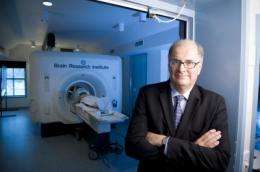
Professor Sam Berkovic, from the University of Melbourne, Australia, said the discovery of the gene at the root of the brain disorder, Kufs type A disease, will enable us to use a rapid and simple blood test to genetically test for the disease. Credit: Gavin Blue/The University of Melbourne
Scientists from the Walter and Eliza Hall Institute and the University of Melbourne have used innovative new technologies to identify the gene responsible for a rare but fatal hereditary brain disorder. The discovery will make it possible to diagnose the disease through a blood test rather than a brain biopsy.
Dr Melanie Bahlo, Ms Katherine Smith and Ms Catherine Bromhead from the Walter and Eliza Hall Institute's Bioinformatics division, in collaboration with neurologist and epilepsy specialist Professor Sam Berkovic and Dr Todor Arsov from the University of Melbourne, have found that mutations in the CLN6 gene on chromosome 15 are the cause of inherited recessive Kufs type A disease. The paper was published in the American Journal of Human Genetics.
Kufs disease is a rare but fatal, hereditary neurodegenerative disease usually identified in early adulthood. Brain symptoms result from a build up of fat in brain cells that is toxic to the cells, causing symptoms including epilepsy, dementia, impaired motor function and intellectual deterioration. It affects approximately 1 in 1,000,000 people.
Professor Berkovic, head of the Epilepsy Research Centre at the University of Melbourne and the Comprehensive Epilepsy Program at Austin Health, said identification of the CLN6 gene would enable more efficient and much less invasive techniques for earlier diagnosis of Kufs disease.
"Currently, the only way that we can reliably diagnose this disease is to do an invasive and dangerous brain biopsy, or at autopsy," Professor Berkovic said. "The discovery of the gene at the root of Kufs type A disease will enable us to use a rapid and simple blood test to genetically test for the disease. It will also give us the ability to screen for the disease in people in at-risk families, and make it possible for genetic counseling, which we already know to be very important for patients."
Dr Bahlo's and Ms Smith's innovative work used data generated from a person's DNA, called SNP genotyping. When combined with sophisticated mathematical and statistical analysis, the information helped them identify the region in the human genome likely to contain the DNA error that causes Kufs disease which led to discovery of the gene mutations.
"The genetic cause of Kufs disease has remained a mystery for over 25 years, because the rarity of the condition meant that our patient groups were so small we couldn't reliably pinpoint any particular genetic mutations that caused their disease," Dr Bahlo said. "In this study, we used an innovative suite of highly specialised techniques and statistical algorithms that compensated for the small sample size and allowed us to look at the entire genetic code of people with Kufs disease to find which region of the DNA had the mutation which caused disease. Discovering the CLN6 gene as the cause of Kufs disease is a great outcome for us and for the people who are affected by this awful disease."
Professor Berkovic said the best possible outcome from the study would be the development of a treatment for Kufs disease, which is currently untreatable and invariably fatal. "The general aim and hope of this work is always to be able to use the discovery to translate to a treatment, but this is still some time away," he said.
Professor Berkovic said that his team's collaboration with Dr Bahlo's bioinformatics group at the institute had produced several exciting results in a short time. This includes a number of important outcomes for epilepsy sufferers, with the genetic basis for four epilepsy-related diseases discovered in the past four years.
Dr Bahlo said that the innovative study used to find the gene responsible for Kufs disease could hold the key for finding the genetic cause of a number of other hereditary diseases including other epilepsy-related diseases, deafness and some familial cancers.
"These new techniques for using statistical data and mathematical algorithms to track down the genetic basis of disease are really at the forefront of medical research today," Dr Bahlo said. "Finding the genes responsible for certain diseases will help us in our quest to generate new diagnostic tools as well as provide the basis for fundamental biology that leads to development of new drugs and therapies to treat disease."
Provided by Walter and Eliza Hall Institute
-
Researchers find gene responsible for neurodegenerative disease in dogs, possibly in humans
Aug 23, 2010 |
not rated yet |
0
-
Genetic epilepsy can originate in the embryo, study shows
Sep 30, 2010 |
not rated yet |
0
-
Major breakthrough will revolutionize the screening and treatment of genetic diseases
Jun 10, 2010 |
not rated yet |
0
-
Discovery could improve hepatitis C treatment
Sep 23, 2009 |
not rated yet |
0
-
With just 3 affected individuals, researchers find gene behind rare form of epilepsy
Feb 28, 2008 |
not rated yet |
0
-
Limits to growth: Scientists identify key metastasis-enabling enzyme
May 22, 2012 |
5 / 5 (3) |
0
-
Seeing is as seeing does: Spatially-structured retinal input in early development of cortical maps
Apr 26, 2012 |
5 / 5 (4) |
1
-
Dreamless nights: Brain activity during nonrapid eye movement sleep
Apr 09, 2012 |
4.4 / 5 (12) |
0
-
Take your time: Neurobiology sheds light on the superiority of spaced vs. massed learning
Mar 28, 2012 |
4.5 / 5 (21) |
3
-
Your brain on 'shrooms: fMRI elucidates neural correlates of psilocybin psychedelic state
Feb 29, 2012 |
4.9 / 5 (42) |
45
-
Classical and Quantum Mechanics via Lie algebras
Apr 15, 2011
- More from Physics Forums - Independent Research
More news stories
Key gene found responsible for chronic inflammation, accelerated aging and cancer
Researchers at NYU School of Medicine have, for the first time, identified a single gene that simultaneously controls inflammation, accelerated aging and cancer.
Genetics
1 hour ago |
not rated yet |
0
Knowing genetic makeup may not significantly improve disease risk prediction
Harvard School of Public Health (HSPH) researchers have found that detailed knowledge about your genetic makeupthe interplay between genetic variants and other genetic variants, or between genetic variants and environmental ...
Genetics
1 hour ago |
2 / 5 (1) |
0
|
Male fertility genes discovered
A new study has revealed previously undiscovered genetic variants that influence fertility in men. The findings, published by Cell Press on May 24th in the American Journal of Human Genetics, shed much-needed light on hum ...
Genetics
1 hour ago |
not rated yet |
0
|
New genetic method pinpoints geographic origin
(Medical Xpress) -- Understanding the genetic diversity within and between populations has important implications for studies of human disease and evolution. This includes identifying associations between genetic variants ...
Genetics
6 hours ago |
not rated yet |
0
|
Whole genome sequencing of rare olfactory neuroblastoma
The Translational Genomics Research Institute (TGen) and the Virginia G. Piper Cancer Center at Scottsdale Healthcare have conducted whole genome sequencing (WGS) of a rare nasal tract cancer called olfactory neuroblastoma ...
Genetics
20 hours ago |
not rated yet |
0
|
New test shows potential for detecting active cases of Lyme disease
George Mason University researchers can find out if a tick bite means Lyme disease well before the bite victim begins to show symptoms.
Researchers identify protein necessary for behavioral flexibility
Researchers have identified a protein necessary to maintain behavioral flexibility, which allows us to modify our behaviors to adjust to circumstances that are similar, but not identical, to previous experiences. Their findings, ...
Boundary stops molecule right where it needs to be
A molecule responsible for the proper formation of a key portion of the nervous system finds its way to the proper place not because it is actively recruited, but instead because it can't go anywhere else.
Thioridazine kills cancer stem cells in human while avoiding toxic side-effects of conventional cancer treatments
A team of scientists at McMaster University has discovered a drug, thioridazine, successfully kills cancer stem cells in the human while avoiding the toxic side-effects of conventional cancer treatments.
Researcher calls for new approach to regulating probiotics
In today's Nature scientific journal Dr. Gregor Reid, Director of the Canadian R&D Centre for Probiotics at Lawson Health Research Institute and a scientist at Western University, calls for a Category Tree system to be imp ...
A boost in microRNA may protect against sepsis and other inflammatory diseases
Acute inflammatory diseases, such as sepsis, as well as chronic inflammatory diseases like diabetes and arthritis, develop as a result of sustained inflammation of the blood vessel wall. Researchers at Brigham and Women's ...