Biomaterial aids nerve regeneration
June 7, 2011 in Medical research
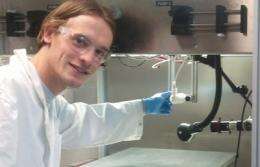
Andrew Rodda in the laboratory.
(Medical Xpress) -- A Monash University researcher has developed a new biomaterial that encourages damaged nerves in the brain and spinal cord to regrow. The work could revolutionise treatment of nerve-based injuries and diseases, such as Parkinsons.
PhD student Andrew Rodda was part of a Monash Materials Engineering team investigating xyloglucan, a plant-based compound derived from the seeds of the tamarind tree.
Within plants, xyloglucan plays an important role in linking cells together and Mr Rodda has been studying its effects in animals with damaged nerve cells.
The compound developed by Mr Rodda can be injected into an injury site as a liquid, before becoming a gel as it reaches body temperature.
Once in place, the gel acts as a support structure through which healthy cells can migrate and potentially reattach themselves to the nervous system.
Until now, all damage to the nerve cells of the central nervous system - the brain and spinal cord had been considered irreparable.
Mr Rodda said the lack of repair, or regrowth is due mainly to the toxic environment left behind after nerve death.
Nerve cells are sensitive, and will only grow in the most supportive of environments, Mr Rodda said.
After injury, new cells cannot normally penetrate into the empty space left after mass cell death. Cells clump at the edges, forming an impenetrable barrier. This leaves the centre of the wound as a lesion, which contains chemicals that kill growing nerves.
Mr Rodda said the new biomaterial works by providing a temporary scaffold on which new cells can grow and penetrate the lesion.
Significantly, it was the helper cells, known as astrocytes, which were the first to move into the implanted gel. These cells secrete beneficial chemicals, which may have helped create an environment in which the delicate nerve cells can survive.
Mr Roddas study is part of a worldwide effort to encourage nerve regeneration in the brain and spinal cord. It builds on previous work at Monash University to understand and control nerve growth using biomaterials.
Provided by
Monash University
-
Study: Stem cells report olfactory nerves
Apr 30, 2007 |
not rated yet |
0
-
Human stem cell transplants mature into neurons and make contacts in rat spinal cord
Feb 13, 2007 |
not rated yet |
0
-
Study: Spinal cord can repair itself
Feb 14, 2007 |
not rated yet |
0
-
Cancer drug aids cell regeneration after spinal cord injury
Jan 27, 2011 |
not rated yet |
0
-
Company Develops a New Approach to Nerve Repair
Mar 12, 2007 |
not rated yet |
0
-
Motion perception revisited: High Phi effect challenges established motion perception assumptions
Apr 23, 2013 |
3 / 5 (2) |
2
-
Anything you can do I can do better: Neuromolecular foundations of the superiority illusion (Update)
Apr 02, 2013 |
4.5 / 5 (11) |
5
-
The visual system as economist: Neural resource allocation in visual adaptation
Mar 30, 2013 |
5 / 5 (2) |
9
-
Separate lives: Neuronal and organismal lifespans decoupled
Mar 27, 2013 |
4.9 / 5 (8) |
0
-
Sizing things up: The evolutionary neurobiology of scale invariance
Feb 28, 2013 |
4.8 / 5 (10) |
14
-
Pressure-volume curve: Elastic Recoil Pressure don't make sense
May 18, 2013
-
If you became brain-dead, would you want them to pull the plug?
May 17, 2013
-
MRI bill question
May 15, 2013
-
Ratio of Hydrogen of Oxygen in Dessicated Animal Protein
May 13, 2013
-
Alcohol and acetaminophen
May 13, 2013
-
Marie Curie's leukemia
May 13, 2013
- More from Physics Forums - Medical Sciences
More news stories
Now we know why old scizophrenia medicine works on antibiotics-resistant bacteria
In 2008 researchers from the University of Southern Denmark showed that the drug thioridazine, which has previously been used to treat schizophrenia, is also a powerful weapon against antibiotic-resistant bacteria such as ...
Medical research
May 17, 2013 |
3.7 / 5 (3) |
0
|
SUMO wrestling cells reveal new protective mechanism target for stroke
Scientists investigating the interaction of a group of proteins in the brain responsible for protecting nerve cells from damage have identified a new target that could increase cell survival.
Medical research
May 17, 2013 |
5 / 5 (1) |
0
How serotonin receptors can shape drug effects, from LSD to migraine medication
New findings by researchers carrying out experiments at the U.S. Department of Energy Office of Science's Advanced Photon Source (APS) help explain why some drugs that interact with two kinds of human serotonin ...
Medical research
May 17, 2013 |
4 / 5 (1) |
0
|
Preventing blood poisoning
Peptide molecules derived from the body's natural immune system can help boost the body's defence against life-threatening blood poisoning, joint University research has uncovered.
Medical research
May 17, 2013 |
4 / 5 (1) |
0
|
New mechanism to prevent type 2 diabetes in obese individuals
A new Montréal study conducted by Dr. May Faraj, associate research professor at the Université de Montréal and invited scientist at the IRCM, along with her research team and medical collaborators, shows ...
Medical research
May 17, 2013 |
not rated yet |
0
|
Alzheimer's leaves bilingual victims stranded in Canada
The devastating effect of Alzheimer's disease on bilingual people has been thrown into focus in Canada, where the sudden loss of a second language can leave sufferers feeling like strangers in their own country.
'Gap' for HIV vaccine efforts after latest setback
The hunt for an HIV vaccine has gobbled up $8 billion in the past decade, and the failure of the most recent efficacy trial has delivered yet another setback to 26 years of efforts.
Consuming coffee linked to lower risk of detrimental liver disease, study finds
Regular consumption of coffee is associated with a reduced risk of primary sclerosing cholangitis (PSC), an autoimmune liver disease, Mayo Clinic research shows. The findings were being presented at the Digestive Disease ...
Ketamine shows significant therapeutic benefit in people with treatment-resistant depression
Patients with treatment-resistant major depression saw dramatic improvement in their illness after treatment with ketamine, an anesthetic, according to the largest ketamine clinical trial to-date led by researchers from the ...
Research examines new methods for managing digestive health
Research presented at Digestive Disease Week (DDW) explores new methods for managing digestive health through diet and lifestyle.
New smartphone application improves colonoscopy preparation
The use of a smartphone application significantly improves patients' preparation for a colonoscopy, according to new research presented today at Digestive Disease Week (DDW). The preparation process, which begins days in ...