Depressed, pregnant women receive inconsistent treatment, have longer hospital stays
June 16, 2011 in Psychology & Psychiatry
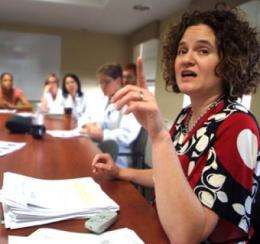
Dr. Christie Palladino of Georgia Health Sciences University discusses survey results pointing to inconsistent treatment and longer hospital stays for pregnant women who are depressed. Credit: Phil Jones
Pregnant women who screen positive for depression are unlikely to receive consistent treatment, researchers say.
That may translate to women spending more time in the hospital before babies are even born.
The Obstetric Clinics and Resources Study, published in General Hospital Psychiatry, tracked 20 health care providers in six Michigan clinics and revealed a lack of uniformity in addressing perinatal depression.
"There are a lot of barriers to translating information into everyday practice situations," said Dr. Christie Palladino, an obstetrician/gynecologist with Georgia Health Sciences University's Education Discovery Institute and principal investigator on the study. "We wanted to understand what it's like for prenatal care providers to deal with depression care."
Providers felt burdened having to make instant decisions about complex issues, the multidisciplinary research team found. And those decisions varied dramatically, even within the same clinic.
"There was no system-level support for providers," Palladino said. "They felt as if they were making decisions out on an island."
That sense of isolation, coupled with a lack of direction about how to treat pregnant women with depression, may explain why fewer than half of women who need treatment receive it.
Adding to the disconnect was providers' discomfort in talking about the disease with both patients and mental health care providers.
"In training, we tend to talk about how frequent a disease is, what the known causes are and the treatments that are available, but we don't address developing referral relationships," Palladino said. "We need to focus on not only knowledge of the disease, but also on the intrinsic motivations."
To address the problem, GHSU's Education Discovery Institute is conducting a pilot project to teach such skills. Residents and faculty in OB-GYN, psychiatry and pediatrics are collaborating to develop and test tailored educational interventions in perinatal depression care, in hopes of quickly implementing the content into clinical practice.
Palladino is applying for a Health Resources and Services Administration grant to test the curriculum and intervention at other locations as well.
An earlier study led by Palladino discovered that depressed women had significantly longer-than-average hospital stays: more than 24 hours prior to delivery.
"That's a long time for an otherwise healthy woman to be in the hospital before going into labor," Palladino said. "It has serious consequences for the mother, for the family and for the hospital system in terms of time and cost."
The study, published in the Journal of Women's Health and funded by the Robert Wood Johnson Foundation, also confirmed previous research linking depression to an increased risk of complications such as pre-term delivery, pre-eclampsia, premature membrane rupture and gestational diabetes.
"I was in a fantastic residency program, but treating depression during pregnancy wasn't even on the map at the time," Palladino said, noting that many OB-GYN residency programs still lack mental health training. "This has become my passion."
Provided by Georgia Health Sciences University
-
Less than 50 percent of men and women with depression see a doctor for treatment
Sep 30, 2009 |
not rated yet |
0
-
Women with diabetes before or during pregnancy at higher risk of depression
Feb 24, 2009 |
not rated yet |
0
-
Abused women seek more infant health care, study finds
Dec 16, 2008 |
not rated yet |
0
-
ACPM recommends primary care have systems in place for screening and treating depression
Oct 06, 2009 |
not rated yet |
0
-
Racism shapes African-American women's views on depression care
Jul 07, 2010 |
not rated yet |
0
-
Motion perception revisited: High Phi effect challenges established motion perception assumptions
Apr 23, 2013 |
3 / 5 (2) |
2
-
Anything you can do I can do better: Neuromolecular foundations of the superiority illusion (Update)
Apr 02, 2013 |
4.5 / 5 (11) |
5
-
The visual system as economist: Neural resource allocation in visual adaptation
Mar 30, 2013 |
5 / 5 (2) |
9
-
Separate lives: Neuronal and organismal lifespans decoupled
Mar 27, 2013 |
4.9 / 5 (8) |
0
-
Sizing things up: The evolutionary neurobiology of scale invariance
Feb 28, 2013 |
4.8 / 5 (10) |
14
-
How can there be villous adenoma in colon, if there are no villi there
17 hours ago
-
How can there be a term called "intestinal metaplasia" of stomach
May 21, 2013
-
Pressure-volume curve: Elastic Recoil Pressure don't make sense
May 18, 2013
-
If you became brain-dead, would you want them to pull the plug?
May 17, 2013
-
MRI bill question
May 15, 2013
-
Ratio of Hydrogen of Oxygen in Dessicated Animal Protein
May 13, 2013
- More from Physics Forums - Medical Sciences
More news stories
'Boys will be boys' in US, but not in Asia
A new study shows there is a gender gap when it comes to behavior and self-control in American young children – one that does not appear to exist in children in Asia.
Psychology & Psychiatry
7 hours ago |
not rated yet |
0
Brain can be trained in compassion, study shows
Until now, little was scientifically known about the human potential to cultivate compassion—the emotional state of caring for people who are suffering in a way that motivates altruistic behavior.
Psychology & Psychiatry
8 hours ago |
5 / 5 (2) |
2
|
Good marriage can buffer effects of dad's depression on young children
What effect does a father's depression have on his young son or daughter? When fathers report a high level of emotional intimacy in their marriage, their children benefit, said a University of Illinois study.
Psychology & Psychiatry
9 hours ago |
not rated yet |
0
American, Nepalese kids a world apart on social duties
(Medical Xpress)—Preschoolers universally recognize that one's choices are not always free – that our decisions may be constrained by social obligations to be nice to others or follow rules set by parents ...
Psychology & Psychiatry
16 hours ago |
not rated yet |
0
Ethicists' behavior not more moral, study finds
(Medical Xpress)—Do ethicists engage in better moral behavior than other professors? The answer is no. Nor are they more likely than nonethicists to act according to values they espouse, according to researchers from the ...
Psychology & Psychiatry
16 hours ago |
5 / 5 (1) |
0
Rate of bicycle-related fatalities significantly lower in states with helmet laws
Existing research shows that bicyclists who wear helmets have an 88 percent lower risk of brain injury, but researchers at Boston Children's Hospital found that simply having bicycle helmet laws in place showed a 20 percent ...
Slowing the aging process—only with antibiotics
Swiss scientists reveal the mechanism responsible for aging hidden deep within mitochondria—and dramatically slow it down in worms by administering antibiotics to the young.
Researchers complete largest genetic sequencing study of human disease
Researchers from Queen Mary, University of London have led the largest sequencing study of human disease to date, investigating the genetic basis of six autoimmune diseases.
Having both migraines, depression may mean smaller brain
(HealthDay)—Migraines and depression can each cause a great deal of suffering, but new research indicates the combination of the two may be linked to something else entirely—a smaller brain.
Novel approach for influenza vaccination shows promise in early animal testing
A new approach for immunizing against influenza elicited a more potent immune response and broader protection than the currently licensed seasonal influenza vaccines when tested in mice and ferrets. The vaccine ...
Calorie information in fast food restaurants used by 40 percent of 9-18 year olds when making food choices
A new study published online today (Thursday) in the Journal of Public Health has found that of young people who visited fast food or chain restaurants in the U.S. in 2010, girls and youth who were obese were more likely ...