Goodbye cold sores

June 8, 2011 in Medical research

Goodbye cold sores

Enlarge

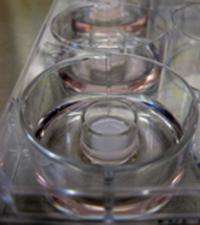
The 3-D infection model makes it possible to examine infection mechanisms such as a herpes infection. (© Fraunhofer IGB)

Herpes infections on the lips, in the eyes or on the nose are painful, long-lasting and unpleasant. A new 3D herpes infection model brings hope: active ingredients and new treatments can be reliably tested with this model. Animal tests could soon be a thing of the past.

It burns and itches on your upper lip: a infection is on the advance. Caught early, the number and size blisters can be controlled with virus-controlling salves, but the can recur at any time. “About 90 percent of the world‘s population carry it in them all their lives, once infected, and become sick again in stress situations,“ explains Dr. Anke Burger-Kentischer of the  Fraunhofer Institute for Interfacial Engineering and Biotechnology IGB in Stuttgart. Coming down with a is not always without its dangers. In the worst cases the nervous system and the brain become inflamed. The researcher, together with her team and the cell systems department, developed a 3D model.  This makes it possible for the first time to integrate the complicated dormant stage of the virus into a model of the skin. A patent application has been submitted for the new process.

The expert explains the particularity of the virus: “After the blisters subside, the herpes virus retreats to the and rests there. At this stage, only the virus’ DNA can be proven.“ As soon as a human suffers too much stress or is even exposed to too much intense sun, the nerve cell may release the virus. It travels along the neural pathways to sites where it has occurred several times before, and the new infection becomes visible.

To date the skin models used for drug testing and to detect the virus have been very simple and unable to simulate the dormancy state of the virus. “We have integrated a neuronal cell line into the certified skin model of the IGB and are able to detect this latency stage for the first time. Just like in the human nerve cells, the particles of the virus itself cannot be seen; only the presence of its DNA can be proven by means of a PCR (polymerase chain reaction) analysis,“ explains the expert. The researcher and her team then exposed the skin model to ultraviolet radiation at wave lengths of 280 to 315 nanometers (UVB). This reactivated the herpes virus, and there was an infection on the skin model. Proof of this reactivation was also possible on a co-culture. For this, the researchers introduced the latently infected neuronal cell line to a carrier with pores. Subsequently the cells were also irradiated with UVB. The virus was reactivated and penetrated these pores, infecting the cutaneous keratinocytes – the keratinizing cells cultivated previously. To verify the infection, the scientists used a specific antibody that binds to a specific protein on the outer layer of the virus. The coloration of this antibody made it possible to clearly show the infection of the skin cells with the reactivated virus from the nerve cells. “The 3-D herpes infection model therefore simulates an in-vivo situation exactly. Animal experiments will in the future become largely unnecessary,“ happily explain Burger-Kentischer and the doctoral candidate, Ina Hogk, who has worked on the development of the model from the beginning.

Research on can profit from the 3D herpes infection model of the researchers from IGB, a model that also enables improved study of infection mechanisms. This procedure might also be used to test new medications for shingles, which is also caused by a variant strain of the herpes . At the BIO trade fair from June 27 - 30, 2011, in Washington, DC, the researchers will answer questions regarding their new development.

Provided by Fraunhofer-Gesellschaft search and more info website

4.3 /5 (6 votes)  

Filter


Move the slider to adjust rank threshold, so that you can hide some of the comments.


Display comments: newest first

nanotech_republika_pl
Jun 08, 2011

Rank: not rated yet
Excellent work!

I hope we can build other cell models like that for other bug, say, a parasite that causes toxoplasmosis, which is also very prevalent in the society and causes no problem till a person gets weak.
Sepp
Jun 09, 2011

Rank: not rated yet
I wonder when our valiant medical researchers will find out that the activation of herpes virus is dependent on the body's chemistry.

There are some simple nutrients that will keep the virus in the inactive state indefinitely. When they are missing, the terrain becomes right and the virus "wakes up". What is so difficult about this?
caringstd66
Jun 10, 2011

Rank: 1 / 5 (2)
Living with herpes or other sexually transmitted diseases? Try STDdatings.com, the most trusted STD support and dating site. All personal info is private and anonymous.
Ethelred
Jun 13, 2011

Rank: 5 / 5 (1)
Living with spam? Try STDexchange.com where you can mix and match strains to make sure you have the most effective disease possible.

Ethelred
Rank 4.3 /5 (6 votes)
Related Stories
Relevant PhysicsForums posts

More news stories

Study reveals new mechanism for estrogen suppression of liver lipid synthesis

By discovering the new mechanism by which estrogen suppresses lipid synthesis in the liver, UC Irvine endocrinologists have revealed a potential new approach toward treating certain liver diseases.

Medical research created 4 hours ago | popularity not rated yet | comments 0 | with audio podcast

MRI-based measurement helps predict vascular disease in the brain

Aortic arch pulse wave velocity, a measure of arterial stiffness, is a strong independent predictor of disease of the vessels that supply blood to the brain, according to a new study published in the June issue the journal ...

Medical research created 4 hours ago | popularity not rated yet | comments 0

Antibiotics: A new understanding of sulfonamide nervous system side effects

Since the discovery of Prontosil in 1932, sulfonamide antibiotics have been used to combat a wide spectrum of bacterial infections, from acne to chlamydia and pneumonia. However, their side effects can include serious neurological ...

Medical research created 6 hours ago | popularity not rated yet | comments 0 | with audio podcast

Scientists discover molecule triggers sensation of itch

Scientists at the National Institutes of Health report they have discovered in mouse studies that a small molecule released in the spinal cord triggers a process that is later experienced in the brain as ...

Medical research created 6 hours ago | popularity 5 / 5 (2) | comments 0 | with audio podcast

Discarded immune cells induce the relocation of stem cells

Spanish researchers have discovered that the daily clearance of neutrophils from the body stimulates the release of hematopoietic stem cells from the bone marrow into the bloodstream, according to a report published today ...

Medical research created 8 hours ago | popularity 5 / 5 (2) | comments 0


Type 2 diabetes progresses faster in kids, study finds

(HealthDay)—Type 2 diabetes is more aggressive in children than adults, with signs of serious complications seen just a few years after diagnosis, new research finds.

Controlling mood through the motions of mitochondria

(Medical Xpress)—Regulating the distribution of power in neurons is done by a system that makes the national electric grid look simple by comparison. Each neuron has several thousand mitochondria confined ...

Multiple research teams unable to confirm high-profile Alzheimer's study

Teams of highly respected Alzheimer's researchers failed to replicate what appeared to be breakthrough results for the treatment of this brain disease when they were published last year in the journal Science.

Researchers find common childhood asthma unconnected to allergens or inflammation

Little is known about why asthma develops, how it constricts the airway or why response to treatments varies between patients. Now, a team of researchers at Weill Cornell Medical College, Columbia University Medical Center ...

Motion quotient: IQ predicted by ability to filter motion (w/ video)

A brief visual task can predict IQ, according to a new study. This surprisingly simple exercise measures the brain's unconscious ability to filter out visual movement. The study shows that individuals whose ...

When oxygen is short, EGFR prevents maturation of cancer-fighting miRNAs

Even while being dragged to its destruction inside a cell, a cancer-promoting growth factor receptor fires away, sending signals that thwart the development of tumor-suppressing microRNAs (miRNAs) before it's dissolved, researchers ...