Researchers link chromosome region to thoracic aortic disease
June 16, 2011 in Genetics
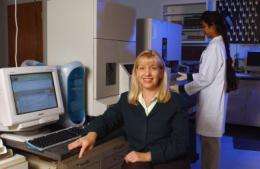
Dr. Dianna Milewicz of UTHealth led a team of researchers who have linked a region of a chromosome to thoracic aortic aneurysms and dissections. Credit: UTHealth
Patients with thoracic aortic aneurysms that lead to acute aortic dissections are 12 times more likely to have duplications in the DNA in a region of chromosome 16 (16p13.1) than those without the disease, according to a study led by genetic researchers at The University of Texas Health Science Center at Houston (UTHealth).
The results of the innovative study, which included researchers at Baylor College of Medicine, are published in the June 16 issue of the open-access journal PLoS Genetics.
In human DNA, there are regions of the DNA that are deleted or duplicated and these are referred to as copy number variants or CNVs. These CNVs can cause a loss of the number of copies of a gene from two to one (deletion) or cause more copies of a gene from two to three (duplications). Researchers are just beginning to identify a subset of these CNVs that can increase a person's risk to get a particular disorder.
"We're just starting to understand copy number variants and their link to disease," said Dianna Milewicz, M.D., Ph.D., senior author, professor and the President George H.W. Bush Chair in Cardiovascular Research, and director of the Division of Medical Genetics at The University of Texas Medical School at Houston, part of UTHealth. "This is the first recurrent CNV discovered to be associated with thoracic aortic aneurysms and dissections. In addition, it is the first recurrent copy number variant to cause a predisposition to more than one disorder, neuropsychiatic conditions and thoracic aortic disease."
This region of chromosome 16 (16p13.1) contains nine genes and the additional copy of any of these nine genes can potentially cause predisposition to different problems. Duplications of 16p13.1, which are present in approximately one in 1,000 people, have been associated with a variety of neuropsychiatric disorders, such as schizophrenia and attention-deficit hyperactivity disorder (ADHD).
Those nine genes include MYH11, whose dysfunction is known to affect the smooth muscle cell tissue in major arteries in the body, including the thoracic aorta. A weakness in the lining of the thoracic aorta, which carries blood from the heart to the rest of the body, can lead to an aneurysm and/or dissection, which can cause sudden death. An estimated 8,000 people die annually from thoracic aortic aneurysms and dissections (TAAD). Previous studies have determined that other types of MYH11 genetic alterations can cause thoracic aortic disease to be inherited in families.
Researchers found 16p13.1 duplications in eight of 765 patients with non-familial, non-syndrome-related thoracic aortic aneurysms and dissections compared to four patients in 4,569 controls. The 12-fold increased risk for aortic disease associated with this duplication of this region of chromosome 16 is greater than the three-fold increase for schizophrenia and the five-fold increase for ADHD.
"The results of this study could affect clinical care because it appears patients with 16p13.1 duplications have an aggressive form of the thoracic aortic disease that causes aneurysms to dissect at smaller diameters," Milewicz said. "Also, once doctors are able to use the entire genome, people with duplications in 16p13.1 would need to have their aortas monitored."
Some of the patient samples used for this study were obtained from GenTAC, a National Institutes of Health (NIH)-funded registry of patients with thoracic aortic disease.
More information: Kuang S-Q, Guo D-C, Prakash SK, McDonald M-LN, Johnson RJ, et al. (2011) Recurrent Chromosome 16p13.1 Duplications Are a Risk Factor for Aortic Dissections. PLoS Genet 7(6): e1002118. doi:10.1371/journal.pgen.1002118
Provided by
University of Texas Health Science Center at Houston
-
Discovery sheds more light on deadly thoracic aortic disease
Nov 18, 2010 |
not rated yet |
0
-
Single gene defect can cause stroke, other artery diseases
May 01, 2009 |
not rated yet |
0
-
More aortic chest aneurysms being treated with less-invasive stents
Aug 27, 2008 |
not rated yet |
0
-
Study Finds Greater Risk of Brain Aneurysms in People with Aortic Aneurysms
Jan 04, 2010 |
not rated yet |
0
-
Scott & White Memorial Hospital uses device to revolutionize treatment of traumatic aortic injury
Feb 10, 2010 |
not rated yet |
0
-
Limits to growth: Scientists identify key metastasis-enabling enzyme
May 22, 2012 |
5 / 5 (3) |
0
-
Seeing is as seeing does: Spatially-structured retinal input in early development of cortical maps
Apr 26, 2012 |
5 / 5 (4) |
1
-
Dreamless nights: Brain activity during nonrapid eye movement sleep
Apr 09, 2012 |
4.4 / 5 (12) |
0
-
Take your time: Neurobiology sheds light on the superiority of spaced vs. massed learning
Mar 28, 2012 |
4.5 / 5 (21) |
3
-
Your brain on 'shrooms: fMRI elucidates neural correlates of psilocybin psychedelic state
Feb 29, 2012 |
4.9 / 5 (42) |
45
-
Classical and Quantum Mechanics via Lie algebras
Apr 15, 2011
- More from Physics Forums - Independent Research
More news stories
'Personality genes' may help account for longevity
"It's in their genes" is a common refrain from scientists when asked about factors that allow centenarians to reach age 100 and beyond. Up until now, research has focused on genetic variations that offer a physiological advantage ...
Genetics
3 hours ago |
not rated yet |
0
|
Gene discovery points towards non-hormonal male contraceptive
A new type of male contraceptive could be created thanks to the discovery of a key gene essential for sperm development.
Genetics
3 hours ago |
5 / 5 (3) |
0
|
Key gene found responsible for chronic inflammation, accelerated aging and cancer
Researchers at NYU School of Medicine have, for the first time, identified a single gene that simultaneously controls inflammation, accelerated aging and cancer.
Genetics
8 hours ago |
not rated yet |
0
Knowing genetic makeup may not significantly improve disease risk prediction
Harvard School of Public Health (HSPH) researchers have found that detailed knowledge about your genetic makeupthe interplay between genetic variants and other genetic variants, or between genetic variants and environmental ...
Genetics
8 hours ago |
2 / 5 (1) |
0
|
Male fertility genes discovered
A new study has revealed previously undiscovered genetic variants that influence fertility in men. The findings, published by Cell Press on May 24th in the American Journal of Human Genetics, shed much-needed light on hum ...
Genetics
8 hours ago |
not rated yet |
0
|
Amino acid consumption associated with how fast cancer cells divide
For almost a century, researchers have known that cancer cells have peculiar appetites, devouring glucose in ways that normal cells do not. But glucose uptake may tell only part of cancer's metabolic story. Researchers from ...
Thioridazine kills cancer stem cells in human while avoiding toxic side-effects of conventional cancer treatments
A team of scientists at McMaster University has discovered a drug, thioridazine, successfully kills cancer stem cells in the human while avoiding the toxic side-effects of conventional cancer treatments.
Cyber exercise partners help you go the distance: Motivation gains can double
A new study testing the benefits of a virtual exercise partner shows the presence of a moderately more capable cycling partner can significantly boost the motivation by as much as 100 percent ...
Brentuximab vedotin effective in large-cell lymphoma
(HealthDay) -- More than half of patients with relapsed or refractory systemic anaplastic large-cell lymphoma (ALCL) treated with the CD30-directed antibody-drug conjugate brentuximab vedotin achieve a complete ...
Study provides compelling evidence for an effective new treatment for tinnitus
According to new research, a multidisciplinary approach to treating tinnitus that combines cognitive behaviour therapy with sound-based tinnitus retraining therapy is significantly more effective than currently available ...
Researchers identify protein necessary for behavioral flexibility
Researchers have identified a protein necessary to maintain behavioral flexibility, which allows us to modify our behaviors to adjust to circumstances that are similar, but not identical, to previous experiences. Their findings, ...