Sticky solution for surgical sealants
June 22, 2011 in Other
sticky solution

Enlarge

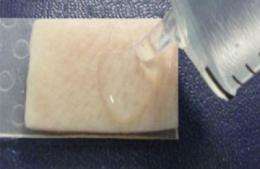
The sealant developed by Dr Chen being applied to a skin sample

(Medical Xpress) -- A Monash University researcher has developed a new form of surgical sealant that is not only easier for surgeons to manipulate, allowing for a more effective application, but significantly reduces the risk of virus contamination.

Surgical sealants are wax or gel-like substances used with sutures to completely seal internal and external after surgery. They are particularly important following lung or spinal operations, where air and cerebro-spinal fluid can leak through the suture holes, causing numerous complications.

Limiting these leaks results in reduced , less post-operative pain and shorter hospital stays for patients.

Initial research on the new sealant formula, developed by Dr Qizhi Chen, and her team from the Department of Materials Engineering at Monash University, was recently published in the journal .

“To be effective, a sealant must be sticky enough to allow the suture line to heal underneath, flexible, to allow for the body’s movement, and able to be absorbed by the body to eliminate the need for a second operation.”

“We’ve conducted initial tests on the new sealant and the results are very promising.”

“The major advantage of our sealant is that there’s no risk of infection because it’s synthetic. It’s not developed from human blood extract, like the current sealants on the market,” said Dr Chen.

The most common form of sealants currently in use are composed of natural materials extracted from human blood, such as fibrin. Although the natural sealants promote wound healing, their use involves a serious risk of blood-borne disease contamination such as HIV/AIDS or Hepatitis B.

The other major advantage of Dr Chen’s synthetic formula is the ease of application.

“It can be pasted on as a liquid at 45 degrees celsius. This hardens into a flexible wax-like substance at body temperature. The surgeon has plenty of time to make sure the sealant is properly applied. currently in use can harden too quickly, meaning they’re not always applied as effectively as they could be. Our formula resolves this issue.”

Provided by Monash University search and more info website

not rated yet  

Rank not rated yet
Relevant PhysicsForums posts

More news stories

Researcher calls for new approach to regulating probiotics

In today's Nature scientific journal Dr. Gregor Reid, Director of the Canadian R&D Centre for Probiotics at Lawson Health Research Institute and a scientist at Western University, calls for a Category Tree system to be imp ...

Other created 16 hours ago | popularity not rated yet | comments 1 | with audio podcast

Professor conducting study to determine whether supplements help muscles grow

Nutritional supplements are often associated with athletes and body builders, but a University of Kansas professor is conducting a research project to determine whether they are in fact, effective and if they might be able ...

Other created 22 hours ago | popularity not rated yet | comments 0

Researchers develop IT solution to help disabled make better wheelchair selections

A Wayne State University researcher has introduced computer technology that makes it easier for people who need wheelchairs to select one that best suits their needs.

Other created May 23, 2012 | popularity not rated yet | comments 0

Study shows how patients use Facebook to solicit kidney donations

Loyola University Medical Center researchers are reporting one of the first studies to examine how patients and families are soliciting living kidney donors on Facebook.

Other created May 23, 2012 | popularity not rated yet | comments 0

WHO's Chan re-elected for second term

The World Health Organisation on Wednesday re-appointed Margaret Chan as its chief, who declared universal health care as her top priority.

Other created May 23, 2012 | popularity not rated yet | comments 0


Amino acid consumption associated with how fast cancer cells divide

For almost a century, researchers have known that cancer cells have peculiar appetites, devouring glucose in ways that normal cells do not. But glucose uptake may tell only part of cancer's metabolic story. Researchers from ...

Thioridazine kills cancer stem cells in human while avoiding toxic side-effects of conventional cancer treatments

A team of scientists at McMaster University has discovered a drug, thioridazine, successfully kills cancer stem cells in the human while avoiding the toxic side-effects of conventional cancer treatments.

Like curry? New biological role identified for compound used in ancient medicine

Scientists have just identified a new reason why some curry dishes, made with spices humans have used for thousands of years, might be good for you.

'Personality genes' may help account for longevity

"It's in their genes" is a common refrain from scientists when asked about factors that allow centenarians to reach age 100 and beyond. Up until now, research has focused on genetic variations that offer a physiological advantage ...

Gene discovery points towards non-hormonal male contraceptive

A new type of male contraceptive could be created thanks to the discovery of a key gene essential for sperm development.

Cyber exercise partners help you go the distance: Motivation gains can double

A new study testing the benefits of a virtual exercise partner shows the presence of a moderately more capable cycling partner can significantly boost the motivation – by as much as 100 percent – ...