Deeper insight in the activity of cortical cells
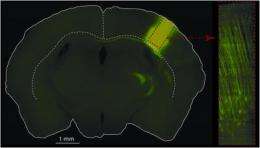
Left is an image of a cross-section through the whole mammalian brain that shows both brain hemispheres (solid white outline) as well as the overlaying cerebral cortex which is made up of many layers (I-VI). On the right hemisphere are brain cells, neurons, labeled with a genetically encoded fluorescent marker that reports back the cells activity by fast changes in brightness. This image has been taken from a brain slice post mortem where the lower limit of the cortex can be seen (dotted white line). Right, this image shows the same deep layer V brain cells (red box) labeled with the genetically encoded fluorescent marker but actually imaged noninvasively from a living animal using a modified multi-photon microscope, or RAMM approach. This allows scientists to study activity in neuronal populations deep in the cortex of an awake behaving animal and will lead to a deeper understanding of how cortical networks perform computations. Credit: Wolfgang Mittmann, Jason Kerr / Max Planck Institute for Biological Cybernetics
Visual and tactile objects in our surroundings are translated into a perception by complex interactions of neurons in the cortex. The principles underlying spatial and temporal organization of neuronal activity during decision-making and object perception are not all understood yet. Jason Kerr from Max Planck Institute for Biological Cybernetics in Tübingen, in collaboration with Winfried Denk from the Max Planck Institute for Medical Research in Heidelberg, now investigated how different sensations are represented by measuring activity in neuronal populations deep in the cortex. The scientists developed a method, with which they can study the neuronal activity in some of the deepest layers of the cortex in rodents, something that has not been possible up until now.
The cerebral cortex, or just cortex, is the outermost sheet of neural tissue of the mammalian brain. It plays a key role in memory, perceptual awareness and consciousness. It receives and processes the information from the senses, such as sight, touch or smell. The principles underlying these processes are not fully understood yet. Jason Kerr, research group leader of the Network Imaging Group at the Max Planck Institute for Biological Cybernetics in Tübingen and his colleagues from the same institute, Wolfgang Mittmann, Damian Wallace und Uwe Czubayko managed to image neuronal activity simultaneously from many neurons with single cell resolution, over twice as deep as previously achieved. In collaboration with Winfried Denk from the Department Biomedical Optics at the Max Planck Institute for Medical Research in Heidelberg and scientists from the Howard Hughes Medical Institute in Ashburn, Virginia they studied the neural cell activity in layer L5b in the adult rodent, which, as well as being one of the output layers of the cortex, it is also only one layer away from the cortex end.
Up until now. most imaging studies were restricted to the upper third of the cortex in the so-called layers L2 and L3. Deeper layers could only be studied using electrodes or by damaging the cortex using optical fibers or prisms. The Max Planck scientists now further developed a method, with which they can see exactly which cell is active and importantly, what cells are not active during a stimulus up to one millimeter from the cortical surface. This has enabled the scientists to measure the spatiotemporal organization of activity in these deep layers.
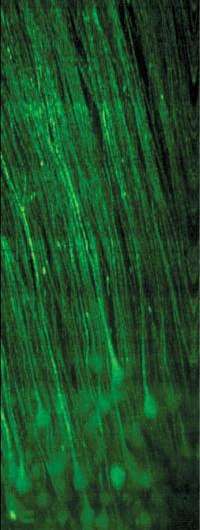
This image shows the same deep layer V brain cells (red box) labeled with the genetically encoded fluorescent marker, but actually imaged noninvasively from a living animal using a modified multi-photon microscope, or RAMM approach. This allows scientists to study activity in neuronal populations deep in the cortex of an awake behaving animal and will lead to a deeper understanding of how cortical networks perform computations. Credit: W. Mittmann, J. Kerr / MIP for Biological Cybernetics
"We express a genetically encoded fluorescent activity reporter in the neurons of interest and with this we can measure the activity of many neurons at the same time", explains Jason Kerr. Changes in brightness of the fluorescent marker are relative to the activity of the neuron. Using the new multi photon imaging technique the activity of many neuronal populations in the deeper cortical layers can be recorded simultaneously in vivo. Jason Kerr and his team combined regenerative amplification multiphoton microscopy (RAMM) with generally encoded calcium indicators to extend multi photon imaging of neuronal population activity to the deeper layers of the cortex. Using this approach, they found, that it could be used to record and quantify spontaneous and activity evoked in the animal by sensory stimulation such as whisker touches or natural movies in neuronal populations of the layer L5a and L5b.
The goal of their research is to record activity from populations of neurons located in all cortical layers, from the layer 6 to layer 1. In combination with genetically encoded activity indicators, the team plans to investigate the spatial temporal organization of neuronal activity from all cortical layers in animals trained to discriminate between objects. Further, they want to address the question of whether the deeper layers also show spatiotemporal re-organization similar to that shown for the upper cortical layers during learning. With these technical advances the scientists aim to gain insights into cortical circuits involved in decision making in the awake, behaving cortex, and how these circuits are functionally modified during learning.
More information: Wolfgang Mittmann, Damian J Wallace, Uwe Czubayko, Jan T Herb, Andreas T Schaefer, Loren L Looger, Winfried Denk & Jason N D Kerr. (2011) Two-photon calcium imaging of evoked activity from L5 somatosensory neurons in vivo. Nature Neuroscience doi:10.1038/nn.2879
Provided by
Max-Planck-Gesellschaft
-
Picower research finds unexpected activity in visual cortex
Mar 16, 2006 |
not rated yet |
0
-
Scientists identify neuron types that mediate different behavioral states
Mar 17, 2011 |
not rated yet |
0
-
New powerful tool can visualize dynamic activity of electrical signals in neuronal populations
Sep 27, 2010 |
not rated yet |
0
-
Regions of the brain can rewire themselves
Mar 09, 2009 |
not rated yet |
0
-
Mobile microscopes illuminate the brain
Nov 03, 2009 |
not rated yet |
0
-
Motion perception revisited: High Phi effect challenges established motion perception assumptions
Apr 23, 2013 |
3 / 5 (2) |
2
-
Anything you can do I can do better: Neuromolecular foundations of the superiority illusion (Update)
Apr 02, 2013 |
4.5 / 5 (11) |
5
-
The visual system as economist: Neural resource allocation in visual adaptation
Mar 30, 2013 |
5 / 5 (2) |
9
-
Separate lives: Neuronal and organismal lifespans decoupled
Mar 27, 2013 |
4.9 / 5 (8) |
0
-
Sizing things up: The evolutionary neurobiology of scale invariance
Feb 28, 2013 |
4.8 / 5 (10) |
14
-
Why is zone 1 in liver more prone to ischemic injury?
19 hours ago
-
How can there be villous adenoma in colon, if there are no villi there
May 22, 2013
-
How can there be a term called "intestinal metaplasia" of stomach
May 21, 2013
-
Pressure-volume curve: Elastic Recoil Pressure don't make sense
May 18, 2013
-
If you became brain-dead, would you want them to pull the plug?
May 17, 2013
-
MRI bill question
May 15, 2013
- More from Physics Forums - Medical Sciences
More news stories
Controlling mood through the motions of mitochondria
(Medical Xpress)—Regulating the distribution of power in neurons is done by a system that makes the national electric grid look simple by comparison. Each neuron has several thousand mitochondria confined ...
Neuroscience
6 hours ago |
4.8 / 5 (5) |
0
|
Brain uses internal 'average voice' prototype to identify who is talking
(Medical Xpress)—The human brain is able to identify individuals' voices by comparing them against an internal 'average voice' prototype, according to neuroscientists.
Neuroscience
10 hours ago |
1 / 5 (1) |
0
|
Depression common among children with temporal lobe epilepsy
A new study determined that children and adolescents with seizures involving the temporal lobe are likely to have clinically significant behavioral problems and psychiatric illness, especially depression. Findings published ...
Neuroscience
10 hours ago |
not rated yet |
0
The secret lives, and deaths, of neurons
As the human body fine-tunes its neurological wiring, nerve cells often must fix a faulty connection by amputating an axon—the "business end" of the neuron that sends electrical impulses to tissues or other ...
Neuroscience
11 hours ago |
5 / 5 (2) |
0
|
Regenerating spinal cord fibers may be treatment for stroke-related disabilities
A study by researchers at Henry Ford Hospital found "substantial evidence" that a regenerative process involving damaged nerve fibers in the spinal cord could hold the key to better functional recovery by most stroke victims.
Neuroscience
11 hours ago |
not rated yet |
0
|
Multiple research teams unable to confirm high-profile Alzheimer's study
Teams of highly respected Alzheimer's researchers failed to replicate what appeared to be breakthrough results for the treatment of this brain disease when they were published last year in the journal Science.
Motion quotient: IQ predicted by ability to filter motion (w/ video)
A brief visual task can predict IQ, according to a new study. This surprisingly simple exercise measures the brain's unconscious ability to filter out visual movement. The study shows that individuals whose ...
Scientists discover molecule triggers sensation of itch
Scientists at the National Institutes of Health report they have discovered in mouse studies that a small molecule released in the spinal cord triggers a process that is later experienced in the brain as ...
Researchers find common childhood asthma unconnected to allergens or inflammation
Little is known about why asthma develops, how it constricts the airway or why response to treatments varies between patients. Now, a team of researchers at Weill Cornell Medical College, Columbia University Medical Center ...
Diabetes' genetic underpinnings can vary based on ethnic background, studies say
Ethnic background plays a surprisingly large role in how diabetes develops on a cellular level, according to two new studies led by researchers at the Stanford University School of Medicine.
Study reveals new mechanism for estrogen suppression of liver lipid synthesis
By discovering the new mechanism by which estrogen suppresses lipid synthesis in the liver, UC Irvine endocrinologists have revealed a potential new approach toward treating certain liver diseases.
