Scientists explore alternative to antibiotics
July 15, 2011 in Medical research
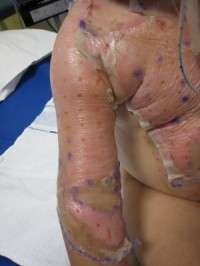
A child suffering from 32 per cent burns from a cup of tea. Credit: North Bristol NHS Trust
A pioneering method for fighting burn infections in children using viruses which destroy disease-causing bacteria has been awarded new funding.
It is hoped the project will develop a burns dressing that will prevent and treat superbugs that have become resistant to antibiotics without the use of antibiotics or synthetic antimicrobials.
Scientists from Bristols Frenchay hospital, the University of Bath and AmpliPhi Biosciences in Bedfordshire are harnessing bacteriophages viruses which kill bacteria.
The project has now been awarded a grant of £620,000 from the Engineering and Physical Sciences Research Council (EPSRC) to develop a prototype dressing.
Half of all burn injuries occur in children, and most of these are due to scalds from hot tea, coffee and bath water.
Around 10 percent of children who are burnt become infected by disease-causing bacteria which can increase the likelihood of scarring and in some cases even cause death.
In the last year the South West UK Childrens Burn Center at Frenchay Hospital in Bristol has treated more than 800 children for serious burn injuries.
Current treatments for infections use chemical antibiotics but bacteria are rapidly evolving resistance to such drugs.
University of Bath project leader Dr. Toby Jenkins said: The fact that bacteria are becoming more and more resistant to antibiotics is extremely worrying.
There is an arsenal of drugs at our disposal to treat children with infected burn wounds, but in recent years there have been an increasing number of cases where antibiotics prove ineffective due to bacterial antibiotic resistance. In some cases of infection no antibiotics will be effective in treatment.
This is a very serious situation and a great deal of innovation is required in the way we treat infections.
The answer, we believe, lies in a radical new approach to treating infection using natural bacteria-killing viruses.
Bacteriophages have already been shown to be safe and effective in a recent clinical trial in patients with chronic ear infections, carried out by AmpliPhis wholly-owned subsidiary Biocontrol Ltd.
Professor Mark Enright, AmpliPhis Research Director, told us These phages are naturally occurring and safe as they only ever infect their target species of bacteria.
They enter their host, reproduce and then burst out and then go on to kill more bacteria. Once all the infection-causing bacteria are consumed the phages simply die.
Our company is targeting antibiotic resistant bacteria in a number of projects with the aim of producing safe and effective therapies that are subjected to the same type of clinical trials and regulations as new drugs.
Dr. Amber Young, a paediatric burn specialist at the South West UK Childrens Burn Centre, a clinical consultant and partner on the project, said: Of the 37,000 scald accidents in the UK each year, nearly 76 percent are children under five, and 70 percent are caused by hot liquids being split.
180 children every day are seen in accident and emergency departments with scalds from hot drink spillage alone.
The terrible truth is that even a very small burn can very quickly become infected, and the child can become seriously ill.
This funding award is absolutely essential for the research team to develop this product, so its a really positive step forward in the field of paediatric burn treatment.
Dr. Jenkins aims to introduce phage into burns using advanced dressings, covered with nanocapsules used to contain and stabilize the phage.
Dr. Jenkins said: This is as part of a wider research interest looking at making very advanced burns dressings which monitor the burn environment and treat infection.
Ultimately we want to make a prototype dressing which release a phage cocktail into the wound only if infected, clearing bacteria and allowing healing. The dressing will also change colour indicating infection at very early stages.
Dr. Jenkins colleague Dr. Tom Arnot is developing large scale methods of producing the nanocapsules, and for incorporating the nanocapsules into a gel formulation for topical application to the skin.
Dr. Arnot said: Different burns require different approaches to treatment, so developing a gel for topical skin application in addition to the wound dressing would allow this unique technology to be applied under a wider range of circumstances. We are also looking at the engineering and production aspects of formulating this type of preparation at larger scale
The EPSRC funding award will allow the team to develop prototype dressings, undertake microbial analysis and begin preclinical trials, with the aim of commencing clinical trials at the end of the project.
Provided by
University of Bath
-
Revolutionary medical dressing uses nano-technology to fight infection
Jul 08, 2010 |
not rated yet |
0
-
New viruses to treat bacterial diseases
Sep 03, 2007 |
not rated yet |
0
-
The kids are alright
May 26, 2011 |
not rated yet |
0
-
New antibiotic for hospital superbug looks promising
Oct 12, 2010 |
not rated yet |
0
-
'Smart' wound dressings could identify and destroy infection-causing bacteria
May 06, 2010 |
not rated yet |
0
-
Of mice and mental models: Neuroscientific implications of risk-optimized behavior in the mouse
7 hours ago |
not rated yet |
0
-
Limits to growth: Scientists identify key metastasis-enabling enzyme
May 22, 2012 |
5 / 5 (3) |
0
-
Seeing is as seeing does: Spatially-structured retinal input in early development of cortical maps
Apr 26, 2012 |
5 / 5 (4) |
1
-
Dreamless nights: Brain activity during nonrapid eye movement sleep
Apr 09, 2012 |
4.4 / 5 (12) |
0
-
Take your time: Neurobiology sheds light on the superiority of spaced vs. massed learning
Mar 28, 2012 |
4.5 / 5 (21) |
3
-
A question about drug tolerance
May 23, 2012
-
Poor nutrition leading to overeating?
May 23, 2012
-
Math and dyslexia?
May 21, 2012
-
portable metabolism meter?
May 21, 2012
-
Rare medical conditions on 20/20 tonight
May 18, 2012
-
"Good" Cholesterol in Doubt
May 17, 2012
- More from Physics Forums - Medical Sciences
More news stories
Implantable pain disk may help those with cancer
An estimated 3.5 million cancer patients around the globe are in severe pain from their disease, but many get no relief.
Medical research
5 hours ago |
not rated yet |
0
|
Energy levels link sleep control mechanisms
Sleep, or lack of it, can determine level of cognitive performance which is linked with accidents as well as increased risk of serious health problems. Links between cell energy levels, gene transcription ...
Medical research
7 hours ago |
not rated yet |
0
Researchers identify key brain cell in antidepressant action
(Medical Xpress) -- Antidepressant medications such as Prozac have helped improve mood and lessen anxiety in millions of people with major depression. But scientists know surprisingly little about how these drugs work.
Medical research
7 hours ago |
not rated yet |
0
|
Rockefeller scientists pioneer new method to determine mechanisms of drug action
(Medical Xpress) -- Knowing that a drug works is great. Knowing how it works is a luxury. And until now, determining a drugs mechanism of action has been a tedious and difficult process for scientists.
Medical research
7 hours ago |
not rated yet |
0
|
Like curry? New biological role identified for compound used in ancient medicine
Scientists have just identified a new reason why some curry dishes, made with spices humans have used for thousands of years, might be good for you.
Medical research
15 hours ago |
4 / 5 (3) |
1
|
Early physical therapist treatment associated with reduced risk of healthcare utilization and reduced overall healthcare
A new study published in Spine shows that early treatment by a physical therapist for low back pain (LBP), as compared to delayed treatment, was associated with reduced risk of subsequent healthcare utilization and lower ...
Skp2 activates cancer-promoting, glucose-processing Akt
HER2 and its epidermal growth factor receptor cousins mobilize a specialized protein to activate a major player in cancer development and sugar metabolism, scientists report in the May 25 issue of Cell.
Of mice and mental models: Neuroscientific implications of risk-optimized behavior in the mouse
(Medical Xpress) -- Regardless of an organism’s biological complexity, every encephalized animal continuously makes under-informed behavioral choices that can have serious consequences. Despite its ubiquity, ...
Cancer may require simpler genetic mutations than previously thought
Chromosomal deletions in DNA often involve just one of two gene copies inherited from either parent. But scientists haven't known how a deletion in one gene from one parent, called a "hemizygous" deletion, can contribute ...
Inherited DNA change explains overactive leukemia gene
A small inherited change in DNA is largely responsible for overactivating a gene linked to poor treatment response in people with acute leukemia.
Flesh-Eating bacteria no cause for panic, experts say
(HealthDay) -- Despite scary headlines by the score, most people don't have to fear that they'll be the next victim of the so-called flesh-eating bacteria disease, experts say.
Jul 15, 2011
Rank: not rated yet
If different types of cells' membranes have different resonant frequencies, the theory of the Rife generator is possible even if the current devices are a hoax: http://episin.blo...dly.html
Jul 15, 2011
Rank: not rated yet
Ask them about this in Ukraine, and they'll assume you're dumb. Duh!
They have a center where you send a wound sample, and they'll grow a tailor made set of phages to combat the exact set of bacteria that you are infected with.
I don't know about the UK, but in america, each drug has to be approved for a use. since there are thousands of different bacteria that can infect you or your wounds, a phage has to be shown to be beneficial by itself, and then repeated for each. and. ever. bacteria. it would take centuries for the US approval process.
I guess that's one medical advance that communism was able to push ahead with better than us.