Timothy syndrome mutations provide new insights into the structure of L-calcium channel
July 14, 2011 in Medical research
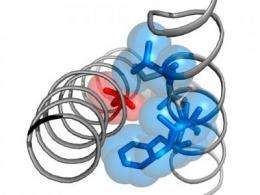
The Timothy mutation is part of a highly conserved structure motif, which consists of small amino acids. Credit: Anna Stary-Weinzinger
The human genome encodes 243 voltage-gated ion channels. Mutations in calcium channels can cause severe inherited diseases such as migraine, night blindness, autism spectrum disorders and Timothy syndrome, which leads to severe cardiovascular disorders. Katrin Depil and Anna Stary-Weinzinger together with colleagues from the Department of Pharmacology and Toxicology, University of Vienna analyzed changes in molecular organization of calcium channels caused by Timothy syndrome mutations. Recently, they published their current research results in the Journal of Biological Chemistry.
Ion channels are large membrane proteins that conduct potassium, sodium or calcium ions. They regulate electrical signals in the nervous system, control the release of neurotransmitters and are responsible for the regulation of the heart rhythm and muscle contractions. Voltage-gated calcium channels, like all other voltage-gated ion channels open and close in response to changes in membrane potential. The exact mechanisms underlying this gating process are still unexplored. It is however known that mutations can severely affect channel opening and closing, thereby disturbing the calcium homeostasis, which could lead to so called "ion channel diseases" or "channelopathies".
Life-threatening disease
Timothy syndrome, which was first described in the 90s, often leads to sudden cardiac death in early childhood. In 2004 it was discovered that mutations in calcium channel, which replace two amino acids in the ion channel protein sequence with other amino acids, cause the neurological disorders, autism, severe arrhythmias and webbing of fingers and toes that are associated with the Timothy syndrome. Prof. Hering, Head of the Department of Pharmacology and Toxicology of the University of Vienna, explains that the Timothy mutations result in enhanced calcium entry caused by defects in channel closure during an action potential. This in turn induces a calcium overflow causing arrhythmias and multiple disease patterns."
Destabilization of the closed pore
The current research focus of the two young scientists, Katrin Depil and Anna Stary-Weinzinger, are voltage gated calcium channels. In the recently published paper in Journal of Biological Chemistry the authors describe that the Timothy-mutation is part of a highly conserved structure motif, which consists of small amino acids glycines (G) and alanines (A), which they named the "G/A/G/A"-motif. The strongest effect on channel opening occurs when residues from this motif are replaced with bigger hydrophobic amino acids. Anna Stary-Weinzinger: "We assume that the Timothy G406 and the whole G/A/G/A-motif are essential for sealing of the closed channel pore. Mutations to larger amino acids in this position prevent optimal channel closure. Our data suggest that these residues form an important part of the channel gate."
Guided by systematic mutation and correlation analyzes of specific pore segments in calcium channels, Katrin Depil already succeeded in identifying key amino acid side chain properties, that play a key role in the molecular mechanism of channel opening and closure. Katrin Depil: "By analyzing further interactions in different positions in the pore region we aim to refine our calcium channel homology models. We hope to contribute to a better understanding of Timothy disease and other channelopathies."
More information: Depil K, Beyl S, Stary-Weinzinger A, Hohaus A, Timin E, Hering S. Timothy mutation disrupts link between activation and inactivation in CaV1.2. Journal of Biological Chemistry. Jun 17, 2011
DOI: 10.1074/jbc.M111.255273
Provided by
University of Vienna
-
New study has implications for understanding ion channel defects
Feb 01, 2010 |
not rated yet |
0
-
Rare disease provides clues about enzyme role in arrhythmias
Dec 11, 2008 |
not rated yet |
0
-
Solving the puzzle of the BK ion channel (w/ Video)
Jun 23, 2010 |
not rated yet |
0
-
Jefferson scientists uncover new clues to how crucial molecular gatekeepers work
Oct 11, 2005 |
not rated yet |
0
-
Common mechanism underlies many diseases of excitability
Dec 28, 2009 |
not rated yet |
0
-
Motion perception revisited: High Phi effect challenges established motion perception assumptions
Apr 23, 2013 |
3 / 5 (2) |
2
-
Anything you can do I can do better: Neuromolecular foundations of the superiority illusion (Update)
Apr 02, 2013 |
4.5 / 5 (11) |
5
-
The visual system as economist: Neural resource allocation in visual adaptation
Mar 30, 2013 |
5 / 5 (2) |
9
-
Separate lives: Neuronal and organismal lifespans decoupled
Mar 27, 2013 |
4.9 / 5 (8) |
0
-
Sizing things up: The evolutionary neurobiology of scale invariance
Feb 28, 2013 |
4.8 / 5 (10) |
14
-
Pressure-volume curve: Elastic Recoil Pressure don't make sense
23 hours ago
-
If you became brain-dead, would you want them to pull the plug?
May 17, 2013
-
MRI bill question
May 15, 2013
-
Ratio of Hydrogen of Oxygen in Dessicated Animal Protein
May 13, 2013
-
Alcohol and acetaminophen
May 13, 2013
-
Marie Curie's leukemia
May 13, 2013
- More from Physics Forums - Medical Sciences
More news stories
Now we know why old scizophrenia medicine works on antibiotics-resistant bacteria
In 2008 researchers from the University of Southern Denmark showed that the drug thioridazine, which has previously been used to treat schizophrenia, is also a powerful weapon against antibiotic-resistant bacteria such as ...
Medical research
May 17, 2013 |
3.7 / 5 (3) |
0
|
SUMO wrestling cells reveal new protective mechanism target for stroke
Scientists investigating the interaction of a group of proteins in the brain responsible for protecting nerve cells from damage have identified a new target that could increase cell survival.
Medical research
May 17, 2013 |
5 / 5 (1) |
0
How serotonin receptors can shape drug effects, from LSD to migraine medication
New findings by researchers carrying out experiments at the U.S. Department of Energy Office of Science's Advanced Photon Source (APS) help explain why some drugs that interact with two kinds of human serotonin ...
Medical research
May 17, 2013 |
not rated yet |
0
|
Preventing blood poisoning
Peptide molecules derived from the body's natural immune system can help boost the body's defence against life-threatening blood poisoning, joint University research has uncovered.
Medical research
May 17, 2013 |
4 / 5 (1) |
0
|
New mechanism to prevent type 2 diabetes in obese individuals
A new Montréal study conducted by Dr. May Faraj, associate research professor at the Université de Montréal and invited scientist at the IRCM, along with her research team and medical collaborators, shows ...
Medical research
May 17, 2013 |
not rated yet |
0
|
Ketamine shows significant therapeutic benefit in people with treatment-resistant depression
Patients with treatment-resistant major depression saw dramatic improvement in their illness after treatment with ketamine, an anesthetic, according to the largest ketamine clinical trial to-date led by researchers from the ...
Consuming coffee linked to lower risk of detrimental liver disease, study finds
Regular consumption of coffee is associated with a reduced risk of primary sclerosing cholangitis (PSC), an autoimmune liver disease, Mayo Clinic research shows. The findings were being presented at the Digestive Disease ...
Research examines new methods for managing digestive health
Research presented at Digestive Disease Week (DDW) explores new methods for managing digestive health through diet and lifestyle.
New smartphone application improves colonoscopy preparation
The use of a smartphone application significantly improves patients' preparation for a colonoscopy, according to new research presented today at Digestive Disease Week (DDW). The preparation process, which begins days in ...
New research identifies practice changes to improve value and quality of GI procedures
There are significant cost and risk factors associated with two procedures commonly used to diagnose or treat gastrointestinal problems, according to research presented at Digestive Disease Week (DDW).
New research identifies risks, interventions for children's GI health
An increasing number of U.S. children are experiencing gastrointestinal issues that require interventions to resolve, according to research presented at Digestive Disease Week (DDW).