When well-known flu strains 'hook up' dangerous progeny can result
July 13, 2011 in Diseases, Conditions, Syndromes
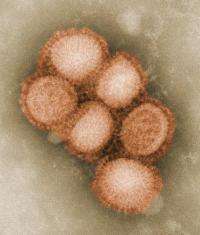
Pictured is a negative stain electron microscope image of the H1N1 Influenza virus that was responsible for the 2009 flu pandemic. Credit: C. S. Goldsmith and A. Balish, CDC
A new University of Maryland-led study finds that 'sex' between the virus responsible for the 2009 flu pandemic (H1N1) and a common type of avian flu virus (H9N2) can produce offspring -- new combined flu viruses -- with the potential for creating a new influenza pandemic.
Of course, viruses don't actually have sex, but University of Maryland virologist Daniel Perez, who directed the new study, says new pandemic viruses are formed mainly through a process called reassortment, which can best be described as viral sexual reproduction. "In reassortment, two viruses enter the same cell; their genetic material is mixed; and new genetically distinct viruses emerge," explains Perez, an associate professor in the VA-MD Regional College of Veterinary Medicine, Maryland Campus.
According to Perez and his colleagues many factors are involved in the viability of new viruses that result from reassortment, but the most important is the compatibility of their two sets of viral genes to work together to form functional offspring. The importance of reassortment in the generation of viruses with pandemic potential, the scientists say, was demonstrated in 2009 when a novel H1N1 influenza (pH1N1) virus caused the first influenza pandemic in 40 years. That virus was identified as the product of a three way reassortment, between avian, swine, and human influenza viruses.
In their current study, the researchers looked at the compatibility of the 2009 pandemic pH1N1 virus -- which has some genetic characteristics that may allow it to reassort more easily than other influenza viruses with an influenza strain known as H9N2.
Published in the Proceedings of the National Academy of Sciences (PNAS) the week of July 4-8, this new research builds on earlier findings by Perez and his team of the heightened communicability of the H1N1 virus as well as their work on the airborne communicability of H9N2. And it adds knowledge that may advance modern medicine's longstanding effort to learn how to predict when pandemic flu viruses will arise. An effort that in recent years has focused on study of H5, H7, and H9 subtypes of flu viruses because these all occasionally infect humans and, in the case of H5 viruses, can cause significant disease and death.
For their PNAS study, the researchers created four reassortant viruses with one or two genes from the H9N2 virus and the rest of the genes from pH1N1. They used two different H9N2 viruses to provide the genes. One was a typical H9N2 isolated from a bird in Asia. The other was an avian isolate that had been adapted to infect and transmit in mammals.
Perez and colleagues looked at the growth characteristics of these four viruses and also their infectivity and transmissibility in ferrets. Ferrets are used as a model for human infections as they are susceptible to the same viruses and show similar signs of infection. All four viruses were able to grow to relatively high levels in cell culture. Similarly all four viruses infected ferrets and showed similar signs of disease and levels of replication. Additionally, they were all able to transmit to ferrets housed in the same cage and allowed physical contact. Finally, three of the four viruses were able to transmit to ferrets that were physically separated but shared the same air.
The new results are important for several reasons according to Perez. "Ours is the first study to show respiratory transmission of an H9 reassortant virus in mammals without prior adaptation. This is important because a new virus must be able to transmit via the respiratory route to impact the human population significantly. Secondly, adapting some of the genes to mammalian hosts allows for more efficient infection and transmission. Finally, these studies indicate that the pH1N1 and H9N2 influenza subtypes are highly compatible for reassortment with each other. And this compatibility means there is potential for the emergence of an H9 influenza pandemic."
More information: "Compatibility of H9N2 avian influenza surface genes and 2009 pandemic H1N1 internal genes for transmission in the ferret model," PNAS, July 4- 8, 2011.
Provided by
University of Maryland
-
The pandemic potential of H9N2 avian influenza viruses
Aug 13, 2008 |
not rated yet |
0
-
Avian Flu Research Sheds Light on Swine Flu Outbreak (w/Podcast)
Apr 28, 2009 |
not rated yet |
0
-
H3N1 pig flu virus found in South Korea
Nov 20, 2006 |
not rated yet |
0
-
Virus hybridization could create pandemic bird flu
Feb 22, 2010 |
not rated yet |
0
-
H1N1 pandemic virus does not mutate into 'superbug' in new lab study
Sep 01, 2009 |
not rated yet |
0
-
Of mice and mental models: Neuroscientific implications of risk-optimized behavior in the mouse
9 hours ago |
not rated yet |
0
-
Limits to growth: Scientists identify key metastasis-enabling enzyme
May 22, 2012 |
5 / 5 (3) |
0
-
Seeing is as seeing does: Spatially-structured retinal input in early development of cortical maps
Apr 26, 2012 |
5 / 5 (4) |
1
-
Dreamless nights: Brain activity during nonrapid eye movement sleep
Apr 09, 2012 |
4.4 / 5 (12) |
0
-
Take your time: Neurobiology sheds light on the superiority of spaced vs. massed learning
Mar 28, 2012 |
4.5 / 5 (21) |
3
-
Classical and Quantum Mechanics via Lie algebras
Apr 15, 2011
- More from Physics Forums - Independent Research
More news stories
Flesh-Eating bacteria no cause for panic, experts say
(HealthDay) -- Despite scary headlines by the score, most people don't have to fear that they'll be the next victim of the so-called flesh-eating bacteria disease, experts say.
Diseases, Conditions, Syndromes
3 hours ago |
not rated yet |
0
World Health Assembly endorses new plan to increase global access to vaccines
Ministers of Health from 194 countries at the Sixty-fifth World Health Assembly today endorsed a landmark Global Vaccine Action Plan (GVAP), a roadmap to prevent millions of deaths by 2020 through more equitable access to ...
Diseases, Conditions, Syndromes
7 hours ago |
not rated yet |
0
Physicians definitively links irritable bowel syndrome and bacteria in gut
An overgrowth of bacteria in the gut has been definitively linked to Irritable Bowel Syndrome in the results of a new Cedars-Sinai study which used cultures from the small intestine. This is the first study to use this "gold ...
Diseases, Conditions, Syndromes
8 hours ago |
not rated yet |
0
|
Study provides compelling evidence for an effective new treatment for tinnitus
According to new research, a multidisciplinary approach to treating tinnitus that combines cognitive behaviour therapy with sound-based tinnitus retraining therapy is significantly more effective than currently available ...
Diseases, Conditions, Syndromes
23 hours ago |
not rated yet |
0
Infections may be deadly for many dialysis patients
An infection called peritonitis commonly arises in the weeks before many dialysis patients die, according to a study appearing in an upcoming issue of the Journal of the American Society of Nephrology (JASN). The findings sugges ...
Diseases, Conditions, Syndromes
May 24, 2012 |
not rated yet |
0
Tongue analysis software uses ancient Chinese medicine to warn of disease
For 5,000 years, the Chinese have used a system of medicine based on the flow and balance of positive and negative energies in the body. In this system, the appearance of the tongue is one of the measures used to classify ...
Most occupational injury and illness costs are paid by the government and private payers
UC Davis researchers have found that workers' compensation insurance is not used nearly as much as it should be to cover the nation's multi-billion dollar price tag for workplace illnesses and injuries. Instead, almost 80 ...
Of mice and mental models: Neuroscientific implications of risk-optimized behavior in the mouse
(Medical Xpress) -- Regardless of an organism’s biological complexity, every encephalized animal continuously makes under-informed behavioral choices that can have serious consequences. Despite its ubiquity, ...
Cancer may require simpler genetic mutations than previously thought
Chromosomal deletions in DNA often involve just one of two gene copies inherited from either parent. But scientists haven't known how a deletion in one gene from one parent, called a "hemizygous" deletion, can contribute ...
Inherited DNA change explains overactive leukemia gene
A small inherited change in DNA is largely responsible for overactivating a gene linked to poor treatment response in people with acute leukemia.
Early physical therapist treatment associated with reduced risk of healthcare utilization and reduced overall healthcare
A new study published in Spine shows that early treatment by a physical therapist for low back pain (LBP), as compared to delayed treatment, was associated with reduced risk of subsequent healthcare utilization and lower ...