Filling without drilling
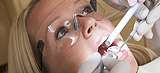
August 23, 2011 in Health
Researchers at the University of Leeds have discovered a pain-free way of tackling dental decay that reverses the damage of acid attack and re-builds teeth as new.
The pioneering treatment promises to transform the approach to filling teeth forever.
Tooth decay begins when acid produced by bacteria in plaque dissolves the mineral in the teeth, causing microscopic holes or 'pores' to form. As the decay process progresses these micro-pores increase in size and number. Eventually the damaged tooth may have to be drilled and filled to prevent toothache, or even removed.
The very thought of drilling puts many people off going to see their dentist, whether or not they actually need treatment. This tendency to miss check-ups and ignore niggling aches and pains means that existing problems get worse and early signs of decay in other teeth are overlooked.
It's a vicious cycle, but one that can be broken, according to researchers at the University of Leeds who have developed a revolutionary new way to treat the first signs of tooth decay. Their solution is to arm dentists with a peptide-based fluid that is literally painted onto the tooth's surface. The peptide technology is based on knowledge of how the tooth forms in the first place and stimulates regeneration of the tooth defect.
"This may sound too good to be true, but we are essentially helping acid-damaged teeth to regenerate themselves. It is a totally natural non-surgical repair process and is entirely pain-free too," said Professor Jennifer Kirkham, from the University of Leeds Dental Institute, who has led development of the new technique.
The 'magic' fluid was designed by researchers in the University of Leeds' School of Chemistry, led by Dr. Amalia Aggeli. It contains a peptide known as P 11-4 that - under certain conditions - will assemble together into fibres. In practice, this means that when applied to the tooth, the fluid seeps into the micro-pores caused by acid attack and then spontaneously forms a gel. This gel then provides a 'scaffold' or framework that attracts calcium and regenerates the tooth's mineral from within, providing a natural and pain-free repair.
The technique was recently taken out of the laboratory and tested on a small group of adults whose dentist had spotted the initial signs of tooth decay. The results from this small trial have shown that P 11-4 can indeed reverse the damage and regenerate the tooth tissue.
"The results of our tests so far are extremely promising," said Professor Paul Brunton, who is overseeing the patient testing at the University of Leeds Dental Institute. "If these results can be repeated on a larger patient group, then I have no doubt whatsoever that in two to three years time this technique will be available for dentists to use in their daily practice."
"The main reason that people don't go to the dentist regularly is fear. If we can offer a treatment that is completely non-invasive, that doesn't involve a mechanical drill, then we can change that perceived link between dental treatment and pain. This really is more than filling without drilling, this is a novel approach that enables the patients to keep their natural teeth!"
The study is being funded by credentis ag who have licensed the technology and are preparing to introduce P11-4 to dentists worldwide.
Provided by
University of Leeds
-
Simple push filling wins crown in battle against tooth decay
Dec 20, 2007 |
not rated yet |
0
-
Dentists could soon have an additional tool to help ward off tooth decay
May 18, 2010 |
not rated yet |
0
-
Scientists detect tooth decay in the 3rd dimension
Sep 07, 2004 |
not rated yet |
0
-
Improper consumption of acidic foods could lead to destroyed enamel
Jun 25, 2007 |
not rated yet |
0
-
Modern lifestyle prevents tooth decay
Feb 26, 2009 |
not rated yet |
0
-
Of mice and mental models: Neuroscientific implications of risk-optimized behavior in the mouse
12 hours ago |
not rated yet |
0
-
Limits to growth: Scientists identify key metastasis-enabling enzyme
May 22, 2012 |
5 / 5 (4) |
0
-
Seeing is as seeing does: Spatially-structured retinal input in early development of cortical maps
Apr 26, 2012 |
5 / 5 (4) |
1
-
Dreamless nights: Brain activity during nonrapid eye movement sleep
Apr 09, 2012 |
4.4 / 5 (12) |
0
-
Take your time: Neurobiology sheds light on the superiority of spaced vs. massed learning
Mar 28, 2012 |
4.5 / 5 (21) |
3
-
Classical and Quantum Mechanics via Lie algebras
Apr 15, 2011
- More from Physics Forums - Independent Research
More news stories
Most occupational injury and illness costs are paid by the government and private payers
UC Davis researchers have found that workers' compensation insurance is not used nearly as much as it should be to cover the nation's multi-billion dollar price tag for workplace illnesses and injuries. Instead, almost 80 ...
Health
3 hours ago |
not rated yet |
0
Early physical therapist treatment associated with reduced risk of healthcare utilization and reduced overall healthcare
A new study published in Spine shows that early treatment by a physical therapist for low back pain (LBP), as compared to delayed treatment, was associated with reduced risk of subsequent healthcare utilization and lower ...
Health
6 hours ago |
not rated yet |
0
|
Cancer patients share web info with docs for insight, advice
(HealthDay) -- Cancer patients' primary goal in talking with their doctors about information they've found on the Internet is to get more insight and advice on the online information, new research indicates.
Health
8 hours ago |
not rated yet |
0
P&G to add latches to make detergent packs safer
(AP) -- Procter & Gamble says it will change the design of packaging for its miniature laundry detergent product to deter children from eating the brightly colored packets that look like candy.
Health
9 hours ago |
not rated yet |
0
In Spain, 70 percent of women use contraceptives during their first sexual encounter
Contraceptive use in Spain during the first sexual encounter is similar to other European countries. However, there are some geographical differences between Spanish regions: women in Murcia use contraceptives ...
Health
10 hours ago |
not rated yet |
0
Tongue analysis software uses ancient Chinese medicine to warn of disease
For 5,000 years, the Chinese have used a system of medicine based on the flow and balance of positive and negative energies in the body. In this system, the appearance of the tongue is one of the measures used to classify ...
Of mice and mental models: Neuroscientific implications of risk-optimized behavior in the mouse
(Medical Xpress) -- Regardless of an organism’s biological complexity, every encephalized animal continuously makes under-informed behavioral choices that can have serious consequences. Despite its ubiquity, ...
Cancer may require simpler genetic mutations than previously thought
Chromosomal deletions in DNA often involve just one of two gene copies inherited from either parent. But scientists haven't known how a deletion in one gene from one parent, called a "hemizygous" deletion, can contribute ...
Skp2 activates cancer-promoting, glucose-processing Akt
HER2 and its epidermal growth factor receptor cousins mobilize a specialized protein to activate a major player in cancer development and sugar metabolism, scientists report in the May 25 issue of Cell.
Inherited DNA change explains overactive leukemia gene
A small inherited change in DNA is largely responsible for overactivating a gene linked to poor treatment response in people with acute leukemia.
New device allows pacemaker patients to safely undergo MRIs
For many, it's a medical conundrum: The very pacemaker keeping their heart in rhythm prevents them from undergoing an MRI to diagnose other ailments, because interaction between the two devices could prove deadly.
Aug 23, 2011
Rank: 5 / 5 (3)
Actually, the main reason that people don't go regularly is the expense, most of which isn't covered by insurance to the same degree as regular medical visits.
Aug 23, 2011
Rank: not rated yet
Aug 24, 2011
Rank: 5 / 5 (1)