Patients in a minimally conscious state remain capable of dreaming during their sleep
August 16, 2011 in Neuroscience
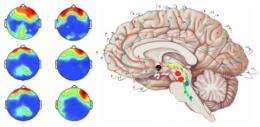
The brain of "minimally conscious" severely brain damaged patients shows "sleep-wake" activity as in normal healthy subjects. Changes in frontal "slow wave" activity during sleep (areas in red) are considered to reflect some capacity for neural plasticity or natural healing of the brain. © Coma Science Group, University/CHU of Liege
The question of sleep in patients with seriously altered states of consciousness has rarely been studied. Do vegetative' patients (now also called patients in a state of unresponsive wakefulness) or minimally conscious state patients experience normal sleep? Up until now the distinction between the two patient populations had not been taken into account by electrophysiological studies. Yet if the vegetative state opens no conscious door onto the external world, the state of minimal consciousness for its part assumes a residual consciousness of the environment, certainly fluctuating but real.
It is this difference which has led a group of researchers at the Coma Science Group and the universities of Wisconsin and Milan to compare the sleep of these two types of brain damaged patients. The results of their study are published this week in the journal Brain. They demonstrate once again the necessity of an adapted and specific medical care for each of these states.
The researchers' work rested on a sample of 11 subjects (6 in a state of minimal consciousness and 5 in a vegetative state) and made use of high density (256 electrodes) electroencephalography (EEG). The goal was to determine the structure of sleep within the two types of patient. "We used as a marker of arousal the fact that the subject had his/her eyes open and muscle tone, and as a marker of sleep the fact that the patient had closed eyes and muscle inactivity," points out Dr. Steven Laureys, the Director of the Coma Science Group.
The high density EEG revealed that the brain's electrical activity differed very little between sleep and wake states in patients in a vegetative state. On the other hand the sleep of patients in a minimally conscious state had characteristics very close to that of normal sleep in a healthy subject. They showed changes in "slow wave" activity in the front of the brain considered important for learning and neural plasticity (figure). It also appeared that these patients produced NREM (non rapid eye movement) slow wave sleep and REM (rapid eye movement) sleep, which is the support for dream activity.
"Everything thus indicates that they have access to dreaming," emphasises Steven Laureys. "As a result, we can legitimately suppose that they still have a form of consciousness of self in addition to a certain consciousness of the external world."
The study published in Brain brings to light a relationship between the electrophysiology of sleep and the degree of consciousness in severely brain damaged patients. Thus, once validated, the method used could constitute an additional tool to evaluate, in a routine clinical setting, the potential maintenance of a residual consciousness in these patients.
More information: Electrophysiological correlates of behavioural changes in vigilance in vegetative state and minimally conscious state', Brain (2011) 134 (8): 2222-2232. doi: 10.1093/brain/awr152
Provided by University of Liege
-
New test may help distinguish between vegetative and minimally conscious state
May 13, 2011 |
not rated yet |
0
-
Brain responses during anesthesia mimic those during natural deep sleep
Jan 27, 2010 |
not rated yet |
0
-
Scientists find that individuals in vegetative states can learn
Sep 20, 2009 |
not rated yet |
0
-
Study sheds light on how the brain shifts between sleep/awake states under anesthesia
Aug 26, 2010 |
not rated yet |
0
-
Out-of-body experiences may be caused by arousal system disturbances in brain
Mar 05, 2007 |
not rated yet |
0
-
Motion perception revisited: High Phi effect challenges established motion perception assumptions
Apr 23, 2013 |
3 / 5 (2) |
2
-
Anything you can do I can do better: Neuromolecular foundations of the superiority illusion (Update)
Apr 02, 2013 |
4.5 / 5 (11) |
5
-
The visual system as economist: Neural resource allocation in visual adaptation
Mar 30, 2013 |
5 / 5 (2) |
9
-
Separate lives: Neuronal and organismal lifespans decoupled
Mar 27, 2013 |
4.9 / 5 (8) |
0
-
Sizing things up: The evolutionary neurobiology of scale invariance
Feb 28, 2013 |
4.8 / 5 (10) |
14
-
Why is zone 1 in liver more prone to ischemic injury?
May 23, 2013
-
How can there be villous adenoma in colon, if there are no villi there
May 22, 2013
-
How can there be a term called "intestinal metaplasia" of stomach
May 21, 2013
-
Pressure-volume curve: Elastic Recoil Pressure don't make sense
May 18, 2013
-
If you became brain-dead, would you want them to pull the plug?
May 17, 2013
-
MRI bill question
May 15, 2013
- More from Physics Forums - Medical Sciences
More news stories
New neuron formation could increase capacity for new learning, at the expense of old memories
New research presented today shows that formation of new neurons in the hippocampus - a brain region known for its importance in learning and remembering - could cause forgetting of old memories by causing a reorganization ...
Neuroscience
6 hours ago |
3.7 / 5 (3) |
0
Help at hand for people with schizophrenia
How can healthy people who hear voices help schizophrenics? Finding the answer for this is at the centre of research conducted at the University of Bergen.
Neuroscience
7 hours ago |
4 / 5 (2) |
2
Japanese research organizations contribute to Human Brain Project
One of the major frontiers of modern science is a comprehensive understanding of the human brain and its functions to guide the development of new technologies in information and communication. In a major announcement for ...
Neuroscience
7 hours ago |
1 / 5 (1) |
0
Controlling mood through the motions of mitochondria
(Medical Xpress)—Regulating the distribution of power in neurons is done by a system that makes the national electric grid look simple by comparison. Each neuron has several thousand mitochondria confined ...
Neuroscience
22 hours ago |
4.9 / 5 (9) |
0
|
Brain uses internal 'average voice' prototype to identify who is talking
(Medical Xpress)—The human brain is able to identify individuals' voices by comparing them against an internal 'average voice' prototype, according to neuroscientists.
Neuroscience
May 23, 2013 |
3 / 5 (2) |
3
|
Researchers identify first drug targets in childhood genetic tumor disorder
Two mutations central to the development of infantile myofibromatosis (IM)—a disorder characterized by multiple tumors involving the skin, bone, and soft tissue—may provide new therapeutic targets, according to researchers ...
Driving and hands-free talking lead to spike in errors, study shows
Talking on a hands-free device while behind the wheel can lead to a sharp increase in errors that could imperil other drivers on the road, according to new research from the University of Alberta.
Engineered cytomegalovirus protects monkeys from HIV equivalent
(Medical Xpress)—A new study by researchers in the US has shown that an ancient virus can be modified to help in the fight against the simian immunodeficiency virus SIV, which is the equivalent in monkeys ...
Hormone levels may provide key to understanding psychological disorders in women
Women at a particular stage in their monthly menstrual cycle may be more vulnerable to some of the psychological side-effects associated with stressful experiences, according to a study from UCL.
Going live: Immune cell activation in multiple sclerosis
Biological processes are generally based on events at the molecular and cellular level. To understand what happens in the course of infections, diseases or normal bodily functions, scientists would need to ...
ACOG: Hormone therapy not recommended to prevent CHD
(HealthDay)—Menopausal hormone therapy should not be used for prevention of coronary heart disease, according to a Committee Opinion from the American College of Obstetricians and Gynecologists (ACOG) published ...
Aug 16, 2011
Rank: not rated yet
If the researchers have confidence in brain locality of sleep functions, then brain fetal development of neuronal sleep patterns with the associated brain circuit activity is baseline. Monitor fetal sleep functions. fMRI is noninvasive.