Specific IQ genes still elusive, latest hunt finds
August 9, 2011 By ALICIA CHANG and MALCOLM RITTER , AP Science Writers in Genetics
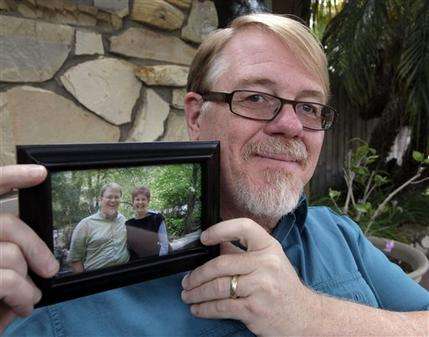
John Olsen shows a picture himself with his biological mother Pat Holmes at his home in Orange Calif. on Monday, August 8, 2011. Olsen, who was adopted at birth, attributes his brainpower to his genes. In his late 20s, Olsen took a genius test and scored high enough to get accepted into Mensa, the high IQ group. (AP Photo/Nick Ut)
(AP) -- Scientists who hunt for "intelligence genes" used to think there were fewer than half a dozen of them.
In recent years, they determined there may be at least 1,000 - each with just a tiny effect on the differences in people's IQ. A study released Tuesday found new evidence that many genes play a role in intelligence, but scientists still couldn't pinpoint the specific genes involved.
"It's been kind of a shock to the system that it hasn't worked," said psychologist Eric Turkheimer at the University of Virginia, who had no role in the study. "We can't find the effects of any individual genes that are large enough to seem worth worrying about."
Previous work involving twins and adopted children has found that genes have a significant influence on differences in IQ scores, producing about half the difference between adults in general. The influence of genes on IQ appears to grow from childhood to adulthood.
Scientists have come to realize that, as with height, differences in intelligence come not from a few genes, but rather the overall effect of many genes, each with only tiny influence. That makes them hard to tease out.
The new DNA study, reported online Tuesday in the journal Molecular Psychiatry, came to similar conclusions. Many genes work together to shape intelligence much like the different instruments of an orchestra that play in sync. Unless there's a soloist playing, it's often difficult to decipher the contributions of individual instruments.
As important as genes are in determining intelligence, they don't act alone and the role of one's upbringing and experiences cannot be ignored.
So why do researchers care so much about the relationship between genes and intelligence?
Our memory, reasoning skills and thinking abilities tend to decline as we age, some faster than others. Understanding the genetics of intelligence may someday help researchers gain a better handle on mind-robbing diseases such as Alzheimer's.
The new work was done by I.J. Deary of the University of Edinburgh in Scotland and colleagues in several countries.
The team wanted to find out "whether genetic differences that we could test on people's DNA could explain some of the reasons that people have different intelligence test scores," Deary said in an email.
Researchers didn't ID any genes affecting IQ. But they estimated that they found a genetic influence that accounts for at least 40 percent to 50 percent of the differences on intelligence test scores in the 3,511 unrelated adults in their study who were tested on knowledge and problem-solving skills.
They focused on more than 500,000 places in the participants' DNA, looking for evidence that IQ-influencing genes lay close to those places. They concluded that the overall effect was coming from many scattered genetic differences, each of only small influence.
The latest work adds to evidence that even the most powerful of these has only weak influence. Deary said that future studies will probably need to involve millions of people to detect the genetic effects.
Robert Plomin of the Institute of Psychiatry in London, who's looked for intelligence-related genes for 15 years but didn't participate in the new study, isn't surprised by the latest findings.
"We've got a century of twin and adoption studies," such as those comparing twins reared in different families, that support the notion that about half of IQ differences come from DNA, he said.
Plomin said this doesn't mean half of a person's intelligence is due to genes nor does such a genetic influence imply that a person's intelligence is fixed.
Turkheimer, the Virginia psychologist, thinks other types of research such as brain scans might have better luck in understanding what intelligence is.
Those methods are better than "pinning your hopes on adding together a bunch" of small effects from individual genes, he said.
John Olsen, of Orange, Calif., who was adopted at birth, attributes his brainpower to his genes. As a kid, he always wondered where his inquisitiveness came from. School bored him and there were no lively debates at the dinner table growing up.
"I was a bit of a challenge," he recalled. "I was very curious and like a lot of intelligent people always asked, `Why?'"
In his late 20s, Olsen took a genius test and scored high enough to get accepted into Mensa, the high IQ group. A telephone call from a long-lost aunt several years ago led to a reunion with his biological mother.
Olsen soon discovered his mother had the same curiosity and liked to ask probing questions. He also learned his maternal grandmother was fond of one-line comebacks and "was wickedly smart till the day she died."
©2011 The Associated Press. All rights reserved. This material may not be published, broadcast, rewritten or redistributed.
-
Family, culture affect whether intelligence leads to education
Sep 27, 2010 |
not rated yet |
0
-
Face recognition ability inherited separately from IQ
Jan 19, 2010 |
not rated yet |
0
-
DNA advances fuel racism fears
Nov 12, 2007 |
not rated yet |
0
-
Ability to process information as a baby continues into adulthood
Aug 07, 2009 |
not rated yet |
0
-
Study of Williams syndrome patients reveals specific gene's role in intelligence
Apr 22, 2010 |
not rated yet |
0
-
Of mice and mental models: Neuroscientific implications of risk-optimized behavior in the mouse
17 hours ago |
not rated yet |
0
-
Limits to growth: Scientists identify key metastasis-enabling enzyme
May 22, 2012 |
5 / 5 (4) |
0
-
Seeing is as seeing does: Spatially-structured retinal input in early development of cortical maps
Apr 26, 2012 |
5 / 5 (4) |
1
-
Dreamless nights: Brain activity during nonrapid eye movement sleep
Apr 09, 2012 |
4.4 / 5 (12) |
0
-
Take your time: Neurobiology sheds light on the superiority of spaced vs. massed learning
Mar 28, 2012 |
4.5 / 5 (21) |
3
-
Classical and Quantum Mechanics via Lie algebras
Apr 15, 2011
- More from Physics Forums - Independent Research
More news stories
Inherited DNA change explains overactive leukemia gene
A small inherited change in DNA is largely responsible for overactivating a gene linked to poor treatment response in people with acute leukemia.
Genetics
15 hours ago |
not rated yet |
0
|
'Personality genes' may help account for longevity
"It's in their genes" is a common refrain from scientists when asked about factors that allow centenarians to reach age 100 and beyond. Up until now, research has focused on genetic variations that offer a physiological advantage ...
Genetics
May 24, 2012 |
3 / 5 (1) |
0
|
Gene discovery points towards non-hormonal male contraceptive
A new type of male contraceptive could be created thanks to the discovery of a key gene essential for sperm development.
Genetics
May 24, 2012 |
5 / 5 (5) |
0
|
Key gene found responsible for chronic inflammation, accelerated aging and cancer
Researchers at NYU School of Medicine have, for the first time, identified a single gene that simultaneously controls inflammation, accelerated aging and cancer.
Genetics
May 24, 2012 |
not rated yet |
0
Knowing genetic makeup may not significantly improve disease risk prediction
Harvard School of Public Health (HSPH) researchers have found that detailed knowledge about your genetic makeupthe interplay between genetic variants and other genetic variants, or between genetic variants and environmental ...
Genetics
May 24, 2012 |
2 / 5 (1) |
0
|
Of mice and mental models: Neuroscientific implications of risk-optimized behavior in the mouse
(Medical Xpress) -- Regardless of an organism’s biological complexity, every encephalized animal continuously makes under-informed behavioral choices that can have serious consequences. Despite its ubiquity, ...
Tongue analysis software uses ancient Chinese medicine to warn of disease
For 5,000 years, the Chinese have used a system of medicine based on the flow and balance of positive and negative energies in the body. In this system, the appearance of the tongue is one of the measures used to classify ...
Cancer may require simpler genetic mutations than previously thought
Chromosomal deletions in DNA often involve just one of two gene copies inherited from either parent. But scientists haven't known how a deletion in one gene from one parent, called a "hemizygous" deletion, can contribute ...
Skp2 activates cancer-promoting, glucose-processing Akt
HER2 and its epidermal growth factor receptor cousins mobilize a specialized protein to activate a major player in cancer development and sugar metabolism, scientists report in the May 25 issue of Cell.
Early physical therapist treatment associated with reduced risk of healthcare utilization and reduced overall healthcare
A new study published in Spine shows that early treatment by a physical therapist for low back pain (LBP), as compared to delayed treatment, was associated with reduced risk of subsequent healthcare utilization and lower ...
New device allows pacemaker patients to safely undergo MRIs
For many, it's a medical conundrum: The very pacemaker keeping their heart in rhythm prevents them from undergoing an MRI to diagnose other ailments, because interaction between the two devices could prove deadly.
Aug 09, 2011
Rank: 5 / 5 (1)
all available science of the mind, of neurology, of neuroscience, of computational neuroscience, and of genetics in particular points to the fact that the brain/mind is highly complex . idea of simplifying its still unexplored capacities for pattern recognition , processing and other capabilities of processing signals in the universe ( what we refer to as intelligence) ......seems absurd in light of understanding of the dramatic scientific complexity of the brain
more to the point. the 'geniuses' who mensa recognizes are not immune to the egoistic delusion that genius of a brain can be tested and certified by a social organization of other brains. wise geniuses would never bother with stupidity like this unless deeply persuaded or coerced by mensa itself---and , the institutional perogative of mensa is to justify itself by legitimizing this charade.
Aug 09, 2011
Rank: 3 / 5 (2)
And remains the single best predictor of future success.
Aug 09, 2011
Rank: not rated yet
If I want genius, then I show the players their instruments.
Regardless of what genes gave what instruments to anyone.
And no one is without an instrument or genius.
The science to recognize all instruments (gene expression) and provide the best learning for a particular instrument, regardless of who is in procession of an instrument is the definition of intelligence.
Aug 09, 2011
Rank: 1 / 5 (1)
Aug 09, 2011
Rank: not rated yet
If all the ways of nurturing intelligence were known, then no test for it becomes necessary.
Aug 10, 2011
Rank: 5 / 5 (1)
Which is circular reasoning as "success" can be defined in uncountable many ways.
Aug 10, 2011
Rank: not rated yet
How about a little levity here?
Like the smoke appearing around the ears when caught in circular reasoning. Intelligence? Let me count the ways:
I am. I am not. I am. I am not....
Anyway, good point. For lack of good definitions let's discuss... is a better title for the article.