Study finds that less is more for common cancer drug
September 30, 2011 in Cancer
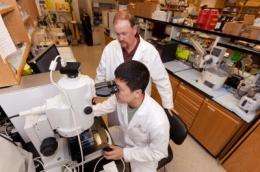
University of Georgia researcher Robert Arnold has found that smaller, less toxic amounts of chemotherapy medicine given frequently to mice with human prostate cancer noticeably slowed tumor growth. Credit: Image courtesy of Andrew Davis Tucker, University of Georgia
University of Georgia scientists have found that smaller, less toxic amounts of chemotherapy medicine given frequently to mice with human prostate cancer noticeably slowed tumor growth. The mice suffered fewer side effects compared with traditional cancer treatment relying on heavy doses that can cause hair and bone loss.
While chemotherapy given repeatedly in small portions, called metronomic dosing, is not new, the study's authors say that the dosing appears to alter the cellular activity of the drug topotecan. This finding offers promising new ways to use topotecan -- which is widely used and approved by the Food and Drug Administration for cervical and other cancersto combat slowly growing prostate tumors. The findings appear this month in the journal Cancer Biology and Therapy.
"At these lower doses, there isn't enough topotecan to follow a classic cell death pathway," said study co-author Robert D. Arnold, a Georgia Cancer Coalition Distinguished Scholar and assistant professor in the UGA College of Pharmacy. "Our research suggests that metronomic dosing altered topotecan's behavior."
Scientists have known that topotecan given to patients in large, traditional doses kills cancer cells by deactivating proteins known as enzymes that are necessary for cell growth, Arnold explained. By contrast, metronomic dosing of topotecan prevents new blood vessels -- which are necessary for growth -- from forming in the tumor. Arnold and his colleagues discovered that topotecan did not change the amount of blood vessels formed, but significantly decreased tumor size and altered genes critical for controlling cell growth.
Brian S. Cummings, a co-author and associate professor at the pharmacy college, compared topotecan's process of killing tumor cells to the everyday task of running an errand.
"Let's assume you're going to go to the grocery store and you could walk, ride your bike or take the car," he said. "Those are different mechanisms of action. You will still get to the same place."
He added that researchers try to determine which pathway, or transportation choice, cells take after different amounts of exposure to topotecan. Their results suggest that when topotecan is given frequently in low doses, the drug could be changing the type of genes turned on in the tumor. These changes may be related to the structure or architecture of a gene -- not a change in gene sequence. Such changes could be considered epigenetic, but more research is needed, Arnold said.
The study suggests that metronomic dosing of topotecan can reduce prostate cancer growth at drug concentrations far below those that can be toxic to healthy cells in the body.
Given the limited treatment options for late-stage prostate cancer and clinical use of topotecan, new clinical trials could occur in the near future, Arnold said. The same research team is now studying the dosing effects of topotecan in breast cancer models.
Provided by
University of Georgia
-
Amrubicin improved response rate and progression-free survival vs. topotecan in Phase III trial
Jul 07, 2011 |
not rated yet |
0
-
Study finds thalidomide shows promise for treatment of recurrent ovarian cancer
Feb 27, 2008 |
not rated yet |
0
-
Adding topotecan to standard treatment for ovarian cancer does not improve progression-free survival
Oct 11, 2010 |
not rated yet |
0
-
Nanotweezers Unlock Anticancer Drug Secrets
Aug 22, 2007 |
not rated yet |
0
-
How chemotherapy drugs block blood vessel growth, slow cancer spread
Jan 22, 2009 |
not rated yet |
0
-
Of mice and mental models: Neuroscientific implications of risk-optimized behavior in the mouse
20 hours ago |
not rated yet |
0
-
Limits to growth: Scientists identify key metastasis-enabling enzyme
May 22, 2012 |
5 / 5 (4) |
0
-
Seeing is as seeing does: Spatially-structured retinal input in early development of cortical maps
Apr 26, 2012 |
5 / 5 (4) |
1
-
Dreamless nights: Brain activity during nonrapid eye movement sleep
Apr 09, 2012 |
4.4 / 5 (12) |
0
-
Take your time: Neurobiology sheds light on the superiority of spaced vs. massed learning
Mar 28, 2012 |
4.5 / 5 (21) |
3
-
A question about drug tolerance
May 23, 2012
-
Poor nutrition leading to overeating?
May 23, 2012
-
Math and dyslexia?
May 21, 2012
-
portable metabolism meter?
May 21, 2012
-
Rare medical conditions on 20/20 tonight
May 18, 2012
-
"Good" Cholesterol in Doubt
May 17, 2012
- More from Physics Forums - Medical Sciences
More news stories
Skp2 activates cancer-promoting, glucose-processing Akt
HER2 and its epidermal growth factor receptor cousins mobilize a specialized protein to activate a major player in cancer development and sugar metabolism, scientists report in the May 25 issue of Cell.
Cancer
14 hours ago |
not rated yet |
0
|
Pancreatectomy OK without downstaging from therapy
(HealthDay) -- Pancreatectomy improves median survival in pancreatic cancer patients even when presurgical neoadjuvant therapy does not lead to radiographic downstaging of tumors, according to a study published ...
Cancer
15 hours ago |
not rated yet |
0
Common therapies for basal cell carcinoma offer similar survival
(HealthDay) -- For patients with superficial basal cell carcinoma (sBCC), treatment with imiquimod or photodynamic therapy (PDT) results in similar long-term tumor-free survival, according to a review published ...
Cancer
16 hours ago |
not rated yet |
0
Cancer may require simpler genetic mutations than previously thought
Chromosomal deletions in DNA often involve just one of two gene copies inherited from either parent. But scientists haven't known how a deletion in one gene from one parent, called a "hemizygous" deletion, can contribute ...
Cancer
18 hours ago |
not rated yet |
0
|
New prostate cancer screening guidelines face a tough sell, study suggests
(Medical Xpress) -- Recent recommendations from the U.S. Preventive Services Task Force (USPSTF) advising elimination of routine prostate-specific antigen (PSA) screening for prostate cancer in healthy men are likely to encounter ...
Cancer
21 hours ago |
not rated yet |
1
Of mice and mental models: Neuroscientific implications of risk-optimized behavior in the mouse
(Medical Xpress) -- Regardless of an organism’s biological complexity, every encephalized animal continuously makes under-informed behavioral choices that can have serious consequences. Despite its ubiquity, ...
Tongue analysis software uses ancient Chinese medicine to warn of disease
For 5,000 years, the Chinese have used a system of medicine based on the flow and balance of positive and negative energies in the body. In this system, the appearance of the tongue is one of the measures used to classify ...
Inherited DNA change explains overactive leukemia gene
A small inherited change in DNA is largely responsible for overactivating a gene linked to poor treatment response in people with acute leukemia.
Early physical therapist treatment associated with reduced risk of healthcare utilization and reduced overall healthcare
A new study published in Spine shows that early treatment by a physical therapist for low back pain (LBP), as compared to delayed treatment, was associated with reduced risk of subsequent healthcare utilization and lower ...
New device allows pacemaker patients to safely undergo MRIs
For many, it's a medical conundrum: The very pacemaker keeping their heart in rhythm prevents them from undergoing an MRI to diagnose other ailments, because interaction between the two devices could prove deadly.
First study to suggest that the immune system may protect against Alzheimer's changes in humans
Recent work in mice suggested that the immune system is involved in removing beta-amyloid, the main Alzheimer's-causing substance in the brain. Researchers have now shown for the first time that this may apply in humans.