Indiana: Upward trend in marijuana use, smokeless tobacco
Alcohol use by Indiana sixth- through 12th-graders has declined, but findings from the 21st Annual Survey of Alcohol, Tobacco, and Other Drug Use also revealed a continuing increase in marijuana and smokeless tobacco use.
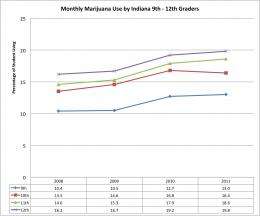
The survey, conducted by the Indiana Prevention Resource Center at Indiana University Bloomington and funded by the Indiana Family and Social Services Administration's Division of Mental Health and Addiction, questioned 168,801 students in public and private schools. Researchers found that the reported use of marijuana is on the rise for grade seven as well as grades nine through 12. Marijuana use among youth in grade eight has decreased, which signals the end of an upward trend that occurred from 2008-2010 in monthly marijuana use.
"Unfortunately we are seeing a continuation of an upward trend in both monthly and lifetime use of marijuana since 2008 in grade seven and grades nine to 12. It should be noted the rate of past month marijuana use among Indiana's eighth-grade youth is higher on average than the 2010 national prevalence rate reported in the Monitoring the Future survey," said Ruth Gassman, director of the IPRC, which is part of IU's School of Health, Physical Education and Recreation. "Among some grade levels, marijuana use did not increase significantly this year compared to last year, however, when the rates are examined over a four-year period (since 2008) the continuation of an upward trend is apparent."
Tobacco: Lifetime use of smokeless tobacco increased for 12th-graders
The survey revealed an upward trend in smokeless tobacco for lifetime and past month use among 12th-graders since 2007, with the largest increase found in their lifetime use, which registered an increase of 4.2 percentage points from 2007-2011.
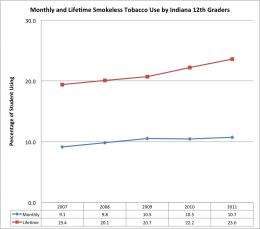
"This is a concern because although rates of cigarette use among high school students continue to decline, smokeless tobacco use still exposes youth to the harmful carcinogenic elements of tobacco," Gassman said. "It is even worse for students who are using both cigarettes and smokeless tobacco concurrently because this increases an individual's exposure to nicotine, which is the addictive agent in all tobacco products."
Tobacco companies target younger consumers with a variety of new products that come out yearly. Items such as tobacco strips and orbs contain finely ground tobacco and are easy for youth to use without being detected. The packaging of smokeless tobacco products is often very appealing to young consumers. These products are also advertised as being lower in chemicals and as tools for quitting smoking. Gassman said it is important to remember that tobacco in any form is dangerous.
Alcohol: Lifetime use is on the decline for youth in grades 6-12
Another important finding from the survey shows that lifetime use of alcohol in grades six-12 is decreasing. In 1993, rates of lifetime alcohol use were 37.8 percent for sixth graders and 85 percent among 12th-graders. Those rates are now at 17.4 percent and 65.4 percent, respectively.
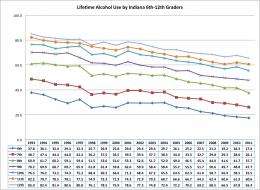
"We are pleased to see that lifetime alcohol use has gradually declined since 1993. Unfortunately, we have seen few reductions in binge drinking among youth in recent years," Gassman said. "Binge drinking is defined as five or more alcoholic drinks for males and four or more for females in one sitting in the last two weeks. Binge drinking is very dangerous and among youth is associated with unintentional injuries such as car crashes, intentional injuries such as sexual assault, and with alcohol poisoning, sexually transmitted diseases and unintended pregnancy."
Reasons for drinking
Among youth who were surveyed, the top reasons given for drinking alcohol were "to have a good time with friends," "to experiment," "because it tastes good," and "to relax or relieve tension." The majority of adolescents in sixth to ninth grades reported no consumption of alcoholic beverages.
Gassman said it is important to understand why adolescents are turning to alcohol so that risk and protective factors can be evaluated and used to implement programs aimed at continuing to reduce alcohol consumption among minors in Indiana. Risk factors refer to situations or conditions that increase chances for involvement in substance use among youth while protective factors are conditions in an adolescents life that protect against negative influences associated with risk factors. There are four areas of risk and protective factors in youth socialization: community, family, school and peer-individual.
The IPRC provides substance abuse prevention resources and services for those working with youth in schools and communities throughout Indiana.
More information: The full report is available online at: www.drugs.indiana.edu/data-survey_monograph.html


