Popular supplement - saw palmetto extract - has no effect on prostate health: study
September 27, 2011 in Cancer
Popular supplement - saw palmetto extract - has no effect on prostate health: study

Enlarge

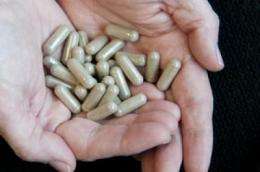
Compared to a placebo, saw palmetto capsules, pictured above, do not alleviate urinary problems related to an enlarged prostate, even when men take up to three times the standard daily dose. Credit: Robert Boston, Washington University

The most widely used over-the-counter supplement for prostate health is no more effective than a placebo in treating men's lower urinary tract symptoms.

The fruit of the saw palmetto tree does not relieve symptoms of an enlarged prostate, even when men take the herbal supplement in very high doses, a new study shows.

The research is published Sept. 28, 2011, in the Journal of the American Medical Association.

Many older U.S. men take saw palmetto extract in an attempt to reduce bothersome symptoms of a swollen prostate, including frequent urination and a sense of urgency. Its use in Europe is even more widespread because doctors often recommend saw palmetto over more traditional drug treatments.

Results of the new study may settle an ongoing debate over the effectiveness of saw palmetto for a condition known as benign prostatic hyperplasia (BPH). Earlier studies of the supplement have produced conflicting results, and none have evaluated the benefits of saw palmetto in high doses.

In the current study, however, men took up to three times the standard dose of saw palmetto.

"Now we know that even very high doses of saw palmetto make absolutely no difference," says co-author Gerald Andriole, MD, the Robert K. Royce Distinguished Professor and chief of urologic surgery at Washington University School of Medicine in St. Louis. "Men should not spend their money on this herbal supplement as a way to reduce symptoms of enlarged prostate because it clearly does not work any better than a sugar pill."

The multi-center study, led by Michael Barry, MD, at Massachusetts General Hospital in Boston, involved more than 300 men ages 45 and older who had moderate symptoms suggestive of an enlarged prostate, such as frequent urination, difficulty emptying their bladders and a weak urine stream. The men were randomly selected to receive a daily dose of saw palmetto extract, beginning at 320 milligrams, or an identical-looking placebo pill with the same distinctive smell and taste.

After 24 weeks, the saw palmetto dosage was increased to 640 milligrams a day, and after another 24 weeks, to 960 milligrams a day – triple the standard dose. In all, men took saw palmetto or a placebo for nearly 17 months. Neither the physicians nor the patients knew who was taking what regimen until the end of the study.

The researchers found that among men who took saw palmetto, prostate problems improved slightly but not more than in men taking a placebo.

"We commonly see this in clinical trials," Andriole explains. "Patients often report an improvement in symptoms because they are taking something, even if it is a placebo. But in this study, there was no benefit to taking saw palmetto over the placebo."

The researchers found that saw palmetto had no greater effect than the placebo on BPH symptoms as well as other conditions related to an enlarged prostate such as waking at night to urinate, PSA level and bladder control.

About half of all men over age 50 have BPH, which becomes more common as men age. If urination becomes difficult or painful, Andriole advises men to visit their physician. Several approved medications, such as alpha-blockers and 5-alpha reductase inhibitors, are available to successfully treat the condition.

More information: JAMA. 2011;306[12]:1344-1351.

Provided by Washington University School of Medicine search and more info website

5 /5 (5 votes)  

Filter


Move the slider to adjust rank threshold, so that you can hide some of the comments.


Display comments: newest first

Temple
Sep 27, 2011

Rank: not rated yet
Obviously this is a case of BigPharma trying to sell more sugar pills.
Skepticus
Sep 27, 2011

Rank: not rated yet
This is absurd, and generally follows a classic pattern. obscure but effective herbal remedy formulae that contain saw palmetto and the like are hijacked by hi tech pharmacoms who butchered them by glossing over all other ingredients and concentrate on selling a particular "extract". If that is true, i'd dispense with my car engine and just stick a turbo in the engine bay!Pathetic.
Burnerjack
Sep 27, 2011

Rank: not rated yet
I don't care what this study says and for good reason: It absolutely did work for me! No BS. The difference was like "night and day"!
Perhaps it wasn't my prostate causing problems, if so, whatever it was, saw palmetto definitely squared it away. Not trying to sway anyone in either direction, just relating my own experience.
Dug
Sep 27, 2011

Rank: 5 / 5 (1)
The pills pictured look typical of saw palmetto leaf powder capsules (inactive ingredients) and don't resemble any of the numerous the SP berry extract type capsules I've used for years. There are also an arm's length list of other double blind studies accomplished over the last 20 years that shows the effectiveness of standardized saw palmetto berry extract in stopping the conversion of regular testosterone to dihydrotestosterone (DHT), the form of testosterone that stimulates prostate-cell growth and BPH - which this study contradicts.

Look at the side affects of the pharmaceutical remedies and you'll see why saw palmetto berry, beta sitosterol, and pumpkin seed oil are used by the majority of men instead of Flowmax and the others. There are also a number of dietary contributory factors that can be changed (avoid red meats) as well that can help reduce BPH.
D Z
Sep 27, 2011

Rank: not rated yet
Based on long-term personal experience of both taking the extract and not taking it for lengthy intervals, I find myself having to agree with the conspiracy theorists on this one. The absorption of some oil-based vitamins and herbal concentrates can be lowered radically by just telling the test-subjects to take them on an empty stomach, without food, or not providing any directions at all (allow common inclinations to kick-in). That's in addition to the already suggested method of supplying an impotent version of the product.
A2G
Sep 28, 2011

Rank: not rated yet
In the study it was also found that these over the counter supplements are not good for the long term health of BigPharma. Nice to see the previous comments. The lies of the BigPharma system are starting to unravel and the people are truly beginning to realize they have been duped for $$$
ROBTHEGOB
Sep 29, 2011

Rank: not rated yet
Typical Big Pharma sponsored propaganda.
Rank 5 /5 (5 votes)
Relevant PhysicsForums posts
  • Potential Breakthrough in Seizure Control
    created4 hours ago
  • Popping/Cracked sternum.
    created9 hours ago
  • Which Mental Illness Encompasses This Problem?
    created9 hours ago
  • A question about drug tolerance
    createdMay 23, 2012
  • Poor nutrition leading to overeating?
    createdMay 23, 2012
  • Math and dyslexia?
    createdMay 21, 2012
  • More from Physics Forums - Medical Sciences

More news stories

Skp2 activates cancer-promoting, glucose-processing Akt

HER2 and its epidermal growth factor receptor cousins mobilize a specialized protein to activate a major player in cancer development and sugar metabolism, scientists report in the May 25 issue of Cell.

Cancer created 17 hours ago | popularity not rated yet | comments 0 | with audio podcast

Pancreatectomy OK without downstaging from therapy

(HealthDay) -- Pancreatectomy improves median survival in pancreatic cancer patients even when presurgical neoadjuvant therapy does not lead to radiographic downstaging of tumors, according to a study published ...

Cancer created 18 hours ago | popularity not rated yet | comments 0

Common therapies for basal cell carcinoma offer similar survival

(HealthDay) -- For patients with superficial basal cell carcinoma (sBCC), treatment with imiquimod or photodynamic therapy (PDT) results in similar long-term tumor-free survival, according to a review published ...

Cancer created 19 hours ago | popularity not rated yet | comments 0

Cancer may require simpler genetic mutations than previously thought

Chromosomal deletions in DNA often involve just one of two gene copies inherited from either parent. But scientists haven't known how a deletion in one gene from one parent, called a "hemizygous" deletion, can contribute ...

Cancer created 21 hours ago | popularity not rated yet | comments 0 | with audio podcast

New prostate cancer screening guidelines face a tough sell, study suggests

(Medical Xpress) -- Recent recommendations from the U.S. Preventive Services Task Force (USPSTF) advising elimination of routine prostate-specific antigen (PSA) screening for prostate cancer in healthy men are likely to encounter ...

Cancer created May 25, 2012 | popularity not rated yet | comments 1


Travel to high altitudes tied to Crohn's, colitis flare-ups

(HealthDay) -- People with inflammatory bowel disease, which includes Crohn's disease and colitis, may be at increased risk for flare-ups when they fly or travel to high altitudes for skiing or mountain climbing, ...

Transvaginal mesh op restores pelvic organ prolapse at price

(HealthDay) -- Transvaginal mesh (TVM) procedures are effective for anatomical restoration of pelvic organ prolapse (POP), but patients report a worsening of sexual function following surgery, according to ...

Of mice and mental models: Neuroscientific implications of risk-optimized behavior in the mouse

(Medical Xpress) -- Regardless of an organism’s biological complexity, every encephalized animal continuously makes under-informed behavioral choices that can have serious consequences. Despite its ubiquity, ...

Inherited DNA change explains overactive leukemia gene

A small inherited change in DNA is largely responsible for overactivating a gene linked to poor treatment response in people with acute leukemia.

Tongue analysis software uses ancient Chinese medicine to warn of disease

For 5,000 years, the Chinese have used a system of medicine based on the flow and balance of positive and negative energies in the body. In this system, the appearance of the tongue is one of the measures used to classify ...

Early physical therapist treatment associated with reduced risk of healthcare utilization and reduced overall healthcare

A new study published in Spine shows that early treatment by a physical therapist for low back pain (LBP), as compared to delayed treatment, was associated with reduced risk of subsequent healthcare utilization and lower ...