Artificial blood could soon be on the way
October 28, 2011
by Bob Yirka
in Medical research
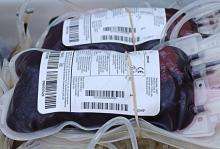
Bags of blood collected during donation. Image: Wikipedia.
(Medical Xpress) -- Researchers at Edinburgh University in Scotland have announced that they believe the type of artificial blood they are working on could be ready for testing in humans in as little as two or three years. Made from growing stem cells taken from adult human bone marrow, the blood they create would be of the rare type O-negative that some 98% of people in need could use.
Researchers have for years been experimenting with different processes and materials to recreate what natures provides every individual free of charge; a liquid material capable of carrying oxygen and other nutrients through veins and arteries during times of blood loss, generally due to injury or surgery. The reason the need is so great is because of the great demand. People are injured every day, and develop problems that require surgery to fix, and sometimes the supply of blood from donors isnt enough to keep up with demand, especially in less developed countries. Plus, there is the always constant threat of infections transferred via blood transfusions, such as HIV, Hepatitis and vCJD, also known as mad cow disease when it infects people.
The team in Edinburgh, led by Professor Marc Turner, has been working on a technique whereby stem cells are taken from the bone marrow of healthy adults and are then grown in a lab into a material that very closely resembles red blood cells grown normally in the human body. They think their process has been sufficiently refined to predict that their results will be ready for clinical trials in as little as two or three years. The next step would be combing their results with the results of others around the world who are working on ways create a form of artificial hemoglobin. If all goes according to plan, the use of such artificial blood could become a routine part of emergency medical practices in about ten years time.
The problem with the artificial blood, however, is even if all works out as planned it still wouldnt be the perfect replacement everyone really wants. Artificial blood, while clearly a lifesaver in medical emergencies would not likely ever be a permanent replacement for blood; it would still be just a stop-gap type measure. This is why research will continue to focus on a true artificial blood that could in theory completely replace all the blood a person needs and function just as their natural blood does, without any advertise side effects or complications.
That is not to say that a stop-gap temporary blood replacement wouldnt be important. If this new type of artificial blood pans out, millions of lives would be saved the world over. And that certainly, is no small thing.
© 2011 PhysOrg.com
-
Artificial blood developed for the battlefield
Jul 13, 2010 |
not rated yet |
0
-
Study uses bone marrow stem cells to regenerate skin
Jan 14, 2009 |
not rated yet |
0
-
Exercise boosts health by influencing stem cells to become bone, not fat, researchers find
Sep 01, 2011 |
not rated yet |
0
-
Correcting sickle cell disease with stem cells
Sep 28, 2011 |
not rated yet |
0
-
Stem cells from cord blood could help repair damaged heart muscle
Oct 13, 2011 |
not rated yet |
0
-
Motion perception revisited: High Phi effect challenges established motion perception assumptions
Apr 23, 2013 |
3 / 5 (2) |
2
-
Anything you can do I can do better: Neuromolecular foundations of the superiority illusion (Update)
Apr 02, 2013 |
4.5 / 5 (11) |
5
-
The visual system as economist: Neural resource allocation in visual adaptation
Mar 30, 2013 |
5 / 5 (2) |
9
-
Separate lives: Neuronal and organismal lifespans decoupled
Mar 27, 2013 |
4.9 / 5 (8) |
0
-
Sizing things up: The evolutionary neurobiology of scale invariance
Feb 28, 2013 |
4.8 / 5 (10) |
14
-
Pressure-volume curve: Elastic Recoil Pressure don't make sense
20 hours ago
-
If you became brain-dead, would you want them to pull the plug?
May 17, 2013
-
MRI bill question
May 15, 2013
-
Ratio of Hydrogen of Oxygen in Dessicated Animal Protein
May 13, 2013
-
Alcohol and acetaminophen
May 13, 2013
-
Marie Curie's leukemia
May 13, 2013
- More from Physics Forums - Medical Sciences
More news stories
Now we know why old scizophrenia medicine works on antibiotics-resistant bacteria
In 2008 researchers from the University of Southern Denmark showed that the drug thioridazine, which has previously been used to treat schizophrenia, is also a powerful weapon against antibiotic-resistant bacteria such as ...
Medical research
May 17, 2013 |
3.7 / 5 (3) |
0
|
SUMO wrestling cells reveal new protective mechanism target for stroke
Scientists investigating the interaction of a group of proteins in the brain responsible for protecting nerve cells from damage have identified a new target that could increase cell survival.
Medical research
May 17, 2013 |
5 / 5 (1) |
0
How serotonin receptors can shape drug effects, from LSD to migraine medication
New findings by researchers carrying out experiments at the U.S. Department of Energy Office of Science's Advanced Photon Source (APS) help explain why some drugs that interact with two kinds of human serotonin ...
Medical research
May 17, 2013 |
not rated yet |
0
|
Preventing blood poisoning
Peptide molecules derived from the body's natural immune system can help boost the body's defence against life-threatening blood poisoning, joint University research has uncovered.
Medical research
May 17, 2013 |
4 / 5 (1) |
0
|
New mechanism to prevent type 2 diabetes in obese individuals
A new Montréal study conducted by Dr. May Faraj, associate research professor at the Université de Montréal and invited scientist at the IRCM, along with her research team and medical collaborators, shows ...
Medical research
May 17, 2013 |
not rated yet |
0
|
New research identifies risks, interventions for children's GI health
An increasing number of U.S. children are experiencing gastrointestinal issues that require interventions to resolve, according to research presented at Digestive Disease Week (DDW).
US psychiatry gets makeover in new manual
The latest makeover to a massive psychiatric tome honored by some, reviled by others and even called the "Bible" of mental disorders is being released Saturday with a host of new changes.
New case of SARS-like virus in Saudi: ministry
A new case of the deadly coronavirus has been detected in Saudi Arabia where 15 people have already died after contracting it, the health ministry announced on Saturday on its Internet website.
AIDS science at 30: 'Cure' now part of lexicon
Big names in medicine are set to give an upbeat assessment of the war on AIDS on Tuesday, 30 years after French researchers identified the virus that causes the disease.
For combat veterans suffering from post-traumatic stress disorder, 'fear circuitry' in the brain never rests
Chronic trauma can inflict lasting damage to brain regions associated with fear and anxiety. Previous imaging studies of people with post-traumatic stress disorder, or PTSD, have shown that these brain regions can over-or ...
New colonoscope provides ground-breaking view of colon
A ground-breaking advance in colonoscopy technology signals the future of colorectal care, according to research presented today at Digestive Disease Week(DDW). Additional research focuses on optimizing the minimal withdrawal ...
Oct 28, 2011
Rank: 5 / 5 (1)
Oct 28, 2011
Rank: 5 / 5 (1)
What are the 2% that can't use O-negative? I thought that blood type worked for everyone.
Oct 28, 2011
Rank: 1 / 5 (1)
A
B
They are not the only antigens, so I've read.
Oct 28, 2011
Rank: 1 / 5 (2)
Oct 29, 2011
Rank: 1 / 5 (4)
Oct 29, 2011
Rank: not rated yet
You say that the injured body now has to fight an infection (thus depleting resources), but if we essentially "force" the body to make more blood through iron injections for example we are still putting an additional strain on the body and still removing resources that could be used to fix the original injury. Hence the idea of giving someone blood is to allow the repair of the original injury to be the top priority (and not for example making lots of blood).
Oct 29, 2011
Rank: 1 / 5 (2)
Not true. When given the iron shots it is giving your body additional resources to help repair itself. Giving someone blood is not like giving a car extra oil cause it is low from another car. Each persons blood is unique to that person, not just type A, AB, etc. If it is volume that is needed, a saline (sp) IV is highly effective in giving the person volume, and allowing the blood (oxygen and nutrient dispersal) to work at peak proficiency. Thus allowing the body to perform its healing, without the additional problem of dealing with an additional infection (someone elses blood) that it now has to dispose of. With a little research you can find that people who do not have blood transfusions but rather use the many alternative options available, have a higher recovery rate, and guess what... no chance of HIV, Hepatitis, and other infections that they do not screen for.
Oct 30, 2011
Rank: not rated yet
More resources should be given to this kind of research. Today, millions of people die from accidents and medical emergencies, who could be saved by simply having blood to give them.
The day we can manufacture blood in bulk and distribute it globally, one big grief is taken care of. Whether this blood is genetically produced or entirely artificial is not the point.
Today we essentially milk each other like cows, just to get a liquid to be administered at hospitals. This is so archaic it's embarrassing.
Oct 30, 2011
Rank: 1 / 5 (2)
Ummm I am a little confused. Where was Religion or Superstition mentioned?
I am trying to get the opinion across that we have affordable solutions available without having to manufacture blood. If blood does become manufactured than they are going to charge a whole lot more to hospitals than what it costs currently for Non-Blood Methods. If a company is able to "Make" blood, what is to stop them from cornering the market and making it super expensive due to "high costs of manufacturing, but 50% safer than Non Manufactured blood". Corporations are already charging for water that falls from the sky by putting it into bottles and selling it, what is to stop them from charging for the blood that pumps through our veins, given the option? Charging a higher price for something when there are already excellent solutions available that are.... dare I say... cheap... That is archaic.
Oct 31, 2011
Rank: 5 / 5 (1)
I didn't see anything in your posts that can have more than a very minor effect on the need for some kind blood or hemoglobin substitute. That rather obvious lack of real alternatives in you posts that made them look like something that would come from someone with a religious agenda. It is difficult to see why you thought those posts had any real meaning regarding the need for some sort of oxygen transport.
Ethelred
Oct 31, 2011
Rank: 1 / 5 (1)
Oct 31, 2011
Rank: 5 / 5 (1)
Yes. And if you were completely correct there wouldn't be any transfusions. But there are. So you are missing something. Like the amount of blood loss in accidents and a lot of surgery. You are also missing is platelets and other clotting factors.
And you aren't posting scripture here because you know better, for which I congratulate you, as it is quite amazing how often some people quote scripture here as if was perfect and without flaw. It would be ignored as it is just the writing of men. In your case the translation was done by people that didn't even understand Hebrew.
This not quite real blood might be good enough to fit your religious needs. I am not sure but then the Watchtower's position on transfusion is really weird even for a religious based concept. It is NOT drinking blood.
Ethelred
Nov 01, 2011
Rank: 1 / 5 (2)
Who has the hidden adjends?
To answer your question, you are treating a blood transfusion as if it is a miracle cure to heal all problems. Our bodies are amazing in their abilities to heal itself, given the chance. With the volume expanders mentioned before, that helps with the blood loss during surgery and injuries, again under the supervision of a doctor.
But I see you just want to attack the facts under the guise of me being religious. So this will be my last post. And remember, you brought religion into this discussion not me.
Nov 01, 2011
Rank: 5 / 5 (1)
Which doesn't change the fact that transfusions save lives.
Did no such thing.
It formed your thinking on this. Quite clearly. The medical evidence of transfusions saving live is incontrovertible.
You. Only it isn't well hidden.
The hell I am. I am pointing out that it works. There are no miracles.
Still doesn't do away with the need for transfusions. Sure it can cut down on the use a bit.>>
Nov 01, 2011
Rank: 5 / 5 (1)
Horseshit. I just brought your motivation into the open, that this is the only thing you have posted on is also indicative of a religious or political posting. People that here for the science or the discussion have broader range of interests. Now it is time YOU looked at the limits of what can be done without transfusions and see just how many deaths would occur if they weren't used.
No guts no glory. And confirmation of your motivations. You have no interest in the science.
Ethelred