How the brain makes memories: Rhythmically!
October 3, 2011 in Neuroscience
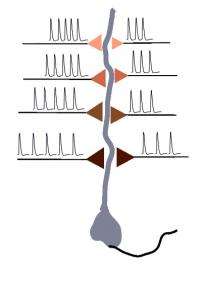
The image shows a neuron with a tree trunk-like dendrite. Each triangular shape touching the dendrite represents a synapse, where inputs from other neurons, called spikes, arrive (the squiggly shapes). Synapses that are further away on the dendritic tree from the cell body require a higher spike frequency (spikes that come closer together in time) and spikes that arrive with perfect timing to generate maximal learning.
The brain learns through changes in the strength of its synapses -- the connections between neurons -- in response to stimuli.
Now, in a discovery that challenges conventional wisdom on the brain mechanisms of learning, UCLA neuro-physicists have found there is an optimal brain "rhythm," or frequency, for changing synaptic strength. And further, like stations on a radio dial, each synapse is tuned to a different optimal frequency for learning.
The findings, which provide a grand-unified theory of the mechanisms that underlie learning in the brain, may lead to possible new therapies for treating learning disabilities.
The study appears in the current issue of the journal Frontiers in Computational Neuroscience.
"Many people have learning and memory disorders, and beyond that group, most of us are not Einstein or Mozart," said Mayank R. Mehta, the paper's senior author and an associate professor in UCLA's departments of neurology, neurobiology, physics and astronomy. "Our work suggests that some problems with learning and memory are caused by synapses not being tuned to the right frequency."
A change in the strength of a synapse in response to stimuli -- known as synaptic plasticity -- is induced through so-called "spike trains," series of neural signals that occur with varying frequency and timing. Previous experiments demonstrated that stimulating neurons at a very high frequency (e.g., 100 spikes per second) strengthened the connecting synapse, while low-frequency stimulation (e.g., one spike per second) reduced synaptic strength.
These earlier experiments used hundreds of consecutive spikes in the very high-frequency range to induce plasticity. Yet when the brain is activated during real-life behavioral tasks, neurons fire only about 10 consecutive spikes, not several hundred. And they do so at a much lower frequency -- typically in the 50 spikes-per-second range.
In other words, said Mehta, "spike frequency refers to how fast the spikes come. Ten spikes could be delivered at a frequency of 100 spikes a second or at a frequency of one spike per second."
Until now, researchers had been unable to conduct experiments that simulated more naturally occurring levels. But Mehta and co-author Arvind Kumar, a former postdoctoral fellow in his lab, were able to obtain these measurements for the first time using a sophisticated mathematical model they developed and validated with experimental data.
Contrary to what was previously assumed, Mehta and Kumar found that when it comes to stimulating synapses with naturally occurring spike patterns, stimulating the neurons at the highest frequencies was not the best way to increase synaptic strength.
When, for example, a synapse was stimulated with just 10 spikes at a frequency of 30 spikes per second, it induced a far greater increase in strength than stimulating that synapse with 10 spikes at 100 times per second.
"The expectation, based on previous studies, was that if you drove the synapse at a higher frequency, the effect on synaptic strengthening, or learning, would be at least as good as, if not better than, the naturally occurring lower frequency," Mehta said. "To our surprise, we found that beyond the optimal frequency, synaptic strengthening actually declined as the frequencies got higher."
The knowledge that a synapse has a preferred frequency for maximal learning led the researchers to compare optimal frequencies based on the location of the synapse on a neuron. Neurons are shaped like trees, with the nucleus being the base of the tree, the dendrites resembling the extensive branches and the synapses resembling the leaves on those branches.
When Mehta and Kumar compared synaptic learning based on where synapses were located on the dendritic branches, what they found was significant: The optimal frequency for inducing synaptic learning changed depending on where the synapse was located. The farther the synapse was from the neuron's cell body, the higher its optimal frequency.
"Incredibly, when it comes to learning, the neuron behaves like a giant antenna, with different branches of dendrites tuned to different frequencies for maximal learning," Mehta said.
The researchers found that not only does each synapse have a preferred frequency for achieving optimal learning, but for the best effect, the frequency needs to be perfectly rhythmic -- timed at exact intervals. Even at the optimal frequency, if the rhythm was thrown off, synaptic learning was substantially diminished.
Their research also showed that once a synapse learns, its optimal frequency changes. In other words, if the optimal frequency for a naïve synapse -- one that has not learned anything yet -- was, say, 30 spikes per second, after learning, that very same synapse would learn optimally at a lower frequency, say 24 spikes per second. Thus, learning itself changes the optimal frequency for a synapse.
This learning-induced "detuning" process has important implications for treating disorders related to forgetting, such as post-traumatic stress disorder, the researchers said.
Although much more research is needed, the findings raise the possibility that drugs could be developed to "retune" the brain rhythms of people with learning or memory disorders, or that many more of us could become Einstein or Mozart if the optimal brain rhythm was delivered to each synapse.
"We already know there are drugs and electrical stimuli that can alter brain rhythms," Mehta said. "Our findings suggest that we can use these tools to deliver the optimal brain rhythm to targeted connections to enhance learning."
More information: The publication and related materials can be found at www.physics.ucla.edu/~mayank/
Provided by University of California - Los Angeles
-
In search of the memory molecule, a key protein complex discovered
Jun 23, 2011 |
not rated yet |
0
-
Researchers connect APC protein to autism and mental retardation
Aug 23, 2010 |
not rated yet |
0
-
MIT reports key pathway in synaptic plasticity
May 21, 2007 |
not rated yet |
0
-
New insight into how environmental enrichment enhances memory
Mar 23, 2011 |
not rated yet |
0
-
Special protein helps maintain an efficient brain
May 18, 2009 |
not rated yet |
0
-
Motion perception revisited: High Phi effect challenges established motion perception assumptions
Apr 23, 2013 |
3 / 5 (2) |
2
-
Anything you can do I can do better: Neuromolecular foundations of the superiority illusion (Update)
Apr 02, 2013 |
4.5 / 5 (11) |
5
-
The visual system as economist: Neural resource allocation in visual adaptation
Mar 30, 2013 |
5 / 5 (2) |
9
-
Separate lives: Neuronal and organismal lifespans decoupled
Mar 27, 2013 |
4.9 / 5 (8) |
0
-
Sizing things up: The evolutionary neurobiology of scale invariance
Feb 28, 2013 |
4.8 / 5 (10) |
14
-
Why is zone 1 in liver more prone to ischemic injury?
9 hours ago
-
How can there be villous adenoma in colon, if there are no villi there
May 22, 2013
-
How can there be a term called "intestinal metaplasia" of stomach
May 21, 2013
-
Pressure-volume curve: Elastic Recoil Pressure don't make sense
May 18, 2013
-
If you became brain-dead, would you want them to pull the plug?
May 17, 2013
-
MRI bill question
May 15, 2013
- More from Physics Forums - Medical Sciences
More news stories
Depression common among children with temporal lobe epilepsy
A new study determined that children and adolescents with seizures involving the temporal lobe are likely to have clinically significant behavioral problems and psychiatric illness, especially depression. Findings published ...
Neuroscience
7 minutes ago |
not rated yet |
0
The secret lives, and deaths, of neurons
As the human body fine-tunes its neurological wiring, nerve cells often must fix a faulty connection by amputating an axon—the "business end" of the neuron that sends electrical impulses to tissues or other ...
Neuroscience
1 hour ago |
5 / 5 (1) |
0
|
Regenerating spinal cord fibers may be treatment for stroke-related disabilities
A study by researchers at Henry Ford Hospital found "substantial evidence" that a regenerative process involving damaged nerve fibers in the spinal cord could hold the key to better functional recovery by most stroke victims.
Neuroscience
1 hour ago |
not rated yet |
0
|
Breakthrough on Huntington's disease
Researchers at Lund University have succeeded in preventing very early symptoms of Huntington's disease, depression and anxiety, by deactivating the mutated huntingtin protein in the brains of mice.
Neuroscience
2 hours ago |
not rated yet |
0
Researchers identify networks of neurons in the brain that are disrupted in psychiatric disease
Studying the networks of connections in the brains of people affected by schizophrenia, bipolar disease or depression has allowed Dr. Peter Williamson, from Western University, to gain a better understanding of the biological ...
Neuroscience
3 hours ago |
not rated yet |
0
Researchers find common childhood asthma unconnected to allergens or inflammation
Little is known about why asthma develops, how it constricts the airway or why response to treatments varies between patients. Now, a team of researchers at Weill Cornell Medical College, Columbia University Medical Center ...
Motion quotient: IQ predicted by ability to filter motion (w/ video)
A brief visual task can predict IQ, according to a new study. This surprisingly simple exercise measures the brain's unconscious ability to filter out visual movement. The study shows that individuals whose ...
Defective cellular waste removal explains why Gaucher patients often develop Parkinson's disease
Gaucher disease causes debilitating and sometimes fatal neurodegeneration in early childhood. Recent studies have uncovered a link between the mutations responsible for Gaucher disease and an increased risk ...
Protein preps cells to survive stress of cancer growth and chemotherapy
Scientists have uncovered a survival mechanism that occurs in breast cells that have just turned premalignant-cells on the cusp between normalcy and cancers-which may lead to new methods of stopping tumors.
Researchers suggest boosting body's natural flu killers
A known difficulty in fighting influenza (flu) is the ability of the flu viruses to mutate and thus evade various medications that were previously found to be effective. Researchers at the Hebrew University of Jerusalem have ...
Discarded immune cells induce the relocation of stem cells
Spanish researchers have discovered that the daily clearance of neutrophils from the body stimulates the release of hematopoietic stem cells from the bone marrow into the bloodstream, according to a report published today ...
Oct 03, 2011
Rank: not rated yet
Oct 03, 2011
Rank: 4 / 5 (1)
"What really puzzles me is how the rhythmic patterns necessary for learning are maintained from relatively chaotic environmental inputs?"
Answer: clock signals.
Oct 04, 2011
Rank: not rated yet
Oct 04, 2011
Rank: 4 / 5 (1)
I'm pretty much lost here, but maybe it has to do with the receptive field ?
http://en.wikiped...ve_field
Oct 04, 2011
Rank: 4 / 5 (1)
All sound are sum of wavelengths each with a unique amount of energy unique to each wavelength.
For all life, - the medium-, determines the 'timing' of energy in a medium. Energy's distribution is effected by the medium before reaching organisms. Further distribution of energy occurs within the organisms' "dynamic spatio-temporal processors".
"Time" is to energy what "clock signals" are for life. Time and clock signals are synonyms. Distribution of energy can not occur without time.
"Rhythmic patterns" is distribution of energy.
A clock is life. If I stick a battery into a clock it is going to tick.
If I stick energy into any life form it is going tick.
"Relatively chaotic environmental inputs" are forms of energy.
All forms of energy are timeless. Great efforts are used to describe distribution of energy. The distribution itself takes time.
Oct 04, 2011
Rank: not rated yet
The premise of this article is antiquated. Look up "Endogenous control of waking brain rhythms induces neuroplasticity in humans," "Significant changes in brain plasticity observed following alpha brainwave training;" Ros T, Munneke MA, Ruge D, Gruzelier JH, Rothwell JC; Department of Psychology, Goldsmiths, University of London
Oct 05, 2011
Rank: not rated yet
Neurons' dendrites are the 'antennas' of all neurons. Up to 5000 antennae per neuron. All neurons have their own oscillators(transmitters). All external stimulus (signals)are already prepped and prepared by your senses to arrive in the approximately 'correct' landscape and fields of antennae already most familiar with the arriving signals.
Where does 'familiarity' come from in the first place?
Where do freshly baked neurons (embryonic and fetal development) get their first signals - their first 'learning' experiences? Well, obviously in the womb - that's what embryonic and fetal development means. And what is the first external stimuli available in a womb? You are suspended in embryonic fluid. So unless your mother is bedrock, the first available external stimuli available to you as an embryo and fetus is motion. And the first neurons receiving external stimuli are called 'motoric' neurons. And they are the first neurons formed in you. Nature is tidy.