High levels of master heat shock protein linked to poor prognosis in breast cancer patients
October 31, 2011 by Nicole Giese in Cancer
High levels of master heat shock protein linked to poor prognosis in breast cancer patients

Enlarge

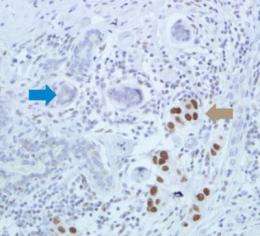
This breast tissue shows both breast cancer cells (brown arrow) and normal breast epithelial cells (blue arrow). There is high expression of heat shock factor 1 protein (HSF1; stained brown) in the nuclei of tumor cells whereas normal cells have lower HSF1 expression. Nuclei without HSF1 are stained blue. In estrogen receptor (ER) positive breast cancer, the amount of HSF1 appears to be important for prognosis. High nuclear levels of HSF1 in cancer cells are associated with reduced survival while lower levels are associated with better outcome. In addition to suggesting a role in prognosis, this finding suggests that HSF1 might be a useful therapeutic target for the treatment of ER-positive breast cancer. Credit: Courtesy of PNAS.

Whitehead Institute scientists report that patients whose estrogen receptor (ER)-positive breast cancers have high levels of the ancient cellular survival factor heat shock factor 1 (HSF1) experience poor outcomes -- including increased mortality.

According to the , approximately two-thirds of breast have ER-positive tumors. Although ER-positive breast cancers are often associated with better outcomes than other breast cancer tumor types, including those that are negative for the HER-2 receptor and so-called triple negative breast cancers (those lacking estrogen, progesterone, and HER-2 receptors), patient prognoses can still vary widely.

"HSF1's relationship to prognosis [in ER-positive patients] raises the interesting possibility for diagnostic applications -- HSF1 levels may have a role in helping determine who will have a better outcome and possibly who will have a poorer response to certain drugs," says Sandro Santagata, a postdoctoral researcher in the lab of Whitehead Member Susan Lindquist and first author of the study whose results are published online this week in the Proceedings of the National Academy of Sciences.

The heat shock response, which is controlled by transcription factors like HSF1, enables cells to withstand temperature spikes and other stressors. Crammed with distorted and abnormal proteins, cancer cells are deviants that live in a tumor's distorted landscape; a world lacking abundant nutrients and oxygen. To survive these exceptionally stressful circumstances, many have usurped the normally beneficial heat shock response to support their existence.

To see how HSF1 levels in cancer are associated with the cancer's aggressiveness, Santagata examined HSF1 levels in tissue samples from 1,841 participants in one of the largest and longest-running epidemiological studies of women's health, the Nurses' Health Study. Santagata and colleagues at the Harvard School of Public Health and University of Miami then looked at the relationship between HSF1 status and the participants' outcomes. Compared with ER-positive with low levels of HSF1, those with high levels of HSF1 had a poorer outcome, including increased mortality. He also noted that invasive ER-positive tumors with elevated HSF1 levels tended to be larger and more aggressive than those with normal HSF1 levels.

Because of this strong link between HSF1 concentrations and prognosis, HSF1 testing could become a valuable part of the oncologist's toolkit.

"If HSF1 status can help predict which of the ER-positive patients will do well with standard treatments and which ones won't, that would be really helpful," says Santagata, who is also an instructor in pathology at Brigham and Women's Hospital. "In terms of understanding the biology, we think these findings are really important for reinforcing our interest in pursuing the response itself as a therapeutic target."

More information: "High levels of nuclear HSF1 are associated with poor prognosis in breast cancer" PNAS, published the week of October 31, 2011

Provided by Whitehead Institute for Biomedical Research search and more info website

not rated yet  

Rank not rated yet
Relevant PhysicsForums posts
  • Potential Breakthrough in Seizure Control
    created7 hours ago
  • Popping/Cracked sternum.
    created11 hours ago
  • Which Mental Illness Encompasses This Problem?
    created12 hours ago
  • A question about drug tolerance
    createdMay 23, 2012
  • Poor nutrition leading to overeating?
    createdMay 23, 2012
  • Math and dyslexia?
    createdMay 21, 2012
  • More from Physics Forums - Medical Sciences

More news stories

Skp2 activates cancer-promoting, glucose-processing Akt

HER2 and its epidermal growth factor receptor cousins mobilize a specialized protein to activate a major player in cancer development and sugar metabolism, scientists report in the May 25 issue of Cell.

Cancer created 19 hours ago | popularity not rated yet | comments 0 | with audio podcast

Pancreatectomy OK without downstaging from therapy

(HealthDay) -- Pancreatectomy improves median survival in pancreatic cancer patients even when presurgical neoadjuvant therapy does not lead to radiographic downstaging of tumors, according to a study published ...

Cancer created 20 hours ago | popularity not rated yet | comments 0

Common therapies for basal cell carcinoma offer similar survival

(HealthDay) -- For patients with superficial basal cell carcinoma (sBCC), treatment with imiquimod or photodynamic therapy (PDT) results in similar long-term tumor-free survival, according to a review published ...

Cancer created 21 hours ago | popularity not rated yet | comments 0

Cancer may require simpler genetic mutations than previously thought

Chromosomal deletions in DNA often involve just one of two gene copies inherited from either parent. But scientists haven't known how a deletion in one gene from one parent, called a "hemizygous" deletion, can contribute ...

Cancer created 23 hours ago | popularity not rated yet | comments 0 | with audio podcast

New prostate cancer screening guidelines face a tough sell, study suggests

(Medical Xpress) -- Recent recommendations from the U.S. Preventive Services Task Force (USPSTF) advising elimination of routine prostate-specific antigen (PSA) screening for prostate cancer in healthy men are likely to encounter ...

Cancer created May 25, 2012 | popularity not rated yet | comments 1


Family history of Alzheimer's affects functional connectivity

(HealthDay) -- Cognitively normal individuals with a family history of late-onset Alzheimer's disease (AD) may display lower resting state functional connectivity in the default mode network (DMN) of the brain, ...

Travel to high altitudes tied to Crohn's, colitis flare-ups

(HealthDay) -- People with inflammatory bowel disease, which includes Crohn's disease and colitis, may be at increased risk for flare-ups when they fly or travel to high altitudes for skiing or mountain climbing, ...

Transvaginal mesh op restores pelvic organ prolapse at price

(HealthDay) -- Transvaginal mesh (TVM) procedures are effective for anatomical restoration of pelvic organ prolapse (POP), but patients report a worsening of sexual function following surgery, according to ...

Inherited DNA change explains overactive leukemia gene

A small inherited change in DNA is largely responsible for overactivating a gene linked to poor treatment response in people with acute leukemia.

Tongue analysis software uses ancient Chinese medicine to warn of disease

For 5,000 years, the Chinese have used a system of medicine based on the flow and balance of positive and negative energies in the body. In this system, the appearance of the tongue is one of the measures used to classify ...

Early physical therapist treatment associated with reduced risk of healthcare utilization and reduced overall healthcare

A new study published in Spine shows that early treatment by a physical therapist for low back pain (LBP), as compared to delayed treatment, was associated with reduced risk of subsequent healthcare utilization and lower ...