Neuroimmunologists find gut bacteria link to multiple sclerosis
October 27, 2011
by Bob Yirka
in Neuroscience
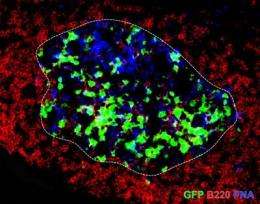
These are autoaggressive B-cells (green) in a lymph node close to the brain. The activation of the B-cells takes place in the germinal centre (blue) of the lymph node. The activated cells produce antibodies against the myelin layer in the brain and thus contribute to the formation of inflammatory reactions. Credit: MPI of Neurobiology
(Medical Xpress) -- Researchers at the Max Planck Institute of Neurobiology have found that commensal gut flora in mice is an essential part of the immune triggering process that leads to multiple sclerosis (MS). In their paper published in Nature, the team led by Gurumoorthy Krishnamoorthy and Hartmut Wekerle write that microbial environmental factors that lead to the disease arent able to do their work in the absence of common gut bacteria, thus they find that such bacteria are a necessary link in the chain of events that lead to the broad spectrum neurological disease known as MS.
People get MS when the myelin sheaths that cover the axons of the brain and spinal cord begin to deteriorate due to attacks by the immune system. This results in nerve cells that are unable to communicate with one another leaving those affected with an individualized set of symptoms ranging from numbness, tingling and muscle loss to problems in hearing, vision and swallowing. And while the particular environmental microbial factors that start the process are still unknown, this new research by the team in Germany shows that the process cant continue without assistance from at least some of the bacteria that exist in the gut.
The researchers discovered the gut bacterial link by subjecting test mice that had been genetically engineered to develop MS like symptoms, to doses of antibiotics to kill off all of their gut bacteria. As a result they found that the immune system in the mice no longer attacked the myelin sheaths, thus they never got MS. When gut bacteria were then subsequently introduced however, eighty percent of the mice then developed symptoms.
Despite this new lead, scientists are still stymied as to what sort of genetic disposition leads the immune system in some people to react to certain unknown microbial factors which appears to lead to excited T cells winding up in the lymph nodes and comingling with B cells, which then together travel to the brain and spinal cord where they begin to attack the myelin coating on the nerves they find there.
The next step in the research project will be a process of elimination to try to figure out which gut bacteria in particular are necessary for the chain of events to proceed.
More information: Commensal microbiota and myelin autoantigen cooperate to trigger autoimmune demyelination, Nature (2011) doi:10.1038/nature10554
Abstract
Active multiple sclerosis lesions show inflammatory changes suggestive of a combined attack by autoreactive T and B lymphocytes against brain white matter. These pathogenic immune cells derive from progenitors that are normal, innocuous components of the healthy immune repertoire but become autoaggressive upon pathological activation. The stimuli triggering this autoimmune conversion have been commonly attributed to environmental factors, in particular microbial infection. However, using the relapsingremitting mouse model of spontaneously developing experimental autoimmune encephalomyelitis, here we show that the commensal gut florain the absence of pathogenic agentsis essential in triggering immune processes, leading to a relapsingremitting autoimmune disease driven by myelin-specific CD4+ T cells. We show further that recruitment and activation of autoantibody-producing B cells from the endogenous immune repertoire depends on availability of the target autoantigen, myelin oligodendrocyte glycoprotein (MOG), and commensal microbiota. Our observations identify a sequence of events triggering organ-specific autoimmune disease and these processes may offer novel therapeutic targets.
© 2011 PhysOrg.com
-
Researchers find gut bacteria teaches immune cells to see them as friendly
Sep 22, 2011 |
not rated yet |
0
-
Of bugs and brains: Researchers discover that gut bacteria affect multiple sclerosis
Jul 19, 2010 |
not rated yet |
0
-
Stress affects the balance of bacteria in the gut and immune response
Mar 21, 2011 |
not rated yet |
0
-
Interferon could be a key to preventing or treating multiple sclerosis
Oct 30, 2008 |
not rated yet |
0
-
Gut-residing bacteria trigger arthritis in genetically susceptible individuals
Jun 17, 2010 |
not rated yet |
0
-
Motion perception revisited: High Phi effect challenges established motion perception assumptions
Apr 23, 2013 |
3 / 5 (2) |
2
-
Anything you can do I can do better: Neuromolecular foundations of the superiority illusion (Update)
Apr 02, 2013 |
4.5 / 5 (11) |
5
-
The visual system as economist: Neural resource allocation in visual adaptation
Mar 30, 2013 |
5 / 5 (2) |
9
-
Separate lives: Neuronal and organismal lifespans decoupled
Mar 27, 2013 |
4.9 / 5 (8) |
0
-
Sizing things up: The evolutionary neurobiology of scale invariance
Feb 28, 2013 |
4.8 / 5 (10) |
14
-
Why is zone 1 in liver more prone to ischemic injury?
16 hours ago
-
How can there be villous adenoma in colon, if there are no villi there
May 22, 2013
-
How can there be a term called "intestinal metaplasia" of stomach
May 21, 2013
-
Pressure-volume curve: Elastic Recoil Pressure don't make sense
May 18, 2013
-
If you became brain-dead, would you want them to pull the plug?
May 17, 2013
-
MRI bill question
May 15, 2013
- More from Physics Forums - Medical Sciences
More news stories
Controlling mood through the motions of mitochondria
(Medical Xpress)—Regulating the distribution of power in neurons is done by a system that makes the national electric grid look simple by comparison. Each neuron has several thousand mitochondria confined ...
Neuroscience
2 hours ago |
4.5 / 5 (2) |
0
|
Brain uses internal 'average voice' prototype to identify who is talking
(Medical Xpress)—The human brain is able to identify individuals' voices by comparing them against an internal 'average voice' prototype, according to neuroscientists.
Neuroscience
6 hours ago |
1 / 5 (1) |
0
|
Depression common among children with temporal lobe epilepsy
A new study determined that children and adolescents with seizures involving the temporal lobe are likely to have clinically significant behavioral problems and psychiatric illness, especially depression. Findings published ...
Neuroscience
6 hours ago |
not rated yet |
0
The secret lives, and deaths, of neurons
As the human body fine-tunes its neurological wiring, nerve cells often must fix a faulty connection by amputating an axon—the "business end" of the neuron that sends electrical impulses to tissues or other ...
Neuroscience
7 hours ago |
5 / 5 (2) |
0
|
Regenerating spinal cord fibers may be treatment for stroke-related disabilities
A study by researchers at Henry Ford Hospital found "substantial evidence" that a regenerative process involving damaged nerve fibers in the spinal cord could hold the key to better functional recovery by most stroke victims.
Neuroscience
7 hours ago |
not rated yet |
0
|
Glucosamine supplements tied to risk of eye condition
(HealthDay)—Glucosamine supplements that millions of Americans take to help treat hip and knee osteoarthritis may have an unexpected side effect: They may increase risk for developing glaucoma, a small ...
WHO: Scientific red tape mars efforts vs. virus
International efforts to combat a new pneumonia-like virus that has now killed 22 people are being slowed by unclear rules and competition for the potentially profitable rights to disease samples, the head ...
Future doctors unaware of their obesity bias
Two out of five medical students have an unconscious bias against obese people, according to a new study by researchers at Wake Forest Baptist Medical Center. The study is published online ahead of print in the Journal of ...
Scientists discover molecule triggers sensation of itch
Scientists at the National Institutes of Health report they have discovered in mouse studies that a small molecule released in the spinal cord triggers a process that is later experienced in the brain as ...
Multiple research teams unable to confirm high-profile Alzheimer's study
Teams of highly respected Alzheimer's researchers failed to replicate what appeared to be breakthrough results for the treatment of this brain disease when they were published last year in the journal Science.
When oxygen is short, EGFR prevents maturation of cancer-fighting miRNAs
Even while being dragged to its destruction inside a cell, a cancer-promoting growth factor receptor fires away, sending signals that thwart the development of tumor-suppressing microRNAs (miRNAs) before it's dissolved, researchers ...
Nov 03, 2011
Rank: not rated yet
For 7 years now, I have had bad stomach and intestine problems, 4 colonoscopies that turned up nothing, and worsening MS symptoms and more lesions and more black holes. I have lost long term memories, short term memory problems, loss of vision, painful itching, spasticity, neuralgia like nobodies business, and seizures out the ying yang.
I've been through 8 Neurologists, 1 was the Director of Neurology at a UCI Irvine, CA and they are all stumped at my atypical case of very strange MS. Dr Stanley van den Noort always thought it was stomach related, but he passed away before he finished.
Nov 03, 2011
Rank: not rated yet