Sexual selection by sugar molecule helped determine human origins
October 10, 2011 in Medical research

Sexual selection by sugar molecule helped determine human origins

Enlarge

This is a sialic acid cartoon. Image courtesy of UC San Diego School of Medicine

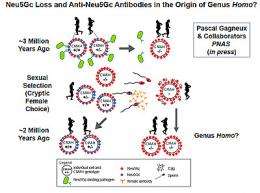
Researchers at the University of California, San Diego School of Medicine say that losing the ability to make a particular kind of sugar molecule boosted disease protection in early hominids, and may have directed the evolutionary emergence of our ancestors, the genus Homo.

The findings, published in this week's early online edition of the , are among the first evidence of a novel link between cell surface sugars, Darwinian sexual selection, and immune function in the context of

Sialic acids are found on the surfaces of all , where they serve as vital contact points for interaction with other cells and with the surrounding environment, including as targets for invasive pathogens. For millions of years, the common ancestors of humans and other apes shared a particular kind of sialic acid known as N-glycolylneuraminic acid or Neu5Gc. Then, for reasons possibly linked to a malarial parasite that bound Neu5Gc, a three million or so years ago inactivated the human enzyme involved in making the molecule. Instead, humans began producing more of a slightly different form of sialic acid called Neu5Ac, the precursor of Neu5Gc.

"This occurred at about the same time as were apparently becoming major predators in their environment," said Pascal Gagneux, PhD, an and associate professor of cellular and molecular medicine at UC San Diego. "It's hard to be sure exactly what happened because evolution works on so many things simultaneously, but the change in sialic acid meant that early humans developed an immune response to Neu5Gc. It became viewed by their immune systems as foreign, something to be destroyed. At about the same time, they started eating red meat, a major source of Neu5Gc, which may have further stimulated the immune response."

Gagneux and colleagues say this strong to Neu5Gc likely had a profound effect upon early human reproduction. In all mammals, the biological costs of pregnancy for the female can be huge, sometimes even life-threatening, and so it behooves females to ensure only the best-matching sperm successfully fertilize an egg. The scientists hypothesized that anti-Neu5Gc antibodies would target Neu5Gc-positive sperm or fetal tissues in early humans, kill them and thus reduce the chances of reproductive success.

Sexual selection by sugar molecule helped determine human origins
Enlarge

This is a reconstruction of a Homo erectus female (based on fossil ER 3733) by paleoartist John Gurche, part of the Smithsonian National Museum of Natural History’s Human Origins Program. Credit: Smithsonian National Museum of Natural History’s Human Origins Program

The researchers tested the idea by exposing chimpanzee sperm, whose cell surface sugars are more than half non-human sialic acids, to human anti-Neu5Gc antibodies. The antibodies bound and killed the ape sperm in vitro. The scientists then mated female mice genetically altered to lack Neu5Gc and immunized to produce anti-Neu5Gc antibodies with Neu5Gc-positive males. The fertility rate for the females was measurably lower due to pre-zygotic incompatibility – the anti-sperm effects of female antibodies.

"Over time, this incompatibility would reduce and then eliminate individuals with Neu5Gc," said Gagneux. "Oddly enough, based on our theoretical model, the process works faster when the fertility rate is only slightly decreased, rather than producing 100 percent infertility."

Gagneux noted that the findings add further weight to the concept of "speciation by infection," in which a combination of infectious diseases suffered by a particular population could predispose that population to diverge from other populations due to reproductive incompatibility. In the case of early humans, one driver may have been female immunity to Neu5Gc.

Previous studies have shown that the loss of Neu5Gc occurred about two to three million years ago, which happens to be about the time of emergence of Homo ergaster/erectus, the likely ancestor of humans.

"We suggest that the immune mechanism described here was involved in the origin of the genus Homo," said study co-author Ajit Varki, MD, professor of medicine and cellular and molecular medicine and director of the Center for Academic Research and Training in Anthropogeny at UC San Diego.

Provided by University of California - San Diego search and more info website

4.8 /5 (6 votes)  

Filter


Move the slider to adjust rank threshold, so that you can hide some of the comments.


Display comments: newest first

omatranter
Oct 10, 2011

Rank: 3 / 5 (4)
Evolution my 3 asses, yes I am that far ahead of you all, to talk the shite I do you need at least 3.

My ideas never evolve so evolution can't exist, Ipso Pepto-Bismol

We (royal usage) were created in Gods image (bad jpeg by the look of some of you) and as such are as perfect as he deemed us to be.
NO ARGUMENTS WILL BE ENTERED INTO!

That doesn't mean we don't change over time to be better able to meet the need that an unchanging environment like the coming fictitious Global Warming induced Ice-ages. this is just adaptation and not evolution.

And Illuminati, yada yada

Repellent Neutronium, Ho!
antonima
Oct 10, 2011

Rank: not rated yet
Fresh.. I wish I had the capacity to write a matching retort! I'm very fortunate to come from a liberal state where evolution isn't considered a dirty word.

Its an interesting article. It sounds similar to what wolbachia are doing to flies and other insects through cytoplasmic incompatibility. Hard to believe, but the little symbionts can take over an entire population in only a few decades by manipulating reproductive success and also improving immunity among other things.
dacarls
Oct 10, 2011

Rank: not rated yet
Hmm, reminds me of the time I wrote a grant proposal to genetically modify obligate Wolbachia found in blood feeding insects for the purpose of inducing more genetic incompatibility and or/inhibit blood digestion.
The panel said it was a good idea but they had never seen anything like it before, so my proposal was rejected.
Rank 4.8 /5 (6 votes)
Relevant PhysicsForums posts

More news stories

Study reveals new mechanism for estrogen suppression of liver lipid synthesis

By discovering the new mechanism by which estrogen suppresses lipid synthesis in the liver, UC Irvine endocrinologists have revealed a potential new approach toward treating certain liver diseases.

Medical research created May 23, 2013 | popularity not rated yet | comments 0 | with audio podcast

MRI-based measurement helps predict vascular disease in the brain

Aortic arch pulse wave velocity, a measure of arterial stiffness, is a strong independent predictor of disease of the vessels that supply blood to the brain, according to a new study published in the June issue the journal ...

Medical research created May 23, 2013 | popularity not rated yet | comments 0

Antibiotics: A new understanding of sulfonamide nervous system side effects

Since the discovery of Prontosil in 1932, sulfonamide antibiotics have been used to combat a wide spectrum of bacterial infections, from acne to chlamydia and pneumonia. However, their side effects can include serious neurological ...

Medical research created May 23, 2013 | popularity not rated yet | comments 0 | with audio podcast

Scientists discover molecule triggers sensation of itch

Scientists at the National Institutes of Health report they have discovered in mouse studies that a small molecule released in the spinal cord triggers a process that is later experienced in the brain as ...

Medical research created May 23, 2013 | popularity 5 / 5 (3) | comments 0 | with audio podcast

Discarded immune cells induce the relocation of stem cells

Spanish researchers have discovered that the daily clearance of neutrophils from the body stimulates the release of hematopoietic stem cells from the bone marrow into the bloodstream, according to a report published today ...

Medical research created May 23, 2013 | popularity 5 / 5 (2) | comments 0


Engineered cytomegalovirus protects monkeys from HIV equivalent

(Medical Xpress)—A new study by researchers in the US has shown that an ancient virus can be modified to help in the fight against the simian immunodeficiency virus SIV, which is the equivalent in monkeys ...

Researchers identify first drug targets in childhood genetic tumor disorder

Two mutations central to the development of infantile myofibromatosis (IM)—a disorder characterized by multiple tumors involving the skin, bone, and soft tissue—may provide new therapeutic targets, according to researchers ...

Hormone levels may provide key to understanding psychological disorders in women

Women at a particular stage in their monthly menstrual cycle may be more vulnerable to some of the psychological side-effects associated with stressful experiences, according to a study from UCL.

Going live: Immune cell activation in multiple sclerosis

Biological processes are generally based on events at the molecular and cellular level. To understand what happens in the course of infections, diseases or normal bodily functions, scientists would need to ...

Driving and hands-free talking lead to spike in errors, study shows

Talking on a hands-free device while behind the wheel can lead to a sharp increase in errors that could imperil other drivers on the road, according to new research from the University of Alberta.

Depression raises diabetics' risk of severe low blood sugar episodes

(Medical Xpress)—Patients with diabetes who are depressed are much more likely to develop episodes of dangerously low blood sugars, or hypoglycemia, than are those who are not depressed, a new study has ...