Singling out the real breast cancer among the lumps
October 25, 2011 in Cancer
Singling out the real breast cancer among the lumps

Enlarge

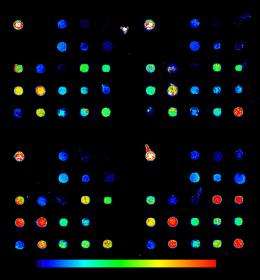
Tests similar to this identify unique proteins in blood from women with breast cancer. In each of the four 25-dot squares, each dot represents one of 21 different proteins being measured in one blood sample. The color indicates how much of the protein is present. Credit: PNNL

(Medical Xpress) -- Early detection of breast cancer saves thousands of lives each year. But screening for breast cancer also produces false alarms, which can cause undue stress and costly medical bills. Now, a recent study using patient blood reveals a possible way to reduce the number of false alarms that arise during early screening. Researchers found a panel of proteins shed by breast cancer that are easily detected and can distinguish between real cancer and benign lumps.

This study used that are already in use in clinics. If the results can be replicated with more volunteers and over a longer period of time, the transition from research lab to clinical lab would be straightforward.

"We were surprised to see we could distinguish between accurate and false results produced by cancer screens such as mammograms," said Department of Energy's Pacific Northwest National Laboratory biologist Richard Zangar, who led the study published in the July issue of , Biomarkers & Prevention. "We really want to expand the work to verify our findings."

Finding is the first step to treating it, but mammograms have a high rate of false alarms. Many women go through unneeded, invasive follow-up tests. To improve the process, some researchers are working on a simple clinical blood test that would detect proteins shed by cancerous tissues.

Called biomarkers, these proteins aren't doing much better than mammograms when it comes to false positives in experimental studies. But researchers have been approaching biomarkers as if every type of breast cancer is the same. In reality, breast cancer exists as several subtypes, with each subtype having distinct characteristics.

For example, breast cancers that produce proteins called estrogen receptors are a different subtype from ones that don't and respond to different therapies. Zangar and colleagues wondered if looking for biomarkers specific for different subtypes would improve the odds of getting the diagnosis right.

To explore this idea, Zangar and his colleagues at PNNL and Duke University picked 23 candidate biomarkers and measured them using tests similar to the ones found in clinics. The team compared proteins in blood from four groups of women — about 20 women in each of the four subtypes of breast cancer — to women with benign lumps that had previously been identified as false positives. Then, Zangar's team homed in on a handful of biomarkers for each subtype that could best distinguish between the most true positives and the least false positives.

The biomarker panel for each subtype was significantly better at distinguishing between breast cancer and benign lumps than mammograms or single biomarkers. The statistical test the team used rates performance from 0.5 to 1.0 — with 0.5 indicating the biomarker panel predicts cancer randomly and 1.0 means it's perfect. and the best single biomarkers rank around 0.8. But for two of the most common breast cancer subtypes, the biomarker panels ranked above 0.95 and reached 0.99 depending on which proteins were included in the panel.

"Perhaps researchers haven't found good biomarkers because they've been treating the different subtypes as a single disease, but they actually represent unique diseases that are associated with different biomarkers," said Zangar. "We're hopeful these results can be repeated because these assays would markedly improve our ability to detect breast cancer early on, when treatment is more effective, less costly and less harsh."

In addition, the study hints about the underlying biology of breast cancer. Four of the biomarkers are proteins involved in normal breast development that turn on and off at different times during growth. The fact that these proteins show up in different ways, depending on the subtype of breast cancer, might provide clues about what goes wrong when breast tissue turns cancerous.

The team is seeking additional funding to repeat the study in larger groups of women and to follow for several years.

More information: Rachel M Gonzalez, et al., Plasma Biomarker Profiles Differ Depending on Breast Cancer Subtype but RANTES Is Consistently Increased, Cancer Epidemiology, Biomarkers & Prevention, July 2011, DOI 10.1158/1055-9965.EPI-10-1248 (http://cebp.aacrjournals.org/content/early/2011/05/16/1055-9965.EPI-10-1248.short).

Provided by Pacific Northwest National Laboratory search and more info website

not rated yet  

Rank not rated yet
Relevant PhysicsForums posts
  • Potential Breakthrough in Seizure Control
    created11 hours ago
  • Popping/Cracked sternum.
    created16 hours ago
  • Which Mental Illness Encompasses This Problem?
    created16 hours ago
  • A question about drug tolerance
    createdMay 23, 2012
  • Poor nutrition leading to overeating?
    createdMay 23, 2012
  • Math and dyslexia?
    createdMay 21, 2012
  • More from Physics Forums - Medical Sciences

More news stories

Skp2 activates cancer-promoting, glucose-processing Akt

HER2 and its epidermal growth factor receptor cousins mobilize a specialized protein to activate a major player in cancer development and sugar metabolism, scientists report in the May 25 issue of Cell.

Cancer created May 25, 2012 | popularity not rated yet | comments 0 | with audio podcast

Pancreatectomy OK without downstaging from therapy

(HealthDay) -- Pancreatectomy improves median survival in pancreatic cancer patients even when presurgical neoadjuvant therapy does not lead to radiographic downstaging of tumors, according to a study published ...

Cancer created May 25, 2012 | popularity not rated yet | comments 0

Common therapies for basal cell carcinoma offer similar survival

(HealthDay) -- For patients with superficial basal cell carcinoma (sBCC), treatment with imiquimod or photodynamic therapy (PDT) results in similar long-term tumor-free survival, according to a review published ...

Cancer created May 25, 2012 | popularity not rated yet | comments 0

Cancer may require simpler genetic mutations than previously thought

Chromosomal deletions in DNA often involve just one of two gene copies inherited from either parent. But scientists haven't known how a deletion in one gene from one parent, called a "hemizygous" deletion, can contribute ...

Cancer created May 25, 2012 | popularity not rated yet | comments 0 | with audio podcast

New prostate cancer screening guidelines face a tough sell, study suggests

(Medical Xpress) -- Recent recommendations from the U.S. Preventive Services Task Force (USPSTF) advising elimination of routine prostate-specific antigen (PSA) screening for prostate cancer in healthy men are likely to encounter ...

Cancer created May 25, 2012 | popularity not rated yet | comments 1


Travel to high altitudes tied to Crohn's, colitis flare-ups

(HealthDay) -- People with inflammatory bowel disease, which includes Crohn's disease and colitis, may be at increased risk for flare-ups when they fly or travel to high altitudes for skiing or mountain climbing, ...

Family history of Alzheimer's affects functional connectivity

(HealthDay) -- Cognitively normal individuals with a family history of late-onset Alzheimer's disease (AD) may display lower resting state functional connectivity in the default mode network (DMN) of the brain, ...

Transvaginal mesh op restores pelvic organ prolapse at price

(HealthDay) -- Transvaginal mesh (TVM) procedures are effective for anatomical restoration of pelvic organ prolapse (POP), but patients report a worsening of sexual function following surgery, according to ...

Tongue analysis software uses ancient Chinese medicine to warn of disease

For 5,000 years, the Chinese have used a system of medicine based on the flow and balance of positive and negative energies in the body. In this system, the appearance of the tongue is one of the measures used to classify ...

Of mice and mental models: Neuroscientific implications of risk-optimized behavior in the mouse

(Medical Xpress) -- Regardless of an organism’s biological complexity, every encephalized animal continuously makes under-informed behavioral choices that can have serious consequences. Despite its ubiquity, ...

Weight struggles? Blame new neurons in your hypothalamus

New nerve cells formed in a select part of the brain could hold considerable sway over how much you eat and consequently weigh, new animal research by Johns Hopkins scientists suggests in a study published in the May issue ...