New algorithm could substantially speed up MRI scans
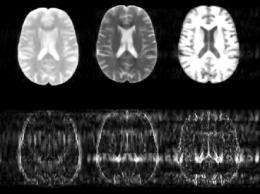
November 1, 2011 by Helen Knight in Medical research
Image credit: courtesy of the researchers
Magnetic resonance imaging (MRI) devices can scan the inside of the body in intricate detail, allowing clinicians to spot even the earliest signs of cancer or other abnormalities. But they can be a long and uncomfortable experience for patients, requiring them to lie still in the machine for up to 45 minutes.
Now this scan time could be cut to just 15 minutes, thanks to an algorithm developed at MITs Research Laboratory of Electronics.
MRI scanners use strong magnetic fields and radio waves to produce images of the body. Rather than taking just one scan of a patient, the machines typically acquire a variety of images of the same body part, each designed to create a contrast between different types of tissue. By comparing multiple images of the same region, and studying how the contrasts vary across the different tissue types, radiologists can detect subtle abnormalities such as a developing tumor. But taking multiple scans of the same region in this way is time-consuming, meaning patients must spend long periods inside the machine.
In a paper to be published in the journal Magnetic Resonance in Medicine, researchers led by Elfar Adalsteinsson, an associate professor of electrical engineering and computer science and health sciences and technology, and Vivek Goyal, the Esther and Harold E. Edgerton Career Development Associate Professor of Electrical Engineering and Computer Science, detail an algorithm they have developed to dramatically speed up this process. The algorithm uses information gained from the first contrast scan to help it produce the subsequent images. In this way, the scanner does not have to start from scratch each time it produces a different image from the raw data, but already has a basic outline to work from, considerably shortening the time it takes to acquire each later scan.
To create this outline, the software looks for features that are common to all the different scans, such as the basic anatomical structure, Adalsteinsson says. If the machine is taking a scan of your brain, your head wont move from one image to the next, he says. So if scan number two already knows where your head is, then it wont take as long to produce the image as when the data had to be acquired from scratch for the first scan.
In particular, the algorithm uses the first scan to predict the likely position of the boundaries between different types of tissue in the subsequent contrast scans. Given the data from one contrast, it gives you a certain likelihood that a particular edge, say the periphery of the brain or the edges that confine different compartments inside the brain, will be in the same place, Adalsteinsson says.
However, the algorithm cannot impose too much information from the first scan onto the subsequent ones, Goyal says, as this would risk losing the unique tissue features revealed by the different contrasts. You dont want to presuppose too much, he says. So you dont assume, for example, that the bright-and-dark pattern from one image will be replicated in the next image, because in fact those kinds of dark and light patterns are often reversed, and can reveal completely different tissue properties.
So for each pixel, the algorithm calculates what new information it needs to construct the image, and what information such as the edges of different types of tissue it can take from the previous scans, says graduate student and first author Berkin Bilgic.
The result is an MRI scan that is three times quicker to complete, cutting the time patients spend in the machine from 45 to 15 minutes. This faster scan time does have a slight impact on image quality, Bilgic admits, but it is much better than competing algorithms.
The team is now working to further improve the algorithm by speeding up the time it takes to process the raw image data into a final scan that can be analyzed by clinicians, once the patient has stepped out of the MRI machine. Using standard computer processors, this final step currently takes considerably longer than with conventional MRI scans.
But the researchers believe they can reduce this calculation time down to the same as that of conventional MRI scans using recent advances in computing hardware from the gaming industry. Graphics processing units, or GPUs, are orders of magnitude faster at certain computational tasks than general processors, like the particular computational task that we need for this algorithm, Adalsteinsson says.
A student at the laboratory is now working to implement the algorithm on a dedicated GPU, he says.
Dwight Nishimura, the director of the Magnetic Resonance Systems Research Laboratory at Stanford University, says Adalsteinsson's group has done some very interesting algorithmic work. This work is potentially of high significance because it applies to routine clinical MRI, among other applications, he says. Ultimately, their approach might enable a substantial reduction in examination time.
This story is republished courtesy of MIT News (http://web.mit.edu/newsoffice/), a popular site that covers news about MIT research, innovation and teaching.
Provided by
Massachusetts Institute of Technology
-
FDA clears Siemens' 2-in-1 medical scanner
Jun 10, 2011 |
not rated yet |
0
-
MRI/PET scanner combo
Mar 07, 2008 |
not rated yet |
0
-
FDA approval for Siemens PET Scan - MRI combo
Jun 13, 2011 |
not rated yet |
0
-
Faster, more precise MRI for the medical world
Sep 25, 2004 |
not rated yet |
0
-
What makes an image memorable? We tend to remember pictures of people much better than wide open spaces
May 24, 2011 |
not rated yet |
0
-
Of mice and mental models: Neuroscientific implications of risk-optimized behavior in the mouse
May 25, 2012 |
not rated yet |
0
-
Limits to growth: Scientists identify key metastasis-enabling enzyme
May 22, 2012 |
5 / 5 (4) |
0
-
Seeing is as seeing does: Spatially-structured retinal input in early development of cortical maps
Apr 26, 2012 |
5 / 5 (4) |
1
-
Dreamless nights: Brain activity during nonrapid eye movement sleep
Apr 09, 2012 |
4.4 / 5 (12) |
0
-
Take your time: Neurobiology sheds light on the superiority of spaced vs. massed learning
Mar 28, 2012 |
4.5 / 5 (21) |
3
-
Potential Breakthrough in Seizure Control
8 hours ago
-
Popping/Cracked sternum.
13 hours ago
-
Which Mental Illness Encompasses This Problem?
13 hours ago
-
A question about drug tolerance
May 23, 2012
-
Poor nutrition leading to overeating?
May 23, 2012
-
Math and dyslexia?
May 21, 2012
- More from Physics Forums - Medical Sciences
More news stories
Implantable pain disk may help those with cancer
An estimated 3.5 million cancer patients around the globe are in severe pain from their disease, but many get no relief.
Medical research
May 25, 2012 |
not rated yet |
0
|
Energy levels link sleep control mechanisms
Sleep, or lack of it, can determine level of cognitive performance which is linked with accidents as well as increased risk of serious health problems. Links between cell energy levels, gene transcription ...
Medical research
May 25, 2012 |
not rated yet |
0
Researchers identify key brain cell in antidepressant action
(Medical Xpress) -- Antidepressant medications such as Prozac have helped improve mood and lessen anxiety in millions of people with major depression. But scientists know surprisingly little about how these drugs work.
Medical research
May 25, 2012 |
4.7 / 5 (3) |
0
|
Rockefeller scientists pioneer new method to determine mechanisms of drug action
(Medical Xpress) -- Knowing that a drug works is great. Knowing how it works is a luxury. And until now, determining a drugs mechanism of action has been a tedious and difficult process for scientists.
Medical research
May 25, 2012 |
not rated yet |
0
|
Like curry? New biological role identified for compound used in ancient medicine
Scientists have just identified a new reason why some curry dishes, made with spices humans have used for thousands of years, might be good for you.
Medical research
May 25, 2012 |
4.5 / 5 (12) |
2
|
Travel to high altitudes tied to Crohn's, colitis flare-ups
(HealthDay) -- People with inflammatory bowel disease, which includes Crohn's disease and colitis, may be at increased risk for flare-ups when they fly or travel to high altitudes for skiing or mountain climbing, ...
Family history of Alzheimer's affects functional connectivity
(HealthDay) -- Cognitively normal individuals with a family history of late-onset Alzheimer's disease (AD) may display lower resting state functional connectivity in the default mode network (DMN) of the brain, ...
Transvaginal mesh op restores pelvic organ prolapse at price
(HealthDay) -- Transvaginal mesh (TVM) procedures are effective for anatomical restoration of pelvic organ prolapse (POP), but patients report a worsening of sexual function following surgery, according to ...
Tongue analysis software uses ancient Chinese medicine to warn of disease
For 5,000 years, the Chinese have used a system of medicine based on the flow and balance of positive and negative energies in the body. In this system, the appearance of the tongue is one of the measures used to classify ...
Skp2 activates cancer-promoting, glucose-processing Akt
HER2 and its epidermal growth factor receptor cousins mobilize a specialized protein to activate a major player in cancer development and sugar metabolism, scientists report in the May 25 issue of Cell.
Early physical therapist treatment associated with reduced risk of healthcare utilization and reduced overall healthcare
A new study published in Spine shows that early treatment by a physical therapist for low back pain (LBP), as compared to delayed treatment, was associated with reduced risk of subsequent healthcare utilization and lower ...
Nov 01, 2011
Rank: not rated yet
Nov 02, 2011
Rank: not rated yet
From a medical standpoint it's not a good idea because the reconstruction algorithm is working on the (first) assumption that nothing has changed.
But that is exactly what you are looking for when you are evaluating MR images: changes (e.g. tumor growth, vertebra disc misalignments, etc.).
If prior information is used as a starting point such change will be downplayed by the algorithm which is NOT what you want.
That said: The algorithm certainly has an application in 4D imaging (when you do a time-series MR) because then medical changes aren't important but you're rather looking at motion.