Testing antioxidant drugs is transparent
November 21, 2011 in Medical research
Testing antioxidant drugs is transparent

Enlarge

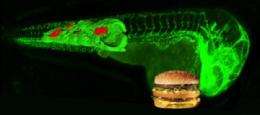
This is a zebrafish model of atherosclerosis. Credit: UC San Diego School of Medicine

A study using genetically modified zebrafish to visualize early events involved in development of human atherosclerosis describes an efficient model – one that the researchers say offers many applications for testing the potential effectiveness of new antioxidant and dietary therapies.

The research, led by scientists from the University of California, San Diego School of Medicine, has been published online by the Journal of Clinical Investigation, and will appear in print in the December 1 issue of the journal.

Atherosclerosis is a process of lipid deposition and inflammation in the artery walls. Low-density lipoprotein (LDL) that carries "bad" cholesterol in blood is easily oxidized, and oxidized LDL promotes inflammatory responses by vascular cells. Inflamed atherosclerotic plaque can often rupture; this results in a blood clot, obstruction of blood flow to the heart or brain, and heart attack or stroke.

An international team of researchers led by Yury Miller, MD, PhD, of the UCSD Department of Medicine, working with colleagues in Australia, developed an approach to see – literally – the accumulation of oxidized LDL in genetically modified zebrafish fed a diet high in cholesterol. Because young zebrafish are transparent, the researchers were able to study vascular lipid accumulation, lipid oxidation, and uptake of oxidized LDL by macrophages – all in live animals.

To be able to see oxidized LDL, the researchers inserted a gene encoding an antibody that recognizes oxidized LDL, conjugated with green fluorescent protein (GFP), into the zebrafish genome. The antibody, called IK17, was originally cloned from a patient with severe coronary heart disease by the group of scientists led by Joseph L. Witztum, MD, and Sotirios Tsimikas, MD, also of the UCSD Department of Medicine.

The new gene was silent in zebrafish until their tank water was warmed to 99ºF (37ºC.) After one hour of this "heat shock," IK17-GFP was produced and eventually bound to its target – oxidized LDL in the vascular wall. The green glow of GFP was clearly seen in tiny, live zebrafish under microscope. It was then put back into the fish tank until next picture-taking session.

"Using this technique, we were able to measure the time course of oxidized lipid accumulation in the vascular wall and visualize the effects of treatment with an antioxidant drug, and saw that it reversed the accumulation of oxidized LDL," said the paper's first author Longhou Fang, PhD. "The same therapeutic effect was achieved by switching the zebrafish back to a diet low in cholesterol. We saw the results in just 10 days working with the zebrafish model. A similar experiment in mice took 6 months to complete."

"I see this cholesterol-fed, transgenic zebrafish model as a novel way to study early vascular lipid accumulation and lipoprotein oxidation, the processes that lead to heart disease in humans," said Miller. "Since it is relatively easy and cost-effective to establish and maintain new transgenic zebrafish lines, this offers an in-vivo test for new antioxidants and other drug candidates that could affect development of human atherosclerosis."

Provided by University of California - San Diego search and more info website

not rated yet  

Filter


Move the slider to adjust rank threshold, so that you can hide some of the comments.


Display comments: newest first

LVT
Nov 21, 2011

Rank: not rated yet
Why the BigMac?
Rank not rated yet
Related Stories
Relevant PhysicsForums posts
  • Potential Breakthrough in Seizure Control
    created8 hours ago
  • Popping/Cracked sternum.
    created13 hours ago
  • Which Mental Illness Encompasses This Problem?
    created13 hours ago
  • A question about drug tolerance
    createdMay 23, 2012
  • Poor nutrition leading to overeating?
    createdMay 23, 2012
  • Math and dyslexia?
    createdMay 21, 2012
  • More from Physics Forums - Medical Sciences

More news stories

Implantable pain disk may help those with cancer

An estimated 3.5 million cancer patients around the globe are in severe pain from their disease, but many get no relief.

Medical research created May 25, 2012 | popularity not rated yet | comments 0 | with audio podcast

Energy levels link sleep control mechanisms

Sleep, or lack of it, can determine level of cognitive performance which is linked with accidents as well as increased risk of serious health problems. Links between cell energy levels, gene transcription ...

Medical research created May 25, 2012 | popularity not rated yet | comments 0

Researchers identify key brain cell in antidepressant action

(Medical Xpress) -- Antidepressant medications such as Prozac have helped improve mood and lessen anxiety in millions of people with major depression. But scientists know surprisingly little about how these drugs work.

Medical research created May 25, 2012 | popularity 4.7 / 5 (3) | comments 0 | with audio podcast

Rockefeller scientists pioneer new method to determine mechanisms of drug action

(Medical Xpress) -- Knowing that a drug works is great. Knowing how it works is a luxury. And until now, determining a drug’s mechanism of action has been a tedious and difficult process for scientists.

Medical research created May 25, 2012 | popularity not rated yet | comments 0 | with audio podcast

Like curry? New biological role identified for compound used in ancient medicine

Scientists have just identified a new reason why some curry dishes, made with spices humans have used for thousands of years, might be good for you.

Medical research created May 25, 2012 | popularity 4.5 / 5 (12) | comments 2 | with audio podcast


Travel to high altitudes tied to Crohn's, colitis flare-ups

(HealthDay) -- People with inflammatory bowel disease, which includes Crohn's disease and colitis, may be at increased risk for flare-ups when they fly or travel to high altitudes for skiing or mountain climbing, ...

Family history of Alzheimer's affects functional connectivity

(HealthDay) -- Cognitively normal individuals with a family history of late-onset Alzheimer's disease (AD) may display lower resting state functional connectivity in the default mode network (DMN) of the brain, ...

Transvaginal mesh op restores pelvic organ prolapse at price

(HealthDay) -- Transvaginal mesh (TVM) procedures are effective for anatomical restoration of pelvic organ prolapse (POP), but patients report a worsening of sexual function following surgery, according to ...

Tongue analysis software uses ancient Chinese medicine to warn of disease

For 5,000 years, the Chinese have used a system of medicine based on the flow and balance of positive and negative energies in the body. In this system, the appearance of the tongue is one of the measures used to classify ...

Skp2 activates cancer-promoting, glucose-processing Akt

HER2 and its epidermal growth factor receptor cousins mobilize a specialized protein to activate a major player in cancer development and sugar metabolism, scientists report in the May 25 issue of Cell.

Early physical therapist treatment associated with reduced risk of healthcare utilization and reduced overall healthcare

A new study published in Spine shows that early treatment by a physical therapist for low back pain (LBP), as compared to delayed treatment, was associated with reduced risk of subsequent healthcare utilization and lower ...