The body's own surveillance system against cancer
November 9, 2011 in Medical research
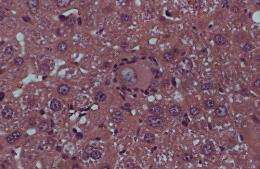
Liver tissue section with a senescent liver cell directly in the center of the image. It is surrounded by small cells - attacking immune cells that have recognized and will have eliminated the senescent cell before long (Hämatoxylin-Eosin-stained section).
(Medical Xpress) -- Liver cell carcinoma is one of the most abundant malign cancer diseases worldwide. In the majority of cases its emergence is triggered by cirrhosis of the liver which is caused by chronic Hepatitis B or C virus infections. Researchers at the Helmholtz Centre for Infection Research (HZI) in Braunschweig and the Hanover Medical School have now revealed how a healthy and potent immune system is able to detect and kill potentially premalignant liver cells at an early stage. Cells with a high risk of degenerating into tumor cells e.g. as a result of chemical stress or nuclear radiation often abandon their normal life cycle and enter a state of arrest, designated as senescence.
Together with fellow researchers from other institutions the HZI scientists discovered that the state of senescence of the cells allows detection by the immune system. This results in an intensified surveillance by the bodys own defense system. The researchers propose that a mechanism, similar to the one shown for the liver, may play a key role in other organs as well. The results of this project have now been published in an online release by the scientific journal Nature.
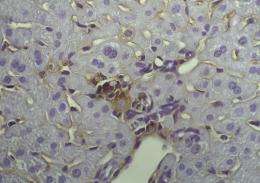
Liver tissue section with a senescent liver cell directly in the center of the image. The senescent cell is stained homogenously brown. In the surrounding small immune cells are located that have recognized the senescent cell and will perform its elimination.
At the end of their life cycle or if their genetic information has been damaged or modified, cells either pass through a precisely organized programme of cell death or decline into a kind of hibernation, the so-called senescence. This resting state prevents defective cells from proliferating in an uncontrolled way and thus avoids the formation of tumors. Professor Lars Zender, head of the HZI research group Chronic Infections and Cancer, and his team were able to demonstrate that the immune system plays a crucial role in the continuous surveillance of these resting cells. By this means the body avoids further alterations of cells that possibly result in cancer, explains Lars Zender.For the investigation of the association between senescence, immune defense and cancer development, Lars Zender and his team used molecular biological methods in order to induce the senescence programme in liver cells of laboratory mice. We were distinctly able to see that the immune system initiates a reaction against the modified cells, says Zender. After a few weeks the modified cells were eliminated.
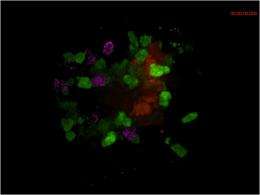
The figure shows a liver tissue section. Multiple cells have been visualized using a fluorescence dye. A senescent liver cell (orange) is dying as it is being attacked by diverse immune cells. Among the attackers are cells of the innate immune system, stained in green (monocytes, macrophages, neutrophilic granulocytes) as well as cells of the acquired immune system, stained in purple (T-helper lymphocytes). The T-helper lymphocytes “instruct” the green cells to kill the senescent liver cell.
In immunodeficient mice that lack protective T-helper cells, researchers were able to observe that senescent liver cells progressed to develop liver cell carcinoma. This clearly shows how important the surveillance of senescent cells is a task carried out by the immune system, and specifically, by the T-helper cells, says Zender.
This newly identified mechanism may also explain the fact that HIV-positive patients have an increased risk of developing liver cancer. To investigate this phenomenon, researchers determined the number of senescent cells in the liver of Hepatitis C patients that were also HIV-positive. The results were compared to the numbers of a Hepatitis C patient group without HIV infection. As expected, in the former group the number of senescent cells was strongly increased, says Zender. In HIV patients, the T-helper cell-mediated immune defense is impaired. As a consequence, in livers of HIV patients, senescent liver cells probably cannot be eliminated effectively.
The authors of this study are hopeful that the newly discovered mechanism enables the design of prospective new prevention and therapy strategies for cancer diseases.
More information: Senescence surveillance of premalignant hepatocytes limits liver cancer development. Tae-Won Kang, Tetyana Yevsa, Norman Woller, Lisa Hoenicke, Torsten Wuestefeld, Daniel Dauch, Anja Hohmeyer, Marcus Gereke, Ramona Rudalska, Anna Potapova, Markus Iken, Mihael Vucur, Siegfried Weiss, Mathias Heikenwalder, Sadaf Khan, Jesus Gil, Dunja Bruder, Michael Manns, Peter Schirmacher, Frank Tacke, Michael Ott, Tom Luedde, Thomas Longerich, Stefan Kubicka and Lars Zender
Nature, Advanced Online Publication, DOI: 10.1038/nature10599
Journal reference:
Nature
Provided by Helmholtz Centre for Infection Research
-
To protect against liver disease, body puts cells 'under arrest'
Aug 21, 2008 |
not rated yet |
0
-
Senescence in liver cells can provoke a beneficial immune reaction
Aug 21, 2008 |
not rated yet |
0
-
Pinpointing a tell-tale mark of liver cancer
Jul 08, 2011 |
not rated yet |
0
-
HIV study identifies key cellular defence mechanism
Nov 07, 2011 |
not rated yet |
0
-
Danger signal limits Hepatitis C infection
Sep 19, 2011 |
not rated yet |
0
-
Of mice and mental models: Neuroscientific implications of risk-optimized behavior in the mouse
May 25, 2012 |
not rated yet |
0
-
Limits to growth: Scientists identify key metastasis-enabling enzyme
May 22, 2012 |
5 / 5 (4) |
0
-
Seeing is as seeing does: Spatially-structured retinal input in early development of cortical maps
Apr 26, 2012 |
5 / 5 (4) |
1
-
Dreamless nights: Brain activity during nonrapid eye movement sleep
Apr 09, 2012 |
4.4 / 5 (12) |
0
-
Take your time: Neurobiology sheds light on the superiority of spaced vs. massed learning
Mar 28, 2012 |
4.5 / 5 (21) |
3
-
Potential Breakthrough in Seizure Control
9 hours ago
-
Popping/Cracked sternum.
14 hours ago
-
Which Mental Illness Encompasses This Problem?
14 hours ago
-
A question about drug tolerance
May 23, 2012
-
Poor nutrition leading to overeating?
May 23, 2012
-
Math and dyslexia?
May 21, 2012
- More from Physics Forums - Medical Sciences
More news stories
Implantable pain disk may help those with cancer
An estimated 3.5 million cancer patients around the globe are in severe pain from their disease, but many get no relief.
Medical research
May 25, 2012 |
not rated yet |
0
|
Energy levels link sleep control mechanisms
Sleep, or lack of it, can determine level of cognitive performance which is linked with accidents as well as increased risk of serious health problems. Links between cell energy levels, gene transcription ...
Medical research
May 25, 2012 |
not rated yet |
0
Researchers identify key brain cell in antidepressant action
(Medical Xpress) -- Antidepressant medications such as Prozac have helped improve mood and lessen anxiety in millions of people with major depression. But scientists know surprisingly little about how these drugs work.
Medical research
May 25, 2012 |
4.7 / 5 (3) |
0
|
Rockefeller scientists pioneer new method to determine mechanisms of drug action
(Medical Xpress) -- Knowing that a drug works is great. Knowing how it works is a luxury. And until now, determining a drugs mechanism of action has been a tedious and difficult process for scientists.
Medical research
May 25, 2012 |
not rated yet |
0
|
Like curry? New biological role identified for compound used in ancient medicine
Scientists have just identified a new reason why some curry dishes, made with spices humans have used for thousands of years, might be good for you.
Medical research
May 25, 2012 |
4.5 / 5 (12) |
2
|
Travel to high altitudes tied to Crohn's, colitis flare-ups
(HealthDay) -- People with inflammatory bowel disease, which includes Crohn's disease and colitis, may be at increased risk for flare-ups when they fly or travel to high altitudes for skiing or mountain climbing, ...
Family history of Alzheimer's affects functional connectivity
(HealthDay) -- Cognitively normal individuals with a family history of late-onset Alzheimer's disease (AD) may display lower resting state functional connectivity in the default mode network (DMN) of the brain, ...
Transvaginal mesh op restores pelvic organ prolapse at price
(HealthDay) -- Transvaginal mesh (TVM) procedures are effective for anatomical restoration of pelvic organ prolapse (POP), but patients report a worsening of sexual function following surgery, according to ...
Tongue analysis software uses ancient Chinese medicine to warn of disease
For 5,000 years, the Chinese have used a system of medicine based on the flow and balance of positive and negative energies in the body. In this system, the appearance of the tongue is one of the measures used to classify ...
Skp2 activates cancer-promoting, glucose-processing Akt
HER2 and its epidermal growth factor receptor cousins mobilize a specialized protein to activate a major player in cancer development and sugar metabolism, scientists report in the May 25 issue of Cell.
Early physical therapist treatment associated with reduced risk of healthcare utilization and reduced overall healthcare
A new study published in Spine shows that early treatment by a physical therapist for low back pain (LBP), as compared to delayed treatment, was associated with reduced risk of subsequent healthcare utilization and lower ...

