Many boomers avoid living wills, say they're young
November 16, 2011 By JENNIFER C. KERR , Associated Press in Health
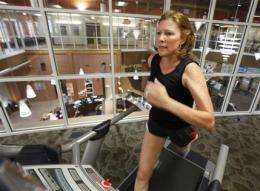
In this Nov. 1, 2011, photo Sandy Morgan, 57, works out in a gym in Midlothian, Va. Most people don’t want to think about death, much less plan for it, especially when they feel healthy and young in their middle-age years. And that, some baby boomers say, is one of the big reasons so few of them have end-of-life legal documents such as a living will. An Associated Press-LifeGoesStrong.com poll found that 64 percent of boomers, those born between 1946 and 1964, said they don't have a health care proxy or living will. "You know when they say, '60 is the new 40,' I really believe that," said Morgan, a retired teacher who is working part-time for an executive search firm. (AP Photo/Steve Helber)
(AP) -- Many baby boomers don't have end-of-life legal documents such as a living will - and some say it's because they feel healthy and young in their middle-age years and don't need to dwell on death.
An Associated Press-LifeGoesStrong.com poll found that 64 percent of boomers - those born between 1946 and 1964 - say they don't have a health care proxy or living will. Those documents would guide medical decisions should a patient be unable to communicate with doctors.
"I'm very healthy for my age," said Mary McGee, 53, of Archbald, Pa. "So, death and dying isn't on my mind a lot."
McGee, a computer programmer, exercises five to seven days a week, everything from aerobics to kickboxing, and her parents are alive and healthy.
The same goes for 57-year-old Sandy Morgan in Richmond, Va., a retired teacher who is working part time for an executive search firm.
"I don't think of myself in terms of my age group," said Morgan, who runs three miles a day twice a week, practices yoga twice a week and takes part in a rigorous fitness boot camp twice a week. Her parents, in their early 80s, are healthy, too - so living wills aren't on her radar.
"I just feel like it's something I'll probably think about in my late 60s or 70s," she said.
A living will spells out a patient's wishes for medical care if he or she is unable to communicate with doctors.
The health care proxy, also known as a health care power of attorney, allows an individual to select a person he or she trusts to make decisions about medical care should the patient become incapacitated.
Kathy Brandt says living wills and health care proxies are a good idea for everyone whether they are healthy and young or older and not so healthy.
Brandt, a senior vice president at the National Hospice and Palliative Care Organization, said the two documents can spare families a painful fight and ensure that patients receive - or don't receive - the medical treatment they wish should they end up in a situation where they can't speak for themselves.
The living will is not "all or nothing," said Brandt. A person could say he or she wants everything, something or nothing. For example, one person may want heroic measures taken to prolong life, while another may want to be resuscitated but decide against being dependent on breathing machines long-term.
Brandt pointed to high-profile cases such as the Florida family fight over Terri Schiavo as a smart reason to draft a living will and health care proxy.
At 26, Schiavo collapsed at her St. Petersburg home in 1990 with no end-of-life care instructions in writing. Her heart stopped and she suffered what doctors said was irreversible brain damage that left her in a permanent vegetative state. Her husband said his wife would not have wanted to live in a vegetative state; her parents wanted her kept alive.
What ensued was a years-long legal battle that involved dozens of judges in numerous jurisdictions, including the U.S. Supreme Court, and Congress. Schiavo's feeding tube was ordered removed in 2005. About two weeks later, she died.
Each state has its own forms for proxies and living wills, said Brandt. And while it's a legal document, she said, you don't need an attorney to draft one. The forms need to be witnessed, but that's it. She advises giving copies to plenty of people - family, friends, colleagues - so a person's wishes are well-known.
For baby boomer William Walsh in Petersburg, Va., drafting a living will hasn't crossed his mind.
"I just haven't really thought about it to tell you the truth," said Walsh, 61. "You always think something is going to happen to the other guy, not you."
Walsh said no one in his family has ever needed one, but also said he might give the idea more thought.
The AP-LifeGoesStrong.com poll was conducted June 3-12 by Knowledge Networks of Palo Alto, Calif., and involved online interviews with 1,416 adults, including 1,078 baby boomers. The margin of sampling error for results from the boomers is plus or minus 3.3 percentage points.
Knowledge Networks used traditional telephone and mail sampling methods to randomly recruit respondents. People selected who had no Internet access were given it for free.
More information:
http://surveys.ap.org
http://family.lifegoesstrong.com/most-midlifers-do-not-have-living-will
©2011 The Associated Press. All rights reserved. This material may not be published, broadcast, rewritten or redistributed.
-
Boomers worry about finances, health costs
Jul 28, 2011 |
not rated yet |
0
-
More than one-quarter of elderly patients lack decision-making capacity at death
Mar 31, 2010 |
not rated yet |
0
-
Poll: Obesity hits more boomers than others in US
Jul 18, 2011 |
not rated yet |
0
-
Poll: Boomers unhappiest over their own sex life
Nov 22, 2010 |
not rated yet |
0
-
Living wills are poor predictors of actual treatment preferences at the end of life
May 19, 2010 |
not rated yet |
0
-
Of mice and mental models: Neuroscientific implications of risk-optimized behavior in the mouse
May 25, 2012 |
not rated yet |
0
-
Limits to growth: Scientists identify key metastasis-enabling enzyme
May 22, 2012 |
5 / 5 (4) |
0
-
Seeing is as seeing does: Spatially-structured retinal input in early development of cortical maps
Apr 26, 2012 |
5 / 5 (4) |
1
-
Dreamless nights: Brain activity during nonrapid eye movement sleep
Apr 09, 2012 |
4.4 / 5 (12) |
0
-
Take your time: Neurobiology sheds light on the superiority of spaced vs. massed learning
Mar 28, 2012 |
4.5 / 5 (21) |
3
-
Classical and Quantum Mechanics via Lie algebras
Apr 15, 2011
- More from Physics Forums - Independent Research
More news stories
Most occupational injury and illness costs are paid by the government and private payers
UC Davis researchers have found that workers' compensation insurance is not used nearly as much as it should be to cover the nation's multi-billion dollar price tag for workplace illnesses and injuries. Instead, almost 80 ...
Health
19 hours ago |
not rated yet |
0
Early physical therapist treatment associated with reduced risk of healthcare utilization and reduced overall healthcare
A new study published in Spine shows that early treatment by a physical therapist for low back pain (LBP), as compared to delayed treatment, was associated with reduced risk of subsequent healthcare utilization and lower ...
Health
22 hours ago |
not rated yet |
0
|
Cancer patients share web info with docs for insight, advice
(HealthDay) -- Cancer patients' primary goal in talking with their doctors about information they've found on the Internet is to get more insight and advice on the online information, new research indicates.
Health
May 25, 2012 |
not rated yet |
0
P&G to add latches to make detergent packs safer
(AP) -- Procter & Gamble says it will change the design of packaging for its miniature laundry detergent product to deter children from eating the brightly colored packets that look like candy.
Health
May 25, 2012 |
not rated yet |
0
In Spain, 70 percent of women use contraceptives during their first sexual encounter
Contraceptive use in Spain during the first sexual encounter is similar to other European countries. However, there are some geographical differences between Spanish regions: women in Murcia use contraceptives ...
Health
May 25, 2012 |
not rated yet |
0
Travel to high altitudes tied to Crohn's, colitis flare-ups
(HealthDay) -- People with inflammatory bowel disease, which includes Crohn's disease and colitis, may be at increased risk for flare-ups when they fly or travel to high altitudes for skiing or mountain climbing, ...
Family history of Alzheimer's affects functional connectivity
(HealthDay) -- Cognitively normal individuals with a family history of late-onset Alzheimer's disease (AD) may display lower resting state functional connectivity in the default mode network (DMN) of the brain, ...
Transvaginal mesh op restores pelvic organ prolapse at price
(HealthDay) -- Transvaginal mesh (TVM) procedures are effective for anatomical restoration of pelvic organ prolapse (POP), but patients report a worsening of sexual function following surgery, according to ...
Tongue analysis software uses ancient Chinese medicine to warn of disease
For 5,000 years, the Chinese have used a system of medicine based on the flow and balance of positive and negative energies in the body. In this system, the appearance of the tongue is one of the measures used to classify ...
Skp2 activates cancer-promoting, glucose-processing Akt
HER2 and its epidermal growth factor receptor cousins mobilize a specialized protein to activate a major player in cancer development and sugar metabolism, scientists report in the May 25 issue of Cell.
Flesh-Eating bacteria no cause for panic, experts say
(HealthDay) -- Despite scary headlines by the score, most people don't have to fear that they'll be the next victim of the so-called flesh-eating bacteria disease, experts say.