The communicative brain
The ability to communicate using language is fundamental to the distinctive and remarkable success of the modern human. It is this capacity that separates us most decisively from our primate cousins, despite all that we have in common across species as intelligent social primates.
A major challenge for the cognitive neurosciences is to understand this relationship: what is the neurobiological context in which human language and communication have emerged, and what are the special human properties that make language itself possible?
For the past 150 years, scientific thinking about this relationship has been dominated by the concept of a single, central language system built around the brain’s left hemisphere. Pioneering 19th-century neurologists Paul Broca and Carl Wernicke noticed that patients with left hemisphere brain damage had difficulties with language comprehension and language production. Two areas of the left frontal and temporal lobes, Broca’s area and Wernicke’s area, and the bundle of nerve fibres connecting them, were identified as critical for speaking and understanding language.
Recent research in our laboratories suggests major limitations to this classic approach to language and the brain. The Broca–Wernicke concept captures one important aspect of the neural language system – the key role of the left hemisphere network – but it obscures another, equally important one. This is the role of bi-hemispheric systems and processes, whereby both left and right hemispheres work together to provide the fundamental underpinnings for human communicative processes.
A more fruitful approach to human language and communication will require a dual neurobiological framework in which these capacities are supported by two intersecting but evolutionarily and functionally distinguishable subsystems. The historical failure to make this separation has, we suggest, severely undermined scientific attempts to understand language, both as a neurocognitive phenomenon in the modern human, and in terms of its evolutionary and neurobiological context.
Dual systems
A strong evolutionary continuity between humans and our primate relatives is provided by a distributed, bi-hemispheric set of capacities that support the dynamic interpretation of visual and auditory signals in the service of social communication. These capacities have been the object of intensive study in monkeys and apes, and there is good evidence that their basic architecture underpins related communicative functions in the human.
In the context of human language comprehension, the bi-hemispheric systems support the ability not only to identify the words a speaker is producing – typically by integrating auditory and visual cues in face-to-face interaction – but also to make sense of these word-meanings in the general context of the listener’s knowledge of the world and of the specific context of speaking.
Where we see divergence between humans and other primates is in the domain of grammatical (or syntactic) function. Primate communication systems are not remotely comparable to human language in their expressive capacities. Human language is much more than a set of signs that stand for things. It constitutes a powerful and flexible set of grammatical devices for organising the flow of linguistic information and its interpretation, allowing us to represent and combine abstract linguistic elements, where these elements convey not only meaning but also the subtle structural cues that indicate how these elements are linked together.
It is the fronto-temporal network of regions in the left hemisphere that mediates these core grammatical functions in humans. This is a network that differs neuroanatomically from those of the brains of other primates, showing substantial increases in size, complexity and connectivity.
Although it’s not yet understood just how these evolutionary changes in the left hemisphere provide the neural substrate on which grammatical functions depend, it is clear that they are essential. When the left hemisphere system is damaged, the parallel right hemisphere regions cannot take over these functions, even when damage is sustained early in childhood.
Critically, however, the left hemisphere system that has emerged in humans neither replaces nor displaces the bi-hemispheric system for social communication and action found in both humans and other primates. It interacts and combines with it to create a co-ordinated process of linguistically guided communication and social interaction.
Functional separability
The most direct evidence for a dual system approach is the ability to separate these systems in the modern human. Using a combination of behavioural and neuroimaging techniques, we have been able to demonstrate this both in patients with left hemisphere brain damage and in unimpaired young adults.
In the research with patients (conducted with Dr Paul Wright in the Department of Experimental Psychology and Dr. Emmanuel Stamatakis in the Division of Anaesthesia) we focus on the comprehension of spoken words and spoken sentences. In initial testing, patients perform classic measures of syntactic function, where they match different spoken sentences to sets of pictures. Shown three pictures – a woman pushing a girl, a girl pushing a woman and a woman teaching a girl – patients will correctly match the sentence ‘The woman pushed the girl’ to the first picture but will incorrectly match the passive sentence ‘The woman is being pushed by the girl’ to the same picture. The second sentence requires the use of syntactic cues to extract the right meaning – just using the order of words is not sufficient.
These behavioural tests of syntactic impairment are linked, in the same patients, to their performance in the neuroimaging laboratory, where they hear sentences that vary in their syntactic demands, and where the precise extent of the injury to their brains can be mapped out. When we put these different sources of information together, we see that damage to the left hemisphere system progressively impairs the syntactic aspects of language processing – the more damage, the worse the performance.
Critically, however, the amount of left hemisphere damage, and the extent to which it involves the key fronto-temporal circuit, does not affect the patients’ ability to identify the words being spoken or to understand the messages being communicated – so long as syntactic cues are not required to do so. These capacities are supported bi-hemispherically, and can remain relatively intact even in the face of massive left hemisphere damage.
In work carried out with Dr. Mirjana Bozic, then based at the Medical Research Council (MRC) Cognition and Brain Sciences Unit in Cambridge, we have been able to delineate these systems in the undamaged brain, using functional neuroimaging to tease out the different processing regions that are engaged by speech inputs with different properties.
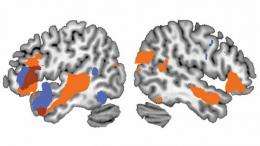
Listeners hear either words that are specifically linguistically complex (words like played, which have the grammatical inflection ‘ed’), or words that make more general demands on the language processing system (words like ramp, which have another word, ram, embedded in them). Using an analysis technique that identifies the separate dimensions of the brain’s response to these sets of words, we see that the linguistically complex words activate a response component that is restricted to the left fronto-temporal region. By contrast, words that are perceptually complex, due to increased competition between the whole word and the embedded word, activate a strongly bi-hemispheric set of regions, partially overlapping with the linguistic component. Even in the intact brain, therefore, we can see the dynamic allocation of processing resources across the two systems, as a function of their joint roles in the communicative process.
Implications
A dual systems account of the ‘communicative brain’ is likely to have important and illuminating consequences for the sciences of language and its disorders.
In the context of left hemisphere brain damage we can better appreciate – and build upon for rehabilitation – the substantial bi-hemispheric communicative capacities the patient may still possess. In first- and second-language acquisition, we can better understand the learning trajectories that lead to language proficiency in terms of the relative contributions of these two aspects of communicative function.
The approach also provides a new perspective on the variation between languages, where different languages may load more or less heavily on the different computational resources made available by the two systems. Most importantly, it enables us to clarify and focus the core issues for a neurobiological account of language and communication, a scientific domain clouded by ideology and inconsistency.


