Predicting cellular response to paclitaxel in epithelial ovarian cancer
November 16, 2011 in Cancer
Predicting cellular response to paclitaxel in epithelial ovarian cancer

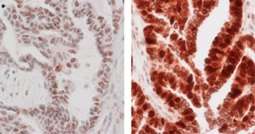
Low (left) and high (right) MAD2 in formalin fixed paraffin embedded epithelial ovarian cancer samples

(Medical Xpress) -- New research findings by UCD scientists published online in the Journal of Pathology may help clinicians predict how patients with high grade, serous, epithelial ovarian cancer will respond to paclitaxel chemotherapy (Taxol).

In collaboration with their colleagues in Trinity College Dublin and the Royal College of Surgeons, the UCD team highlight the central role played by a protein called mitotic arrest deficiency 2 (MAD2) in the cellular response to paclitaxel. For the first time, they have shown that low levels of this protein in epithelial cells are associated with reduced progression free survival or time before relapse.

Epithelial ovarian cancer (EOC) is the leading cause of death from a gynaecological cancer in women. Each year, 334 women in Ireland are diagnosed with ovarian cancer and there are 226 deaths from the disease. With no sensitive screening test available, patients usually present with advanced stage disease. Typically, the treatment regimen consists of surgery followed by chemotherapy (paclitaxel and carboplatin) but, while 70% of patients will respond initially, many will relapse over time.

“We set about building a molecular picture of how paclitaxel interacts with epithelial ovarian in an effort to understand why these cells become resistant over time to the chemotherapeutic drug, paclitaxel”, said Dr Fiona Furlong, Cancer Research Ireland Fellow and first author on the publication.

Paclitaxel is a microtubule stabilising agent that destroys cancer cells by interfering with the cell cycle leading to apoptosis or cell death. Specifically, it interferes with the spindle microtubule dynamics within the cell that ensures the correct alignment of chromosome pairs before they pull apart and become segregated into two daughter cells. Similar to the strings on a puppet, microtubules need to be held at the correct tension for the chromosomes to align. Anything interfering with this process will ultimately cause cell death.

“MAD2 is a key regulator of the spindle assembly checkpoint pathway and in this research we have shown that MAD2 protein expression is necessary for paclitaxel to work in ovarian cancer cells”

The team demonstrated that ovarian cancer cell lines expressing low levels of MAD2 protein are less sensitive to paclitaxel. They looked at the intensity of MAD2 immunohistochemical nuclear staining in 82 patient samples and found that low staining intensity levels associated with patients who relapsed soon after finishing chemotherapy.

They were also able to pinpoint for the first time that a member of a large family of gene regulators, pre-miR-433, is responsible for the down-regulation of MAD2 protein expression and consequently lessens cellular responses to paclitaxel in ovarian cancer cells. 

Commenting on the significance of the findings, Dr Amanda McCann, Conway Fellow and last author on the publication said, “There are few published studies on the role of aberrant MAD2 expression and cellular drug resistance to chemotherapy in human cancer tissue samples. This work used clinical samples to identify a novel association between low MAD2 expression and reduced progression free survival in patients with high grade serous EOC. We believe that measuring MAD2 nuclear staining intensity in the clinical setting may allow clinicians to predict paclitaxel responses in women presenting with this disease.” 

More information: Low MAD2 expression levels associate with reduced progression free survival in patients with high-grade serous epithelial ovarian cancer, Fiona Furlong, Patricia Fitzpatrick, Sharon O'Toole, Sine Phelan, Barbara McGrogan, Aoife Maguire, Anthony O'Grady, Michael Gallagher, Maria Prencipe, Aloysius McGoldrick, Paul McGettigan, Donal Brennan, Orla Sheils, Elaine W. Kay, John O'Leary and Amanda McCann, DOI: 10.1002/path.3035

Journal reference: Journal of Pathology search and more info website

Provided by University College Dublin

not rated yet  

Rank not rated yet
Relevant PhysicsForums posts
  • Potential Breakthrough in Seizure Control
    created9 hours ago
  • Popping/Cracked sternum.
    created13 hours ago
  • Which Mental Illness Encompasses This Problem?
    created14 hours ago
  • A question about drug tolerance
    createdMay 23, 2012
  • Poor nutrition leading to overeating?
    createdMay 23, 2012
  • Math and dyslexia?
    createdMay 21, 2012
  • More from Physics Forums - Medical Sciences

More news stories

Skp2 activates cancer-promoting, glucose-processing Akt

HER2 and its epidermal growth factor receptor cousins mobilize a specialized protein to activate a major player in cancer development and sugar metabolism, scientists report in the May 25 issue of Cell.

Cancer created 22 hours ago | popularity not rated yet | comments 0 | with audio podcast

Pancreatectomy OK without downstaging from therapy

(HealthDay) -- Pancreatectomy improves median survival in pancreatic cancer patients even when presurgical neoadjuvant therapy does not lead to radiographic downstaging of tumors, according to a study published ...

Cancer created 23 hours ago | popularity not rated yet | comments 0

Common therapies for basal cell carcinoma offer similar survival

(HealthDay) -- For patients with superficial basal cell carcinoma (sBCC), treatment with imiquimod or photodynamic therapy (PDT) results in similar long-term tumor-free survival, according to a review published ...

Cancer created May 25, 2012 | popularity not rated yet | comments 0

Cancer may require simpler genetic mutations than previously thought

Chromosomal deletions in DNA often involve just one of two gene copies inherited from either parent. But scientists haven't known how a deletion in one gene from one parent, called a "hemizygous" deletion, can contribute ...

Cancer created May 25, 2012 | popularity not rated yet | comments 0 | with audio podcast

New prostate cancer screening guidelines face a tough sell, study suggests

(Medical Xpress) -- Recent recommendations from the U.S. Preventive Services Task Force (USPSTF) advising elimination of routine prostate-specific antigen (PSA) screening for prostate cancer in healthy men are likely to encounter ...

Cancer created May 25, 2012 | popularity not rated yet | comments 1


Travel to high altitudes tied to Crohn's, colitis flare-ups

(HealthDay) -- People with inflammatory bowel disease, which includes Crohn's disease and colitis, may be at increased risk for flare-ups when they fly or travel to high altitudes for skiing or mountain climbing, ...

Family history of Alzheimer's affects functional connectivity

(HealthDay) -- Cognitively normal individuals with a family history of late-onset Alzheimer's disease (AD) may display lower resting state functional connectivity in the default mode network (DMN) of the brain, ...

Transvaginal mesh op restores pelvic organ prolapse at price

(HealthDay) -- Transvaginal mesh (TVM) procedures are effective for anatomical restoration of pelvic organ prolapse (POP), but patients report a worsening of sexual function following surgery, according to ...

Tongue analysis software uses ancient Chinese medicine to warn of disease

For 5,000 years, the Chinese have used a system of medicine based on the flow and balance of positive and negative energies in the body. In this system, the appearance of the tongue is one of the measures used to classify ...

Early physical therapist treatment associated with reduced risk of healthcare utilization and reduced overall healthcare

A new study published in Spine shows that early treatment by a physical therapist for low back pain (LBP), as compared to delayed treatment, was associated with reduced risk of subsequent healthcare utilization and lower ...

Flesh-Eating bacteria no cause for panic, experts say

(HealthDay) -- Despite scary headlines by the score, most people don't have to fear that they'll be the next victim of the so-called flesh-eating bacteria disease, experts say.