Old drugs find new target for treating brain tumor
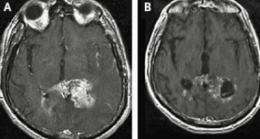
An MRI depicts a glioblastoma (center white mass) before treatment with the drug erlotinib (A) and after (B). Credit: UC San Diego School of Medicine
Scientists at the University of California, San Diego School of Medicine and UC San Diego Moores Cancer Center, in collaboration with colleagues in Boston and South Korea, say they have identified a novel gene mutation that causes at least one form of glioblastoma (GBM), the most common type of malignant brain tumor.
The findings are reported in the online edition of the journal Cancer Research.
Perhaps more importantly, the researchers found that two drugs already being used to treat other forms of cancer effectively prolonged the survival of mice modeling this particular form of GBM. That could be good news for at least some GBM patients. More than 9,000 new cases of the disease are diagnosed each year in the United States and effective treatments are limited. The tumors are aggressive and resistant to current therapies, such as surgery, radiation and chemotherapy. The median survival rate for newly diagnosed GBM patients is just 14 months.
Past studies have identified epidermal growth factor receptor (EGFR) as a common genetically altered gene in GBM, though the cause or causes of the alteration is not known. The research team, led by scientists at the Dana-Farber Cancer Institute in Boston, analyzed the GBM genomic database, ultimately identifying and characterizing an exon 27 deletion mutation within the EGFR carboxyl-terminus domain (CTD). An exon is a segment of a DNA or RNA molecule containing information coding for a protein or peptide sequence.
"The deletion mutant seems to possess a novel mechanism for inducing cellular transformation," said Frank Furnari, PhD, associate professor of medicine at the UC San Diego School of Medicine and an associate investigator at the San Diego branch of the Ludwig Institute for Cancer Research.
The study researchers determined that cellular transformation was induced by the previously unknown EGFR CTD deletion mutant, both in vitro and in vivo, and resulted in GBM in the animals. The researchers then turned to testing a pair of approved drugs that target EGFR: a monoclonal antibody called cetuximab and a small molecule inhibitor called erlotinib.
Cetuximab, marketed under the name Erbitux, is currently approved for use in treating metastatic colorectal cancer and squamous cell carcinoma of the head and neck. Erlotinib, marketed under the name Tarceva, is used to treat lung and pancreatic cancers.
Both drugs were found to effectively impair the tumor-forming abilities of oncogenic EGFR CTD deletion mutants. Cetuximab, in particular, prolonged survival of mice with the deletion mutants when compared to untreated control mice.
However, neither cetuximab nor erlotinib is an unabashed success story. The drugs work by binding to sites on the EGFR protein and inhibiting activation, but they are not effective in all cancer patients and produce some adverse side effects, such as rashes and diarrhea.
But Santosh Kesari, MD, PhD, Director of Neuro-Oncology at UC San Diego Moores Cancer Center and the UCSD Department of Neurosciences, and co-corresponding author of the study, said the new study points to a more selective, effective use of the drugs for some patients with GBM.
"In the past when we treated brain cancer patients with these drugs, the response rate was very small," Kesari said. "What we now show is that the tumors with CTD mutations respond best to these EGFR targeted agents. If we knew this beforehand, we might have been able to select patients most likely to respond to these agents. We are now trying to put together a prospective clinical trial to prove this. We would select only patients with these tumor mutations and treat them. This kind of research gets us closer to identifying genetic subtypes, to doing better biomarker-based clinical trials, and to personalizing treatments in brain cancers."
"This is a great example of personalized medicine in action," said Webster Cavenee, PhD, director of the Ludwig Institute at UC San Diego. "UCSD has made a concerted effort in the past few years to develop a first-class brain tumor research and therapy group that includes adult neuro-oncology, neurosurgery, neuropathology and their pediatric equivalents to join with internationally-renowned brain tumor research. This is making UCSD a destination for the very best in brain tumor management."
Provided by
University of California - San Diego
-
A lethal brain tumor's strength may be a weakness as well
Aug 14, 2010 |
not rated yet |
0
-
Scientists show how brain tumors outsmart drugs
Jan 19, 2010 |
not rated yet |
0
-
High EGFR expression a predictor for improved survival with cetuximab plus chemotherapy
Jul 05, 2011 |
not rated yet |
0
-
Study finds that lung cancer patients respond to erlotinib following cetuximab therapy
Aug 02, 2009 |
not rated yet |
0
-
Biomarker treatment for brain tumors studied
Jun 15, 2010 |
not rated yet |
0
-
Motion perception revisited: High Phi effect challenges established motion perception assumptions
Apr 23, 2013 |
3 / 5 (2) |
2
-
Anything you can do I can do better: Neuromolecular foundations of the superiority illusion (Update)
Apr 02, 2013 |
4.5 / 5 (11) |
5
-
The visual system as economist: Neural resource allocation in visual adaptation
Mar 30, 2013 |
5 / 5 (2) |
9
-
Separate lives: Neuronal and organismal lifespans decoupled
Mar 27, 2013 |
4.9 / 5 (8) |
0
-
Sizing things up: The evolutionary neurobiology of scale invariance
Feb 28, 2013 |
4.8 / 5 (10) |
14
-
Why is zone 1 in liver more prone to ischemic injury?
11 hours ago
-
How can there be villous adenoma in colon, if there are no villi there
May 22, 2013
-
How can there be a term called "intestinal metaplasia" of stomach
May 21, 2013
-
Pressure-volume curve: Elastic Recoil Pressure don't make sense
May 18, 2013
-
If you became brain-dead, would you want them to pull the plug?
May 17, 2013
-
MRI bill question
May 15, 2013
- More from Physics Forums - Medical Sciences
More news stories
Improved chemo regimen for childhood leukemia may offer high survival, no added heart toxicity
Treating pediatric leukemia patients with a liposomal formulation of anthracycline-based chemotherapy at a more intense-than-standard dose during initial treatment may result in high survival rates without causing any added ...
Cancer
3 hours ago |
not rated yet |
0
Protein preps cells to survive stress of cancer growth and chemotherapy
Scientists have uncovered a survival mechanism that occurs in breast cells that have just turned premalignant-cells on the cusp between normalcy and cancers-which may lead to new methods of stopping tumors.
Cancer
3 hours ago |
not rated yet |
0
|
Frequent heartburn may predict cancers of the throat and vocal cord
Frequent heartburn was positively associated with cancers of the throat and vocal cord among nonsmokers and nondrinkers, and the use of antacids, but not prescription medications, had a protective effect, according to data ...
Cancer
3 hours ago |
not rated yet |
0
Key find for early bladder cancer treatment
Aggressive forms of bladder cancer involve the protein PODXL – a discovery that could hold the key to improved treatment, according to researchers at Lund University, Uppsala University and KTH in Sweden.
Cancer
6 hours ago |
5 / 5 (1) |
0
Cold plasma successful against brain cancer cells
For the first time, physicists from the Max Planck Institute for Extraterrestrial Physics (MPE), biologists and physicians demonstrated the synergistic effect of cold atmospheric plasma - a partly ionized ...
Cancer
6 hours ago |
5 / 5 (2) |
0
|
Ferrets, pigs susceptible to H7N9 avian influenza virus
Chinese and U.S. scientists have used virus isolated from a person who died from H7N9 avian influenza infection to determine whether the virus could infect and be transmitted between ferrets. Ferrets are often used as a mammalian ...
Scientists discover molecule triggers sensation of itch
Scientists at the National Institutes of Health report they have discovered in mouse studies that a small molecule released in the spinal cord triggers a process that is later experienced in the brain as the sensation of ...
Multiple research teams unable to confirm high-profile Alzheimer's study
Teams of highly respected Alzheimer's researchers failed to replicate what appeared to be breakthrough results for the treatment of this brain disease when they were published last year in the journal Science.
Motion quotient: IQ predicted by ability to filter motion (w/ video)
A brief visual task can predict IQ, according to a new study. This surprisingly simple exercise measures the brain's unconscious ability to filter out visual movement. The study shows that individuals whose ...
Researchers find common childhood asthma unconnected to allergens or inflammation
Little is known about why asthma develops, how it constricts the airway or why response to treatments varies between patients. Now, a team of researchers at Weill Cornell Medical College, Columbia University Medical Center ...
Drug reverses Alzheimer's disease deficits in mice, research confirms
An anti-cancer drug reverses memory deficits in an Alzheimer's disease mouse model, University of Pittsburgh Graduate School of Public Health researchers confirm in the journal Science.