Research duo uncovers clues about why 'fingernails across a chalkboard' is so horrible
November 3, 2011 by Bob Yirka in Medical research report
Research duo uncovers clues about why 'fingernails across a chalkboard' is so horrible

Enlarge

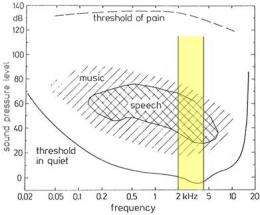
Hearing area between threshold in quiet an threshold of pain. Also indicated are the areas encompassed by music and speech and the area between 2000 Hz and 4000 Hz, where the human ear is most sensitive. The parts of the sounds in this frequency range were particularly important for the perceived unpleasantness (after Fastl & Zwicker, 2006, p. 17).

(Medical Xpress) -- Proving that science isn’t always just fun and games, two researchers with music backgrounds have conducted experiments to get to the bottom of why people are so adversely effected by certain noises such as a fork dragged across a plate, Styrofoam squeaking or most famously, fingernails dragged across a chalk board. Christoph Reuter from the University of Vienna’s Musicological Institute and Michael Oehler of Macromedia University for Media and Communication in Germany, have managed to enlist volunteers to listen to such sounds while having their biological signs measured for reactions. They will be giving a presentation on their findings to the Acoustical Society of America today.

The two had 104 volunteers listen to recordings of various unpleasant sounds, 24 of them hooked up to devices that recorded their heart rate, blood pressure and galvanic skin response (a measure of skin conductance - not exactly a measure of the degree of skin crawling but perhaps close). The volunteers were all asked to rate their level of discomfort as each was played. The sounds played represented a wide frequency of sounds, some going as high as 12,000 hertz.

After analyzing the results the two found that the sounds that caused the most stress in the volunteers came from the 2,000 to 4,000 hertz range, which coincidence or not, is the same range as that produced by the human voice. This was somewhat expected as prior research by others had shown that people reacted more to the medium tones in chalkboard scraping than the high tones; that prior research had not narrowed the frequency range so clearly however.

As part of the experiment, the volunteers were given different explanations regarding the source of the sounds. Some were told a noise played was part of a musical composition, while others were told the truth, i.e. that it was in fact a recording of fingernails being dragged across a chalkboard, etc. Those that believed it was part of a musical composition rated the sounds as less unpleasant, though their bodies disagreed, showing just as much reaction as those that were told what the sounds really were.

In some instances, the researchers removed some parts of the recordings, such as the noisy scraping parts, before playing them for the volunteers, but that appeared to have no discernible reduction in distress, which showed that it was the middle frequencies that caused the problem, not the rough scratchy parts.

Because the noise turned out to be most offensive when in the same range as the human voice, the authors speculate that because previous studies have shown that the human ear canal is shaped in such a way as to amplify frequencies in the human voice range, other noises that appear in that range that are amplified as well, come across as harsh and offensive.

The two conclude that the reason people react so badly to fingernails scraping a chalkboard is because of the frequency range of the sounds that are produced combined with the structure of the ear canal, and that the effect is worsened when the person hearing it knows its source.

More information: Psychoacoustics of chalkboard squeaking, ASA Lay Language Papers, 162nd Acoustical Society of America Meeting, http://www.acousti … r_4pPP6.html

© 2011 PhysOrg.com

3.8 /5 (6 votes)  

Filter


Move the slider to adjust rank threshold, so that you can hide some of the comments.


Display comments: newest first

PJS
Nov 03, 2011

Rank: not rated yet
Uh, how does this explain WHY it's unpleasant? "How" and "why" are two completely different things...
Star_Gazer
Nov 03, 2011

Rank: 1 / 5 (1)
Uh, how does this explain WHY it's unpleasant? "How" and "why" are two completely different things...


This paragraph did not provide enough explanation..?

Because the noise turned out to be most offensive when in the same range as the human voice, the authors speculate that because previous studies have shown that the human ear canal is shaped in such a way as to amplify frequencies in the human voice range, other noises that appear in that range that are amplified as well, come across as harsh and offensive.
Eric_B
Nov 03, 2011

Rank: 5 / 5 (1)
I don't think the ear canal amplification hypothesis will pan out as a significant answer.

The chalkboard gets people all the way across the room.

The tactile sensation of scratching the board with fingernails seems the have an effect on a person.

Funny thing, after I read this article a couple days ago I went right to bed and had a dream that I was joking around and perfectly imitating the crying of a really pissed-off baby (and garnering much attention in the room)--you know, the sound when mom goes to get something in the basement, doesn't hear the kid, spends too much time and the kid is really screaming mad... I think this may be a route to explore; the nervous system responds to the sound profile of babies in distress.
gwrede
Nov 03, 2011

Rank: not rated yet
This paragraph did not provide enough explanation..?
That doesn't even pretend to be an explanation. The authors admit it is speculation. In other words they still are clueless.

And they should. Playing a flute in that range of frequencies will hardly send shivers down anybody's spine. But then, I haven't seen an explanation why the flute is perceived as pleasant, either.
Isaacsname
Nov 03, 2011

Rank: not rated yet
I wonder what would be the respones from people watching fingernails scratching a chalkboard but hearing something different through headphones ?

I could scratch the hell out of a chalkboard if I had other noise to drown it out, the tactile sensation doesn't bother me at all.
EdMoore
Nov 03, 2011

Rank: not rated yet
Here's the explanation: Ernest P. Worrell uses fingernails on a chalkboard.

http://www.youtub...qHjMFYS0
hush1
Nov 05, 2011

Rank: not rated yet
There must have been an original sound. A sound capable of invoking a visceral response. What was this sound before the era of chalkboards?
I lack all the responses to nails on chalk. I do have, however, a similar response to people rubbing balloons. Which indicates my experiences (with sound) established associations of and in the mind that 'missed the boat' to establish a typical sound bias response that many others experience.
Is this visceral response to this sound present at birth?

knikiy
Nov 05, 2011

Rank: not rated yet
this is one of my least favorite intensely grating recordings and somewhat appropriate to this discussion:

http://www.freeso...s/39115/

Rank 3.8 /5 (6 votes)
Tags

Related Stories
Relevant PhysicsForums posts
  • Potential Breakthrough in Seizure Control
    created10 hours ago
  • Popping/Cracked sternum.
    created15 hours ago
  • Which Mental Illness Encompasses This Problem?
    created15 hours ago
  • A question about drug tolerance
    createdMay 23, 2012
  • Poor nutrition leading to overeating?
    createdMay 23, 2012
  • Math and dyslexia?
    createdMay 21, 2012
  • More from Physics Forums - Medical Sciences

More news stories

Implantable pain disk may help those with cancer

An estimated 3.5 million cancer patients around the globe are in severe pain from their disease, but many get no relief.

Medical research created May 25, 2012 | popularity not rated yet | comments 0 | with audio podcast

Energy levels link sleep control mechanisms

Sleep, or lack of it, can determine level of cognitive performance which is linked with accidents as well as increased risk of serious health problems. Links between cell energy levels, gene transcription ...

Medical research created May 25, 2012 | popularity not rated yet | comments 0

Researchers identify key brain cell in antidepressant action

(Medical Xpress) -- Antidepressant medications such as Prozac have helped improve mood and lessen anxiety in millions of people with major depression. But scientists know surprisingly little about how these drugs work.

Medical research created May 25, 2012 | popularity 4.7 / 5 (3) | comments 0 | with audio podcast

Rockefeller scientists pioneer new method to determine mechanisms of drug action

(Medical Xpress) -- Knowing that a drug works is great. Knowing how it works is a luxury. And until now, determining a drug’s mechanism of action has been a tedious and difficult process for scientists.

Medical research created May 25, 2012 | popularity not rated yet | comments 0 | with audio podcast

Like curry? New biological role identified for compound used in ancient medicine

Scientists have just identified a new reason why some curry dishes, made with spices humans have used for thousands of years, might be good for you.

Medical research created May 25, 2012 | popularity 4.5 / 5 (12) | comments 2 | with audio podcast


Travel to high altitudes tied to Crohn's, colitis flare-ups

(HealthDay) -- People with inflammatory bowel disease, which includes Crohn's disease and colitis, may be at increased risk for flare-ups when they fly or travel to high altitudes for skiing or mountain climbing, ...

Family history of Alzheimer's affects functional connectivity

(HealthDay) -- Cognitively normal individuals with a family history of late-onset Alzheimer's disease (AD) may display lower resting state functional connectivity in the default mode network (DMN) of the brain, ...

Transvaginal mesh op restores pelvic organ prolapse at price

(HealthDay) -- Transvaginal mesh (TVM) procedures are effective for anatomical restoration of pelvic organ prolapse (POP), but patients report a worsening of sexual function following surgery, according to ...

Tongue analysis software uses ancient Chinese medicine to warn of disease

For 5,000 years, the Chinese have used a system of medicine based on the flow and balance of positive and negative energies in the body. In this system, the appearance of the tongue is one of the measures used to classify ...

Skp2 activates cancer-promoting, glucose-processing Akt

HER2 and its epidermal growth factor receptor cousins mobilize a specialized protein to activate a major player in cancer development and sugar metabolism, scientists report in the May 25 issue of Cell.

Early physical therapist treatment associated with reduced risk of healthcare utilization and reduced overall healthcare

A new study published in Spine shows that early treatment by a physical therapist for low back pain (LBP), as compared to delayed treatment, was associated with reduced risk of subsequent healthcare utilization and lower ...